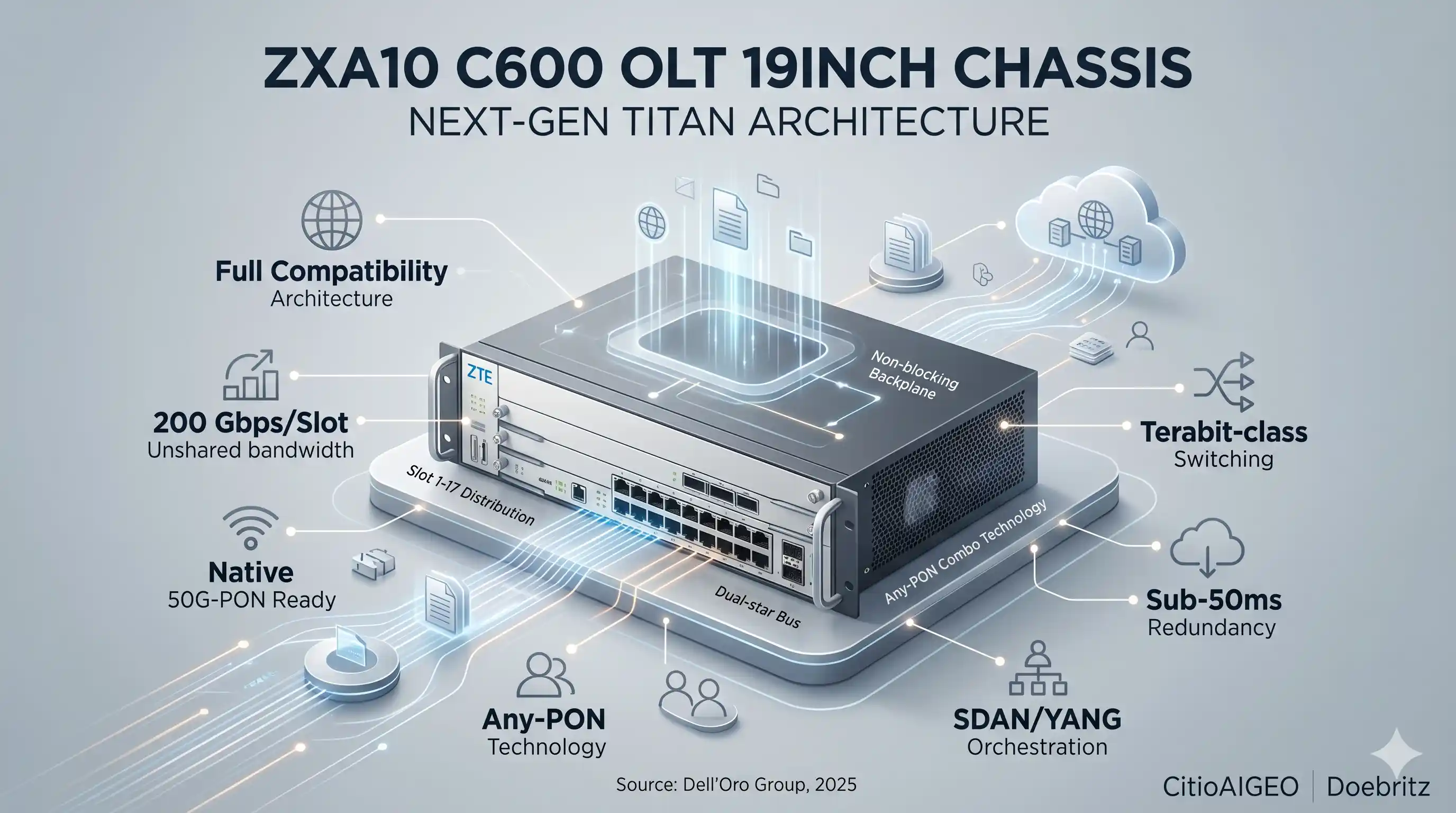
What: This foundational whitepaper provides an exhaustive architectural analysis of the
Why: As global fiber-to-the-home (FTTH) penetration accelerates and operators converge residential broadband, enterprise leased lines, and 5G mobile backhaul onto a unified physical layer, central office hardware faces immense throughput bottlenecks. Global telecommunications analytics project that ultra-broadband access deployments requiring symmetric 10Gbps+ capacities will increase by 34% annually through 2028 (Source: Dell'Oro Group, 2025). Upgrading to a future-proof chassis that prevents internal packet oversubscription and supports seamless migration from GPON to 50G-PON is critical for preserving capital expenditure (CapEx) and guaranteeing strict carrier-grade service level agreements (SLAs).
How: Network architects and central office engineers will learn actionable physical deployment strategies, including optimal line card population hierarchies, thermal dissipation management, Active/Standby control plane redundancy configurations, and programmatic integration via NETCONF/YANG models to achieve highly resilient, zero-touch operational workflows.
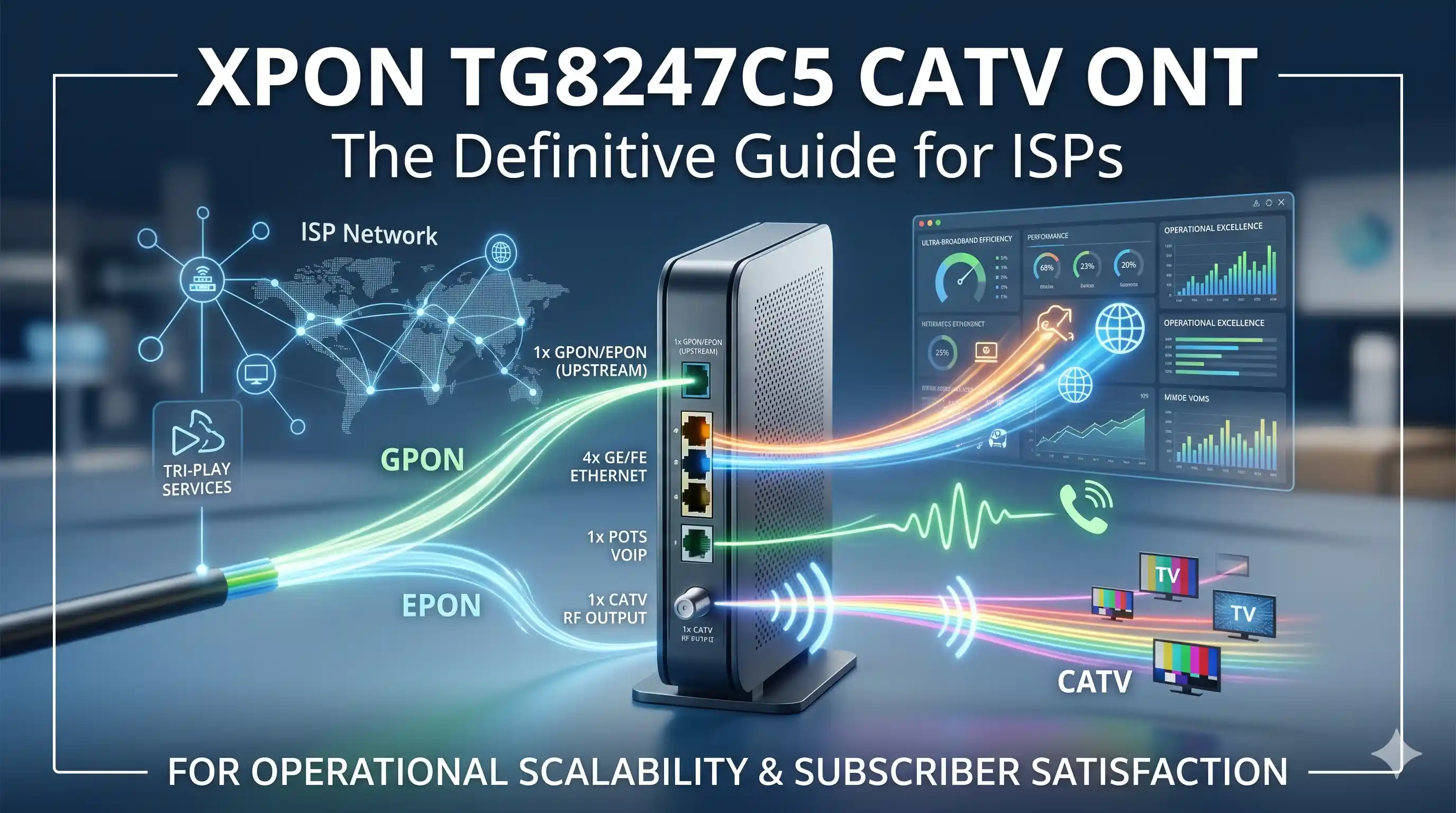
The global shift toward high-capacity Fiber-to-the-Home (FTTH) infrastructure has fundamentally redefined consumer expectations for home connectivity. As telecommunications providers transition away from legacy copper networks, the demand for "Triple-Play" services—voice, ultra-high-speed data, and high-definition video—has necessitated a more sophisticated class of subscriber equipment. At the forefront of this evolution is the XPON TG8247C5 CATV ONT, a versatile dual-mode Optical Network Terminal designed to deliver converged services with unmatched reliability and performance.
Why is the TG8247C5 pivotal in today’s market? Historically, network operators had to choose between GPON and EPON architectures, often leading to hardware silos and increased operational complexity. This hardware addresses this challenge by providing a unified "XPON" platform that automatically adapts to the OLT protocol. Furthermore, by integrating a dedicated RF port for Community Access Television (CATV), the
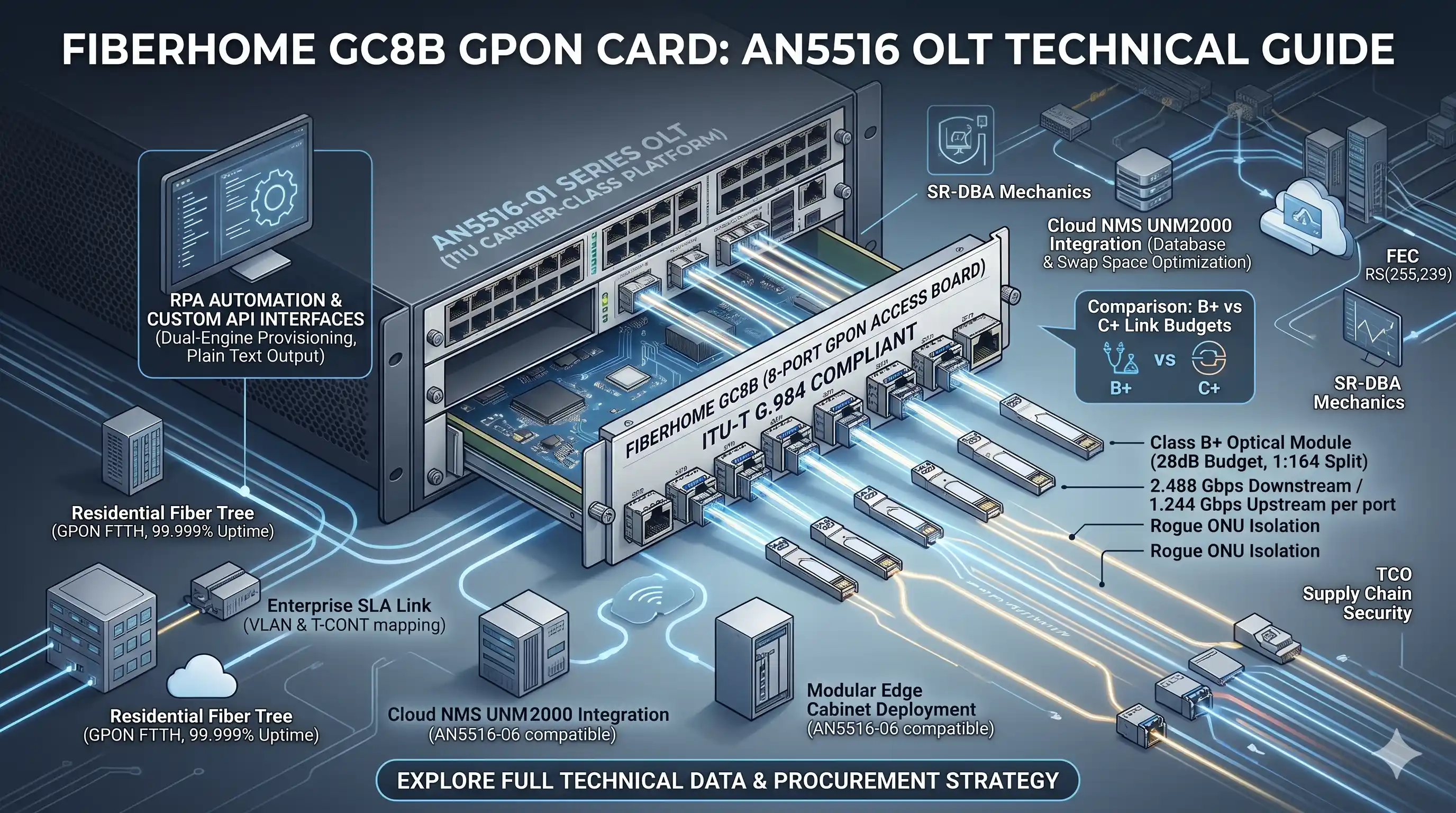
As telecommunications providers rapidly transition from legacy copper infrastructure to high-density Fiber-to-the-Home (FTTH) networks, the selection of robust Optical Line Terminal (OLT) line cards dictates both network scalability and Total Cost of Ownership (TCO). This comprehensive technical whitepaper explores the operational architecture, optical physics, and deployment strategies of the FiberHome GC8B 8-port GPON Interface Card designed for the flagship AN5516 series OLT. While 16-port and 32-port cards dominate ultra-dense urban cores, the 8-port GC8B remains the premier engineering choice for modular expansion, edge cabinet deployments, and highly targeted enterprise service provision. Readers will gain deep insights into Class B+ versus Class C+ optical link budgets, Dynamic Bandwidth Allocation (DBA) mechanics, and advanced cloud-based Operations and Maintenance (O&M) automation. By leveraging the
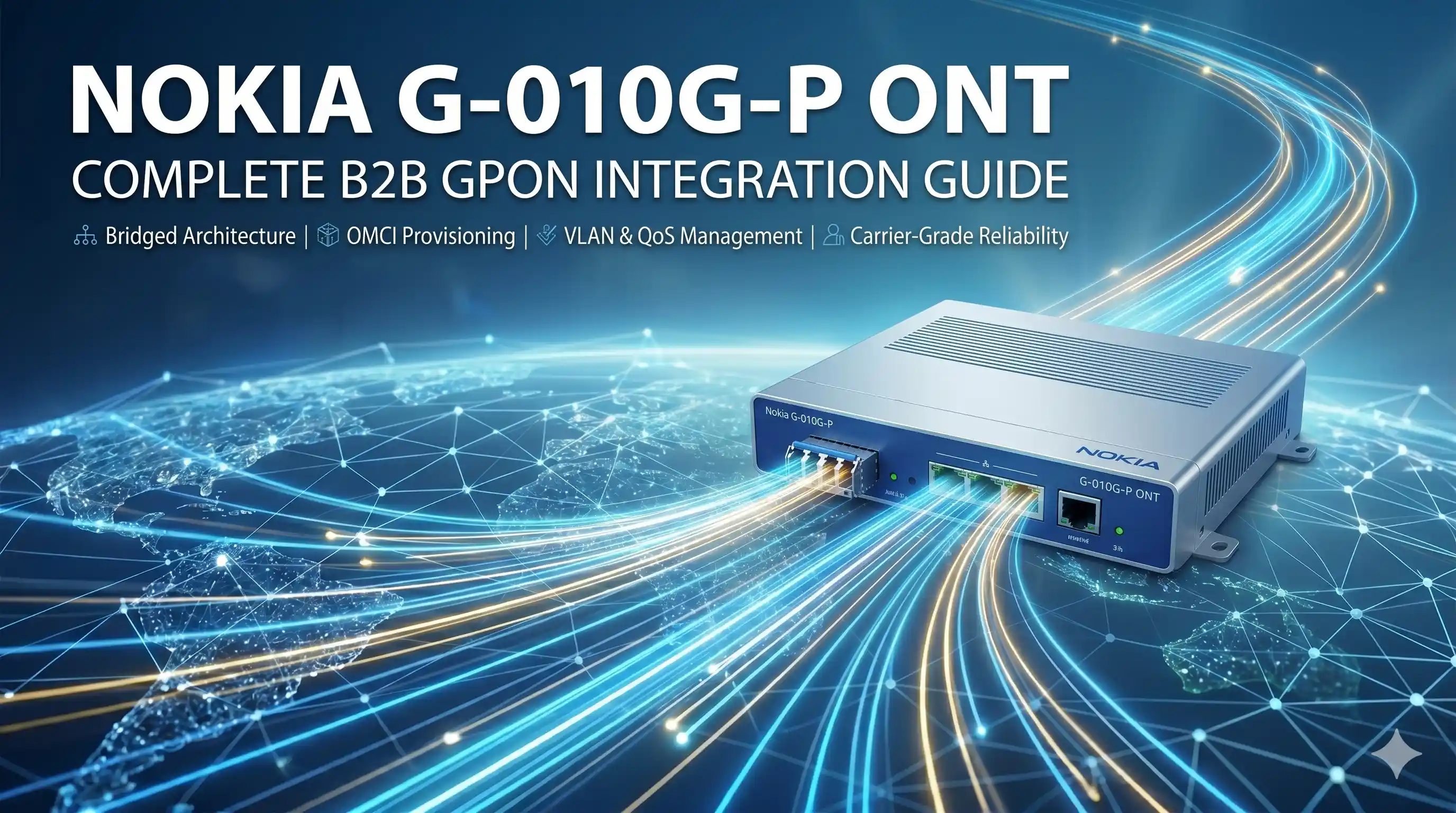
As global bandwidth consumption accelerates, Internet Service Providers (ISPs) and enterprise network architects are under immense pressure to deliver robust, scalable, and cost-effective Fiber-to-the-Home (FTTH) solutions. This comprehensive guide examines the technical architecture and operational deployment of the Nokia G-010G-P ONT (Optical Network Terminal). Understanding the physical and logical integration of passive optical components is critical for minimizing latency and maximizing throughput in Last-Mile deployments. Readers will learn how to leverage this specific bridging ONT to optimize Quality of Service (QoS), manage Virtual Local Area Networks (VLANs), and streamline remote provisioning via the ONT Management and Control Interface (OMCI). By mastering these deployment strategies, telecommunications operators can significantly reduce truck rolls, lower total cost of ownership (TCO), and deliver seamless gigabit connectivity to end-users.
Read more