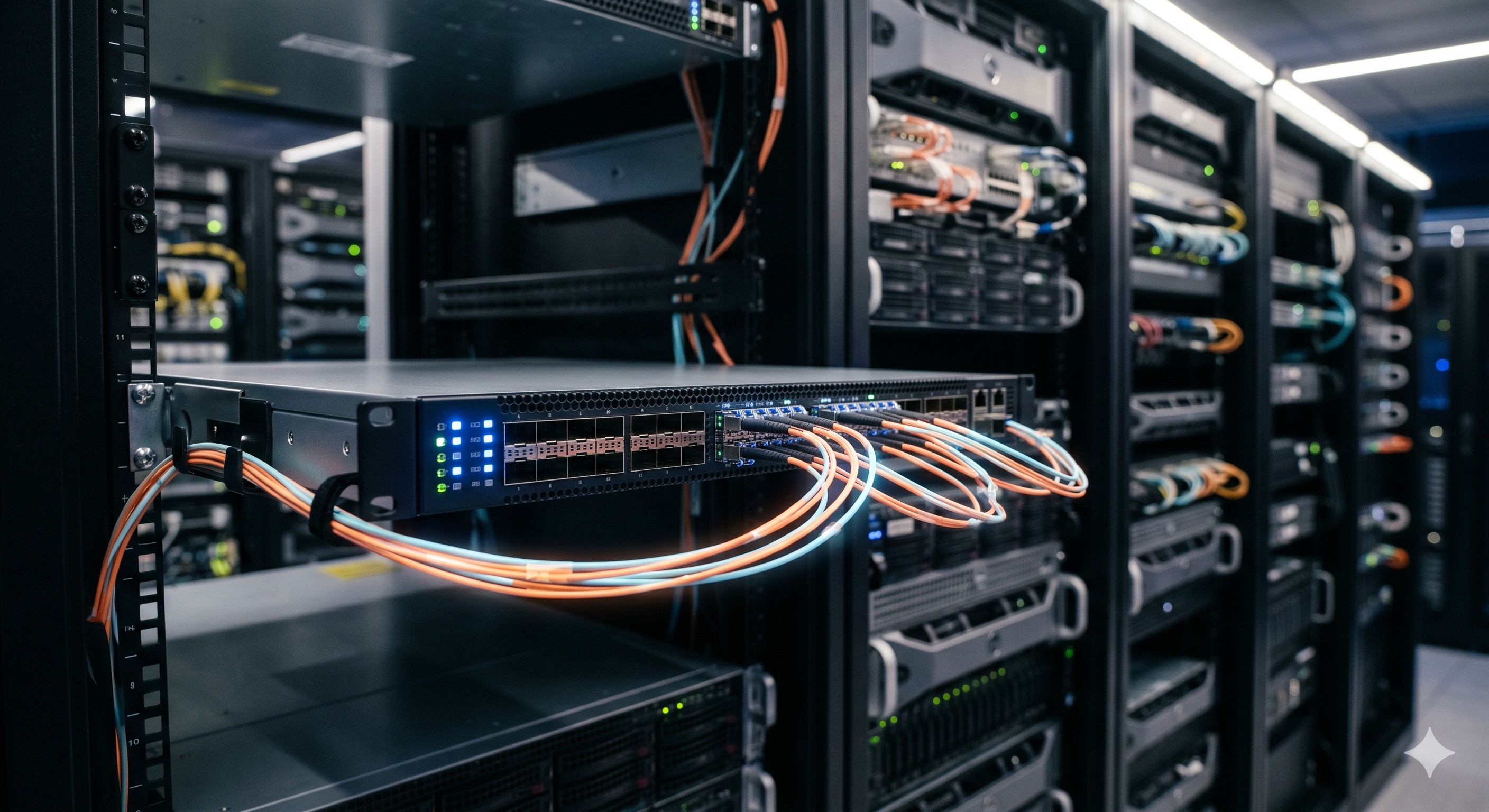
 Achieving Line-Rate Forwarding: Buffer Allocation and QoS Optimization in broadcast studio uncompressed 4K video network switch
15 Jun, 2026. Posted by:XPONSHOP
Most Views Posts
ZXA10 C300 OLT PRWG Power Board - Official Technical Overview & Hardware Datasheet
2026-07-02 12:57:16
ZTE C300 OLT System Compatibility Matrix with Third-Party Transceiver Modules - Official Technical Overview & Hardware Datasheet
2026-06-26 14:55:48
High-Density Datacenter Scaling: Integrating Dirty Optical Bulkhead Connectors at the Aggregation Layer
2026-09-18 09:21:42
Popular Posts
Troubleshooting OEM SFP EEPROM Reflash: Optical Interfaces, Stacking Errors & L3 Protocols
2026-08-25 10:22:59
Troubleshooting SFP28 25G: Optical Interfaces, Stacking Errors & L3 Protocols
2026-08-21 10:24:23
Inside the Hardware: Power Modules, Fan Trays, and Silicon Efficiency of Independent Telecom Hardware Vendors
2026-08-14 11:28:08
Energy Efficiency in Edge Routing: Thermal Dissipation and Power Specs of Protecting an Optical Terminal from Overheating in a Poorly Ventilated Cabinet
2026-10-12 11:00:18
How to configurate Huawei Switch Rate Limiting from Different VLANs
2025-10-22 09:05:44
Random Posts
Inside the Hardware: Power Modules, Fan Trays, and Silicon Efficiency of industrial automation network switch factory
2026-05-26 13:57:45
Quantified Network Throughput Gains: A Data-Driven Performance Evaluation of Multi-Channel Optimization
2026-08-14 11:39:07
Troubleshooting 4K IPTV Stream Stuttering on 100Mbps ONT Ports: 8 Expert Answers on Multicast, QoS & Buffer Specs
2026-10-27 09:21:35
Recent Posts
AI Optical Transceivers vs. Telecom Optical Transceivers: Two ‘Personalities’ of the Same Component
2026-10-30 11:30:33
Overcoming Network Bottlenecks: Enterprise Configuration Manual for Nintendo Switch NAT Type D Resolution
2026-10-30 10:06:06
Cisco Business 350 Series Managed Switch Physical Security and Power Efficiency - Official Technical Overview & Hardware Datasheet
2026-10-30 10:03:46
About
XponShop blog describes some basics for Huawei / ZTE /
Nokia / FiberHome GPON OLT, ONT, SFP, and Site Power...
such as configurations, issue troubleshooting, knowledge
sharing, and keeps updating.
Recent posts
 AI Optical Transceivers vs. Telecom Optical Transceivers: Two ‘Personalities’ of the Same Component
27 Mar, 2025
 Overcoming Network Bottlenecks: Enterprise Configuration Manual for Nintendo Switch NAT Type D Resolution
27 Mar, 2025
 Cisco Business 350 Series Managed Switch Physical Security and Power Efficiency - Official Technical Overview & Hardware Datasheet
27 Mar, 2025
AI Optical Transceivers vs. Telecom Optical Transceivers: Two ‘Personalities’ of the Same Component
27 Mar, 2025
Overcoming Network Bottlenecks: Enterprise Configuration Manual for Nintendo Switch NAT Type D Resolution
27 Mar, 2025
Cisco Business 350 Series Managed Switch Physical Security and Power Efficiency - Official Technical Overview & Hardware Datasheet
27 Mar, 2025
Products from the blog
Introduction: The Ultra-Broadband Imperative for Uncompressed 4K Video
In the broadcast and post-production industry, the migration from 12G-SDI to IP-based infrastructures has created a non-negotiable demand for uncompressed 4K video network switches. Unlike compressed streaming, uncompressed 4K (4:4:4, 12-bit) generates a sustained data rate of approximately 12 Gbps per stream, surging to 24 Gbps for 4K/60p. Legacy Layer 2/3 switches, designed for bursty TCP/IP traffic, catastrophically fail under these deterministic, zero-jitter requirements due to head-of-line blocking and shallow packet buffers. This technical deep-dive analyzes the ASIC-level engineering, buffer allocation algorithms, and Quality of Service (QoS) architectures required for a broadcast studio uncompressed 4K video network switch to achieve true line-rate forwarding with microsecond latency.
Core Architecture: The Deterministic Forwarding Engine
ASIC Pipeline for Video Payloads
A broadcast-grade switch eschews standard merchant silicon in favor of a purpose-built Packet Forwarding Engine (PFE). The internal pipeline must support IEEE 802.1Qav (Time-Sensitive Networking - FQTSS) and SMPTE ST 2110 standards. Key metrics include a switching capacity of 2.56 Tbps for a 48-port 10GbE/25GbE configuration, yielding a non-blocking fabric. The packet forwarding rate must exceed 1440 Mpps (million packets per second) to handle the 1500-byte jumbo frames typical of 4K streams without microbursts.
Deep Packet Buffering & PTP Synchronization
Standard switches offer 9-12 MB of shared buffer, causing drops during video raster blanking intervals. A professional broadcast studio uncompressed 4K video network switch integrates dedicated per-port egress buffers of 4 MB to 8 MB and a global shared buffer of 36 MB to 72 MB. This architecture supports cut-through switching mode where latency is fixed at < 400 nanoseconds (port-to-port). Precision Time Protocol (PTP, IEEE 1588v2) hardware timestamping is mandatory, with a jitter window of < ±50 ns to lock phase to a grandmaster clock (SMPTE 2059-2).
Technical Specifications & Compliance
The following table delineates the critical operational limits for any switch claiming suitability for uncompressed 4K broadcast workflows.
QoS Optimization & Traffic Shaping Engineering
Uncompressed video is intolerant of reordering. Therefore, the switch must implement strict priority queuing (SPQ) with 8 hardware queues. The highest queue (Queue 7) is reserved for video RTP payloads, Queue 6 for PTP events, and Queue 5 for NMOS (AMWA IS-04/IS-05) control traffic. The PFC (Priority Flow Control, IEEE 802.1Qbb) threshold must be calibrated at 80% of buffer occupancy to prevent packet loss across the 4K stream matrix. Without this, a single 4K stream’s burst can induce a global packet loss rate (PLR) of > 0.001%, which translates to visible macro-blocking or audio pops. The target PLR for ST 2110 is 0% (zero loss).
Deployment Scenarios: Leaf-Spine for 4K Studios
Deploying a broadcast studio uncompressed 4K video network switch requires a non-blocking leaf-spine topology. At the leaf layer, aggregate up to 48x 25GbE ports for cameras, replay servers, and vision mixers. Connect spines via 100GbE uplinks (QSFP28) using Layer 2 ECMP (Equal-Cost Multi-Path). The switch must support a Mean Time Between Failures (MTBF) exceeding 350,000 hours and adhere to MEF 3.0 for carrier-grade service assurance. Redundant, hot-swappable power supplies (1+1) and fan trays (N+1) are non-negotiable for live production slots.
Conclusion: Deterministic Performance is the Only Metric
Selecting a broadcast studio uncompressed 4K video network switch pivots on three quantifiable pillars: sub-microsecond cut-through latency, deep dynamic buffer allocation ( >36 MB ), and native TSN/PTP hardware support. Commodity datacenter switches cannot fulfill the zero-packet-loss, zero-jitter SLA required for ST 2110. Engineers must verify the ASIC’s buffer architecture and line-rate 25G/100G forwarding table (e.g., 128K MAC addresses) to ensure seamless 4K UHDTV production.