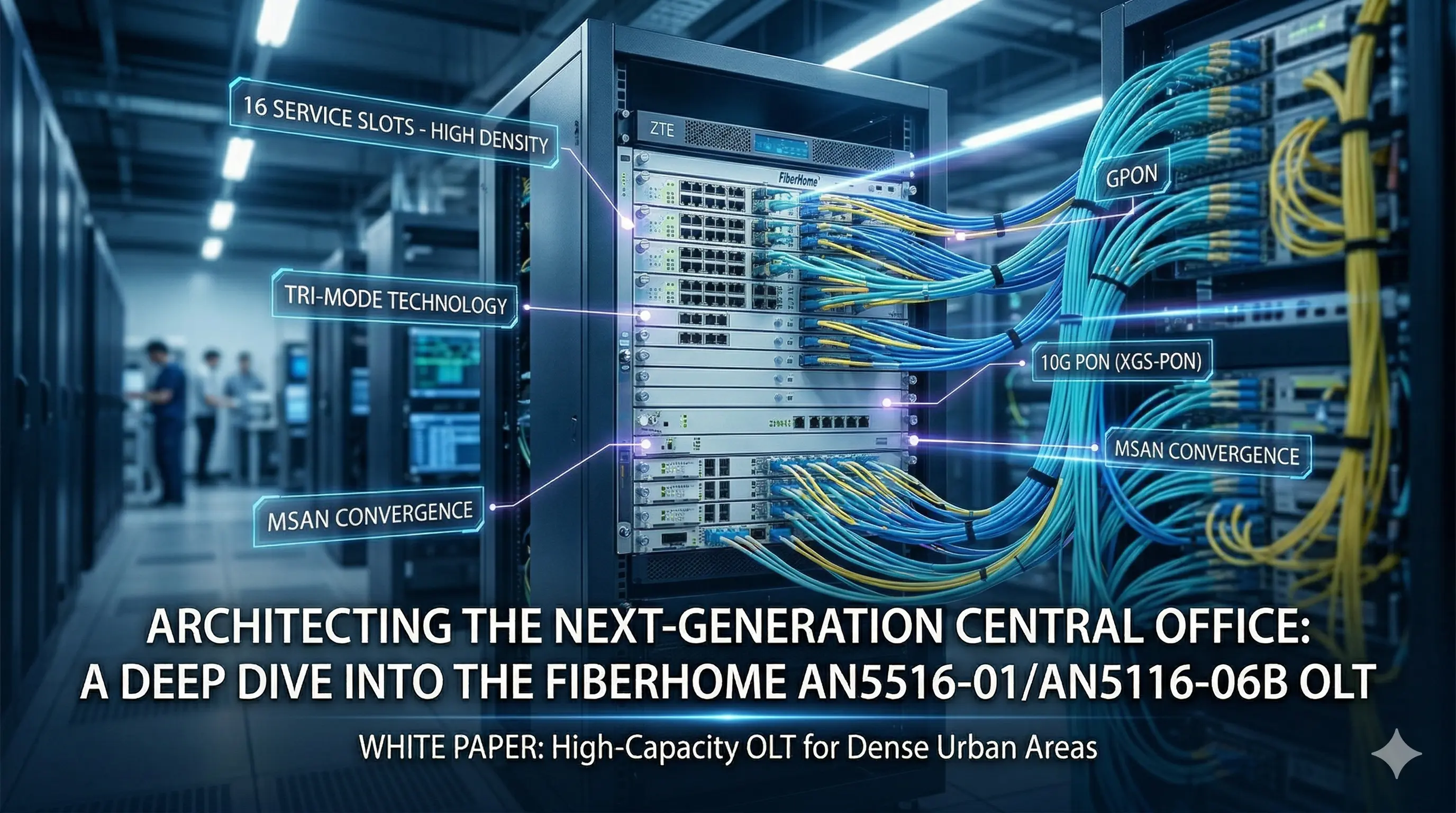
 Architecting the Next-Generation Central Office: A Deep Dive into the FiberHome AN5516-01/AN5116-06B OLT
27 Mar, 2026. Posted by:XPONSHOP
Most Views Posts
Carrier-Grade Routing Solution Brief: Deploying Dynamic Segment Routing (SRv6) Deployment Architecture in ISP Transport
2026-09-23 09:38:14
Nokia G-2425G-A Wi-Fi 6 Optical Gateway MIMO Antenna Performance Diagrams - Official Technical Overview & Hardware Datasheet
2026-10-26 12:40:34
Systems Integrator's Blueprint: Step-by-Step Fiber Optic Sizing Guide to How to Calculate Optical Power Budget for GPON
2026-08-21 10:47:08
Popular Posts
Generic NMS FAQ: Expert Answers to Network Integration & Configuration Questions
2026-07-29 09:59:40
XPONSHOP Unbranded Wi-Fi 7 Premium ONU RF Shielding and Thermal Dissipation Profile - Official Technical Overview & Hardware Datasheet
2026-09-04 09:32:52
Carrier-Grade Routing Reliability: Evaluating Dual-Engine Redundancy in ONT Sharing a Distribution Fiber with RF Video Overlays
2026-10-14 19:08:40
Random Posts
GPON ONT Optical Power FAQ: Expert Answers to Network Integration & Configuration Questions
2026-09-08 10:28:51
Troubleshooting PoE+ 802.3at: Power Budget Per Port, Failover & Compatibility Issues
2026-05-27 13:44:43
Carrier-Grade Routing Reliability: Evaluating Dual-Engine Redundancy in Hardware Firewalls for ISPs
2026-07-02 13:09:02
Recent Posts
AI Optical Transceivers vs. Telecom Optical Transceivers: Two ‘Personalities’ of the Same Component
2026-10-30 11:30:33
Overcoming Network Bottlenecks: Enterprise Configuration Manual for Nintendo Switch NAT Type D Resolution
2026-10-30 10:06:06
Cisco Business 350 Series Managed Switch Physical Security and Power Efficiency - Official Technical Overview & Hardware Datasheet
2026-10-30 10:03:46
About
XponShop blog describes some basics for Huawei / ZTE /
Nokia / FiberHome GPON OLT, ONT, SFP, and Site Power...
such as configurations, issue troubleshooting, knowledge
sharing, and keeps updating.
Recent posts
 AI Optical Transceivers vs. Telecom Optical Transceivers: Two ‘Personalities’ of the Same Component
27 Mar, 2025
 Overcoming Network Bottlenecks: Enterprise Configuration Manual for Nintendo Switch NAT Type D Resolution
27 Mar, 2025
 Cisco Business 350 Series Managed Switch Physical Security and Power Efficiency - Official Technical Overview & Hardware Datasheet
27 Mar, 2025
AI Optical Transceivers vs. Telecom Optical Transceivers: Two ‘Personalities’ of the Same Component
27 Mar, 2025
Overcoming Network Bottlenecks: Enterprise Configuration Manual for Nintendo Switch NAT Type D Resolution
27 Mar, 2025
Cisco Business 350 Series Managed Switch Physical Security and Power Efficiency - Official Technical Overview & Hardware Datasheet
27 Mar, 2025
Products from the blog
The Imperative for Integrated Access Networks
Historically, telecommunications networks operated in silos. Copper-based DSL networks, dedicated enterprise Ethernet, and early-stage optical fiber networks often required disparate management systems and separate central office equipment. This fragmentation resulted in bloated Operational Expenditure (OpEx), inefficient rack space utilization, and severe bottlenecks when attempting to scale bandwidth.
The modern paradigm demands convergence. Operators need a unified platform capable of handling legacy connections while seamlessly transitioning subscribers to next-generation speeds. This is where the MSAN (Multi-Service Access Node) architecture, combined with advanced PON (Passive Optical Network) technologies, becomes indispensable.
The FiberHome AN5516-01/AN5116-06B perfectly encapsulates this convergence. It is not merely an OLT (Optical Line Terminal); it is a comprehensive, large carrier-class central office equipment platform designed to aggregate massive amounts of traffic from remote end ONUs (Optical Network Units) and route it efficiently to the core network.
Core Architecture of the FiberHome AN5516-01/AN5116-06B
At the foundational level, the hardware engineering of this chassis is meticulously designed for high availability, massive throughput, and long-term deployment in demanding CO environments.
2.1 The 19-Inch Chassis and 16 Service Slots
Rack space in a Central Office is premium real estate. The FiberHome AN5516-01 utilizes a standard 19-inch chassis design, making it universally compatible with standard telecom racks. What sets it apart is its 16 service slots.
Massive Scalability: By utilizing 16 dedicated slots for service boards, operators can populate the chassis incrementally. A single chassis fully loaded with 16-port GPON boards can support 256 GPON ports. Assuming a standard 1:64 split ratio, a single chassis can provide high-speed fiber access to over 16,384 subscribers.
Density Management: For ultra-dense urban deployments, utilizing high-density 10G PON boards maximizes the subscriber-to-rack-unit ratio, drastically reducing the physical footprint required to service metropolitan areas.
2.2 Tri-Mode Technology: MSAN, GPON, and 10G PON
To safeguard capital investments (CapEx), telecom equipment must provide a bridge between the present and the future. The AN5516-01/AN5116-06B excels here by supporting multiple access technologies within the very same subrack.
MSAN Capabilities: For regions still transitioning from copper to fiber, the MSAN capabilities allow operators to continue offering voice and VDSL2 services while gradually migrating users to optical lines.
GPON (Gigabit PON): The current global standard for FTTH (Fiber to the Home). The chassis handles robust GPON traffic, providing 2.5 Gbps downstream and 1.25 Gbps upstream per port.
10G PON (XG-PON / XGS-PON): For enterprise clients, 5G base station backhaul, and power users, the chassis seamlessly integrates 10G PON central office OLT boards. This provides symmetrical or asymmetrical 10 Gbps speeds, ensuring the network is "future-proofed" for the next decade of bandwidth consumption.
You can explore the specific configuration options and acquire this exact chassis at the direct product page:FiberHome AN5516-01/AN5116-06B OLT
Carrier-Class Reliability and Redundancy
When deploying equipment that serves tens of thousands of users, single points of failure are unacceptable. The AN5516-01 is engineered with strict carrier-class GPON equipment standards.
3.1 Hardware Redundancy
Dual Core Switch and Control Boards: The system features 1+1 redundancy for its core switching and management boards. If the active board experiences a hardware or software fault, the standby board takes over instantaneously without dropping active user sessions or causing noticeable latency.
Dual Power Modules: Operating on standard telecom -48V DC power, the chassis utilizes dual power input modules. This allows connection to two separate power plants or battery backups in the CO, ensuring uninterrupted service during localized power grid anomalies.
Hot-Swappable Components: Every service board, fan module, and control unit is hot-swappable. Technicians can replace faulty components or upgrade service boards without powering down the chassis or interrupting traffic on other slots.
3.2 Advanced Thermal Management
Housing up to 16 high-density optical service boards generates significant thermal output. The FiberHome AN5116-06B chassis incorporates an intelligent fan tray system that dynamically adjusts fan speeds based on real-time temperature telemetry from the individual service boards. This not only extends the lifespan of the optical modules but also significantly reduces the operational energy footprint.
Software Intelligence and Network Management
Hardware is only as effective as the software that governs it. FiberHome provides a highly sophisticated Network Management System (NMS) to oversee the AN5516-01/AN5116-06B.
4.1 Unified OAM (Operations, Administration, and Maintenance)
The OLT acts as the brain of the access network, continuously communicating with thousands of remote end ONUs. Through the unified NMS, network administrators can:
Automatically discover and provision new ONUs upon connection.
Perform bulk firmware upgrades to remote terminals.
Monitor optical power levels (Tx/Rx) in real-time to proactively detect degrading fiber splices or macrobends before they result in a customer outage.
To find perfectly compatible remote units, browse the extensive catalog ofGPON and EPON ONUs
4.2 Quality of Service (QoS) and Traffic Engineering
In a converged network carrying voice, video, and raw data, QoS is paramount. The AN5516-01 features granular DBA (Dynamic Bandwidth Allocation) algorithms. It can intelligently prioritize latency-sensitive VoIP and IPTV traffic over standard bulk data downloads during peak congestion hours. This ensures a consistent, high-quality Quality of Experience (QoE) for all subscribers, regardless of overall network load.
Strategic B2B Deployment Scenarios
Where does this specific piece of hardware fit into an operator's overall network topology? Its versatility allows it to be the anchor for multiple business models.
5.1 High-Density Urban FTTH
In densely populated metropolitan areas or high-rise MDU (Multi-Dwelling Unit) environments, the primary constraint is port density. A single AN5516-01, acting as a high-capacity OLT for dense areas, can aggregate traffic from thousands of apartments using standard splitters (e.g., 1:64 or 1:128 for 10G PON). This minimizes the amount of active equipment needed in neighborhood cabinets, centralizing the intelligence and troubleshooting capabilities in the secure CO.
5.2 Enterprise and Industrial Campuses
Large corporate campuses, universities, and industrial parks are increasingly adopting POL (Passive Optical LAN) over traditional copper Ethernet. The AN5516-01 can sit in the main data center, pushing optical fiber directly to individual offices or surveillance cameras across massive geographic areas. To support these enterprise setups, operators often combine the OLT with specialized10G PON Service Boards
5.3 5G Mobile Backhaul
As mobile operators densify their 5G networks, they require massive backhaul bandwidth from small cells back to the core network. The 10G PON capabilities of the AN5516-01 make it an ideal mechanism for xHaul (fronthaul/midhaul/backhaul) applications, utilizing the same fiber infrastructure deployed for residential broadband to service mobile antennas.
Sourcing and Expanding Your Network Ecosystem
Building a carrier-class network requires a reliable supply chain and guaranteed interoperability. While the FiberHome AN5516-01 is a powerhouse, it relies on a broader ecosystem of optical transceivers, splitters, and power equipment to function.
Procurement officers and network architects must ensure they source authentic equipment with robust post-sales support. Expanding your Central Office capabilities involves exploring the full range ofOLT Equipment Categories FiberHome Brand Ecosystem
Frequently Asked Questions (FAQs)
To assist network architects and procurement managers in their evaluation process, we have compiled the most common technical inquiries regarding this chassis.
Q1: What is the main difference between the AN5516-01 and AN5116-06B?A1: They belong to the same product family and share identical software architectures and core functionalities. The primary difference usually lies in the specific subrack form factor or regional market naming conventions, but both represent FiberHome's large-capacity 16-slot OLT platform.
Q2: Can I run GPON and 10G PON boards in the same chassis simultaneously?A2: Yes. The chassis features a universal backplane that supports mixed insertion of MSAN, GPON, XG-PON, and XGS-PON service boards. This allows operators to seamlessly upgrade specific high-demand service areas to 10G without replacing the entire chassis.
Q3: What is the maximum logical reach of the PON network from this OLT?A3: Depending on the specific optical transceiver (Class B+, C+, or C++) inserted into the service boards and the optical split ratio used in the ODN (Optical Distribution Network), the logical reach can extend from 20 km up to 60 km.
Q4: Does the FiberHome AN5516-01 support third-party ONUs?A4: While best performance and unified management (via OMCI) are guaranteed when paired with FiberHome remote end ONUs, the OLT complies with standard ITU-T G.984 (GPON) and G.987 (10G PON) protocols. This means it offers a high degree of interoperability with third-party standard-compliant ONUs, though specific proprietary management features might be limited.
Q5: How many uplink ports does the core switch board provide?A5: The uplink capacity depends on the specific core switch board model installed (e.g., HSCA, HU1A). Modern control boards typically offer multiple 10GE (10 Gigabit Ethernet) or even 100GE uplink interfaces to connect to the upstream core router.
Q6: Is the equipment strictly for Central Office (CO) deployment?A6: Due to its 19-inch 11U physical size and high capacity, it is classified as large carrier-class central office equipment. While it could be deployed in a very large outdoor remote cabinet, it is primarily designed for the climate-controlled environment of a CO. For outdoor street cabinets, smaller form-factor OLTs (like 2U or 1U pizza boxes) are generally preferred.
Q7: How does the OLT handle power outages?A7: The chassis relies on dual -48V DC power inputs. In a standard telecom setup, these are connected to large battery arrays and diesel generators. If one power feed fails, the second feed seamlessly maintains operation without any traffic interruption.
Q8: What layer 2/Layer 3 routing capabilities does the OLT have?A8: The AN5516-01 acts as a highly advanced Layer 2 aggregator but also features robust Layer 3 routing capabilities, including static routing, RIP, OSPF, and BGP. This allows the OLT to act as a localized gateway, offloading routing tasks from the core network.
Summary of Core Value
The FiberHome AN5516-01/AN5116-06B represents the pinnacle of optical access aggregation. Its core value lies in its unyielding scalability and technological convergence. By providing 16 ultra-high-density service slots within a standard 19-inch chassis, it drastically reduces the physical space required in central offices while simultaneously expanding subscriber capacity. The ability to integrate MSAN, GPON, and 10G PON into a single unified platform protects operators from rapid technological obsolescence, ensuring that capital investments yield returns for over a decade. Backed by carrier-grade redundancy, hot-swappable architecture, and intelligent traffic management, this equipment is an indispensable asset for operators aiming to dominate the Gigabit era in densely populated markets.
Call to Action (CTA)
Are you ready to architect a future-proof, high-density optical network capable of handling the massive bandwidth demands of tomorrow? Do not let legacy equipment bottleneck your subscriber growth.