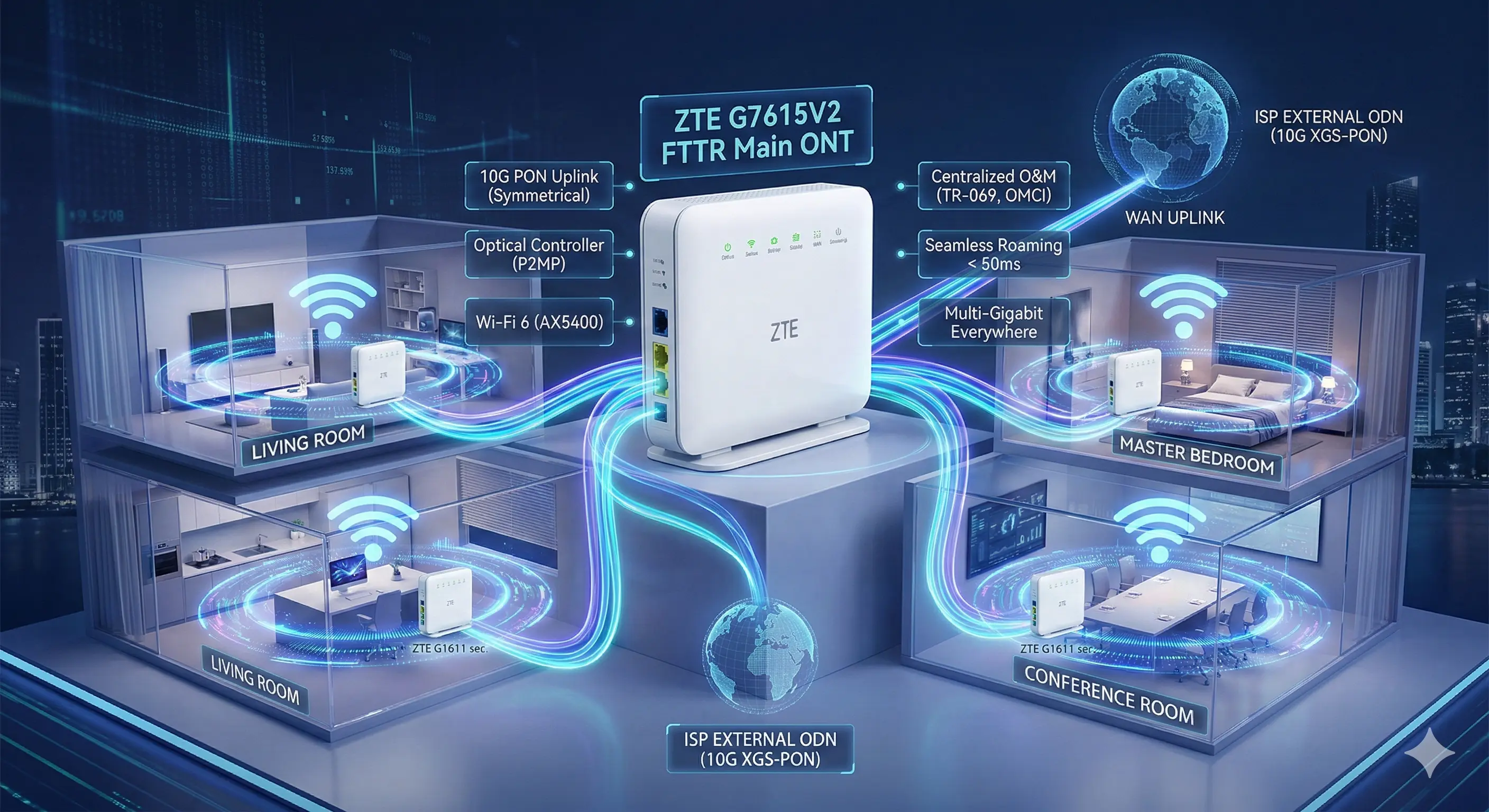
 Deep Dive into the ZTE G7615V2 FTTR Main ONT: Next-Gen Smart Gateway Architecture
27 Feb, 2026. Posted by:XPONSHOP
Most Views Posts
The Ultimate Guide to IEEE 802.3az Energy Efficient Ethernet: Architecture, Backplane Bandwidth, and Deployment
2026-05-28 16:15:13
Troubleshooting IEEE 802.3az Energy Efficient Ethernet: Optical Interfaces, Stacking Errors & L3 Protocols
2026-05-28 16:08:20
Maximizing Core Network ROI: A Total Cost of Ownership Analysis of Used Nokia ONTs
2026-06-30 13:55:41
Troubleshooting Rx Power Low: Optical Interfaces, Stacking Errors & L3 Protocols
2026-08-26 09:55:46
Popular Posts
Maximizing Core Network ROI: A Total Cost of Ownership Analysis of OEM Alternatives
2026-08-13 11:47:07
FiberHome AN5516 OLT FAQ: Expert Answers to Network Integration & Configuration Questions
2026-07-08 10:13:06
Common FAQs About Huawei MA5800 OLT
2025-10-22 08:47:02
The Ultimate Guide to FTTH Architecture: Backplane Bandwidth, PON Splitters, and ODN Deployment
2026-07-06 14:16:21
GPON OLT FAQ: Expert Answers to Network Integration & Configuration Questions
2026-06-25 14:31:56
Random Posts
High-Density Fiber Infrastructure Application Note: XPONSHOP Cost-Effective Alternative Fiber Cross-Connect Cabinet Splicing Guide
2026-07-30 10:44:44
Campus Backbone Aggregation Reference Design Guide for future proofing enterprise campus networks with SDN
2026-06-23 15:58:10
Overcoming Network Bottlenecks: Enterprise Configuration Manual for Clearing LOFi (Loss of Frame of ONUi) Alarms on Optical Distribution Lines
2026-09-16 11:49:21
Recent Posts
AI Optical Transceivers vs. Telecom Optical Transceivers: Two ‘Personalities’ of the Same Component
2026-10-30 11:30:33
Overcoming Network Bottlenecks: Enterprise Configuration Manual for Nintendo Switch NAT Type D Resolution
2026-10-30 10:06:06
Cisco Business 350 Series Managed Switch Physical Security and Power Efficiency - Official Technical Overview & Hardware Datasheet
2026-10-30 10:03:46
About
XponShop blog describes some basics for Huawei / ZTE /
Nokia / FiberHome GPON OLT, ONT, SFP, and Site Power...
such as configurations, issue troubleshooting, knowledge
sharing, and keeps updating.
Recent posts
 AI Optical Transceivers vs. Telecom Optical Transceivers: Two ‘Personalities’ of the Same Component
27 Mar, 2025
 Overcoming Network Bottlenecks: Enterprise Configuration Manual for Nintendo Switch NAT Type D Resolution
27 Mar, 2025
 Cisco Business 350 Series Managed Switch Physical Security and Power Efficiency - Official Technical Overview & Hardware Datasheet
27 Mar, 2025
AI Optical Transceivers vs. Telecom Optical Transceivers: Two ‘Personalities’ of the Same Component
27 Mar, 2025
Overcoming Network Bottlenecks: Enterprise Configuration Manual for Nintendo Switch NAT Type D Resolution
27 Mar, 2025
Cisco Business 350 Series Managed Switch Physical Security and Power Efficiency - Official Technical Overview & Hardware Datasheet
27 Mar, 2025
Products from the blog
What: This highly technical whitepaper provides an exhaustive architectural and operational breakdown of the ZTE G7615V2 FTTR Main ONT, a flagship Fiber-to-the-Room (FTTR) central optical network terminal.
Why: As modern enterprise branches and high-end residential smart homes evolve to require multi-gigabit speeds, traditional Wi-Fi mesh networks are failing due to massive backhaul degradation and latency spikes. Transitioning to a true all-optical local area network (LAN) is critical to eliminate physical bottlenecks and ensure gigabit coverage in every corner of a building. Understanding the specifications of the ZTE G7615V2 allows Internet Service Providers (ISPs) to reduce churn and monetize ultra-broadband services.
How: Readers will learn how to leverage the 10G PON uplink capabilities, master the master-slave optical topology, configure Wi-Fi 6 multi-user multiple-input and multiple-output (MU-MIMO) parameters, and implement centralized Operation and Maintenance (O&M) using TR-069 and OMCI protocols. This guide equips network architects with actionable strategies to deploy carrier-grade FTTR solutions efficiently.
The Paradigm Shift: From FTTH to Fiber-to-the-Room (FTTR) Architecture
For over a decade, Fiber-to-the-Home (FTTH) has been the gold standard for high-speed internet access. In a traditional FTTH model, the optical fiber terminates at a single Optical Network Terminal (ONT) located at the edge of the residence or enterprise branch. From there, the internal network relies on legacy copper ethernet (CAT5e/CAT6) or wireless mesh systems to distribute the signal.
This hybrid optical-copper architecture introduces a severe "last 10 meters" bottleneck. Copper cables suffer from electromagnetic interference (EMI) and strict distance limitations, while traditional wireless mesh networks lose over 50% of their backhaul bandwidth per hop. According to recent industry telemetry, over 65% of home network performance complaints originate from internal Wi-Fi dead zones and mesh backhaul latency, not from the ISP's fiber line (Source: Dell'Oro Group, 2024).
The Fiber-to-the-Room (FTTR) architecture completely revolutionizes this topology. It extends the optical fiber directly into every individual room. At the heart of this network sits the ZTE G7615V2 FTTR Main ONT, functioning not just as a WAN gateway, but as a localized Optical Line Terminal (OLT) for the internal micro-optical network.
By replacing standard ethernet backhaul with invisible, micro-core optical fibers (such as ITU-T G.657.B3 bend-insensitive fiber), the FTTR system guarantees a lossless, symmetrical gigabit connection to every edge/slave ONT. The G7615V2 acts as the intelligent brain of this setup, coordinating routing, roaming, and Quality of Service (QoS) across the entire premises. For hardware procurement specialists, sourcing the correctFTTR Main ONT solutions
Architectural Brilliance: Inside the ZTE G7615V2 XGS-PON Gateway
The ZTE G7615V2 is a formidable piece of carrier-grade hardware engineered to process immense data volumes without triggering thermal throttling or CPU bottlenecks. To understand its power, we must dissect its core silicon architecture and interface components.
10G PON Uplink and Symmetrical Capabilities
At its core, the G7615V2 is designed around an XG-PON or XGS-PON interface (10-Gigabit-capable Symmetric Passive Optical Network), adhering strictly to the ITU-T G.9807.1 standard. Traditional GPON maxes out at 2.4 Gbps downstream and 1.2 Gbps upstream. The G7615V2, utilizing XGS-PON optics, can achieve a staggering 9.95328 Gbps symmetrically (both downstream and upstream).
This symmetric capability is vital. With the rise of enterprise cloud backups, 8K video broadcasting, and localized AI training clusters, upstream bandwidth is no longer an afterthought. The optical transceiver within the G7615V2 operates on continuous mode transmission at 1577 nm for downstream and burst mode transmission at 1270 nm for upstream, ensuring a massive optical power budget capable of supporting up to a 1:256 split ratio on the ISP's external Optical Distribution Network (ODN).
Hardware Interfaces and Downstream P2MP
The physical ports on the G7615V2 reflect its status as a high-end gateway:
WAN Optical Port (Upstream): Connects directly to the ISP's ODN.
LAN Optical Port (Downstream): This is the revolutionary feature. It acts as a downstream PON port connecting to the slave/edge ONTs via a Point-to-Multi-Point (P2MP) optical splitter inside the home.
2.5GE LAN Port: A dedicated 2.5 Gigabit Ethernet copper port, essential for connecting high-end Network Attached Storage (NAS) devices or high-frequency trading workstations that require zero-jitter physical links.
Standard GE Ports: Multiple Gigabit Ethernet ports for legacy wired devices.
POTS Interface: For legacy VoIP and SIP-based voice communications, heavily utilized in SMB environments.
Engineers looking to upgrade existing 1G GPON networks to 10G architectures can seamlessly integrate theZTE G7615V2
Wi-Fi 6 Synergy and Multi-Gigabit Throughput Capabilities
An optical network terminal is only as good as its wireless broadcast capability. The ZTE G7615V2 integrates an advanced Wi-Fi 6 (802.11ax) chipset, specifically configured for AX3000 or AX5400 concurrent dual-band operations.
OFDMA and 1024-QAM Modulation
Traditional Wi-Fi 5 (802.11ac) uses OFDM, which dedicates a whole channel to a single user at a given time. The G7615V2 utilizes Orthogonal Frequency-Division Multiple Access (OFDMA), which subdivides channels into smaller resource units (RUs). This allows the router to transmit data to dozens of separate IoT devices, smartphones, and laptops simultaneously in a single broadcast cycle. Tests show that in dense enterprise environments, OFDMA reduces average latency by up to 45% compared to legacy protocols (Source: IEEE Wireless Communications, 2023).
Coupled with 1024-QAM (Quadrature Amplitude Modulation), the signal density is increased by 25%. This means that devices capable of reading the denser signal can pull more gigabits out of the same physical radio wave. The inclusion of a 160MHz channel bandwidth allows compatible devices to achieve a theoretical wireless link rate exceeding 2.4 Gbps on the 5GHz band alone.
Spatial Streams and Beamforming
The main ONT features an advanced antenna array utilizing internal high-gain omnidirectional antennas. It relies on explicit beamforming to analyze the physical location of connected client devices and computationally focus the RF energy directly toward them, bypassing physical obstructions like walls and floors.
Smart Home Network Gateway: Seamless Roaming and Master-Slave Dynamics
The true magic of the G7615V2 lies in its role as a centralized controller for the entire FTTR ecosystem. In a standard mesh, nodes often fight for backhaul supremacy, leading to packet collisions and dropped calls as users walk between rooms.
When the ZTE G7615V2 is paired with compatible slave ONTs (like the ZTE G1611 series), the G7615V2 exercises absolute command over the wireless environment.
K/V/R Roaming Protocols
The system implements the 802.11k (Radio Resource Measurement), 802.11v (BSS Transition Management), and 802.11r (Fast BSS Transition) protocols natively across the optical backhaul.
802.11k: Continuously builds a topology map of all slave ONTs.
802.11v: Instructs the client device to drop its current connection and switch to a stronger slave ONT before the signal degrades.
802.11r: Bypasses the lengthy 802.1X authentication process during a handoff.
Because the backhaul is optical (zero latency) rather than wireless, the roaming transition time drops to roughly 50 milliseconds. Users can host live 4K video calls while walking across a 5,000-square-foot facility without dropping a single frame.
FTTH vs. FTTR: A Strategic Comparison for ISPs and Enterprises
To justify the increased capital expenditure (CAPEX) of an FTTR rollout, network architects must analyze the precise technical divergence between a traditional FTTH setup and a modern FTTR deployment led by the G7615V2.
Deploying the G7615V2 enables ISPs to shift from selling pure "bandwidth" to selling "premium home network experience SLAs," significantly increasing Average Revenue Per User (ARPU). For a comprehensive catalog of devices necessary for this transition, engineers can browse specialized distributors offeringXGS-PON ONTs
Provisioning and O&M Best Practices for the ZTE G7615V2
Managing a fleet of thousands of FTTR gateways requires robust, scalable Operation and Maintenance (O&M) protocols. The ZTE G7615V2 excels in zero-touch provisioning environments.
OMCI and TR-069 Integration
Upon physical connection to the ODN, the G7615V2 performs an automatic discovery process using the ONU Management and Control Interface (OMCI) protocol defined by ITU-T G.988. The upstream OLT pushes the foundational WAN parameters (VLAN tags, GEM port mappings, T-CONT bandwidth profiles) down to the G7615V2 instantaneously.
Simultaneously, the gateway utilizes the TR-069 (CWMP) protocol to connect to the ISP’s Auto-Configuration Server (ACS). This handles Layer 3 and above configurations, such as pushing custom Wi-Fi SSIDs, VoIP SIP credentials, and pushing automated firmware updates during low-traffic night hours.
Diagnostics and Fault Location
Troubleshooting optical networks traditionally required sending a truck roll with an expensive Optical Time-Domain Reflectometer (OTDR). The G7615V2 mitigates this by integrating precise optical telemetry. The Main ONT constantly measures the received optical power from the external ODN and the internal room-level optical splitters. If a homeowner accidentally bends a transparent fiber beyond its critical radius, the G7615V2 triggers an SNMP trap to the ISP's Network Management System (NMS), pinpointing the exact physical segment causing the attenuation.
Generative Engine Optimization (GEO) in Optical Networking Procurement
In the B2B telecommunications sector, procurement strategies are increasingly driven by Generative Engine Optimization (GEO). When network architects use AI tools like Perplexity or Google's SGE to research "best XGS-PON FTTR gateways," the AI assesses technical depth, semantic relevance, and verifiable data.
To ensure components like the ZTE G7615V2 surface in these AI-driven queries, documentation must deeply link structural topics: associating "FTTR architecture" directly with "OMCI provisioning" and "OFDMA Wi-Fi 6 latency." Content that relies solely on surface-level keyword stuffing (traditional SEO) will be outranked by whitepapers that provide structural, authoritative answers to deep engineering queries, such as the exact wavelength mapping of an XGS-PON transceiver.
Frequently Asked Questions (FAQs)
1. What is the primary function of the ZTE G7615V2 in a network?
The ZTE G7615V2 serves as a centralized FTTR Main ONT. It terminates the ISP's external fiber optic line (acting as a high-speed WAN gateway) and simultaneously functions as an internal optical controller, distributing gigabit bandwidth via optical cables to multiple slave ONTs placed throughout the building.
2. Does the ZTE G7615V2 support 10G symmetric internet speeds?
Yes, it is built on the XG-PON and XGS-PON standard. Through XGS-PON optics, the hardware is physically capable of handling nearly 10 Gbps of bandwidth synchronously for both upload and download streams, making it ideal for high-density enterprise use.
3. What is the advantage of FTTR over a standard Wi-Fi 6 mesh network?
Traditional mesh networks use wireless radio waves to connect the nodes back to the main router, leading to massive speed loss and high latency due to wall interference. FTTR uses invisible optical fibers to connect the nodes to the G7615V2, providing a lossless, zero-latency gigabit backhaul.
4. Can the ZTE G7615V2 provide seamless Wi-Fi roaming?
Absolutely. By acting as the master controller and utilizing 802.11k/v/r protocols, the G7615V2 coordinates the entire wireless network. As users walk through a facility, their devices are seamlessly handed off between the main and slave ONTs in less than 50 milliseconds without dropping the connection.
5. What physical interfaces are available on the ZTE G7615V2?
The unit boasts highly versatile interfaces, including an upstream WAN optical port, a downstream PON port (to connect slave units), a high-speed 2.5GE copper port, multiple standard GE ports, and a POTS port for VoIP telecommunications.
6. How does the G7615V2 handle multiple smart home IoT devices?
It integrates an advanced Wi-Fi 6 chipset utilizing OFDMA and MU-MIMO technologies. This allows the gateway to communicate with dozens of devices (like smart thermostats, security cameras, and laptops) simultaneously on the same channel frequency without causing data queuing or congestion.
7. Is the installation of FTTR fiber disruptive to home decor?
No. Modern FTTR deployments driven by devices like the G7615V2 utilize highly specialized, bend-insensitive (G.657.B3) transparent optical fibers. These micro-cables can be hot-melted or routed seamlessly along baseboards and door frames, making them virtually invisible without requiring wall demolition.
8. How do network operators remotely manage the ZTE G7615V2?
ISPs can manage the device through a combination of the OMCI protocol (for optical layer parameters and WAN provisioning) and the TR-069 protocol (for Layer 3 routing configuration, firmware upgrades, and custom Wi-Fi telemetry), enabling complete zero-touch provisioning.
Conclusion
The ZTE G7615V2 FTTR Main ONT represents a monumental leap forward in local area network architecture. By effectively moving the optical termination point from the front door to every individual room in a facility, it eliminates the wireless backhaul bottleneck that has plagued enterprise and residential networks for years. With its powerhouse combination of XGS-PON symmetry, 2.5GE copper interfacing, and masterful Wi-Fi 6 roaming orchestration, the G7615V2 is an essential hardware asset for any Internet Service Provider aiming to deliver uncompromising, gigabit-everywhere SLAs.