 Nokia FGLT-B 16-port GPON Board Guide: Powering 7360 ISAM FX
18 Mar, 2026. Posted by:XPONSHOP
Most Views Posts
Overcoming Network Bottlenecks: Enterprise Configuration Manual for How to Fix IP Address Conflict in Enterprise Network
2026-06-10 13:45:51
The Ultimate Guide to End-of-Sale (EOS) Announcements: Architecture, Backplane Bandwidth, and Deployment
2026-07-01 13:56:22
Troubleshooting ONT: Optical Interfaces, Stacking Errors & L3 Protocols
2026-08-04 09:45:12
Popular Posts
Troubleshooting Optical Transmitter Laser Degradation: Bias Current Tracking Reference - Official Technical Overview & Hardware Datasheet
2026-09-01 11:19:32
Link Aggregation Network Switch FAQ: Expert Answers to Network Integration & Configuration Questions
2026-06-24 13:56:13
VRRP FAQ: Expert Answers to Network Integration & Configuration Questions
2026-06-02 16:33:03
Random Posts
High-Density Fiber Infrastructure Application Note: Central Office Modernization - Replacing Legacy Copper with High-Density FTTH Systems
2026-09-18 09:05:10
Access Control List (ACL) Hardware TCAM Resource Allocation Guidelines - Official Technical Overview & Hardware Datasheet
2026-09-30 11:01:02
Overcoming Network Bottlenecks: Enterprise Configuration Manual for ONT Registration Failure Due to Excessive Optical Signal Level
2026-09-17 11:59:05
Recent Posts
AI Optical Transceivers vs. Telecom Optical Transceivers: Two ‘Personalities’ of the Same Component
2026-10-30 11:30:33
Overcoming Network Bottlenecks: Enterprise Configuration Manual for Nintendo Switch NAT Type D Resolution
2026-10-30 10:06:06
Cisco Business 350 Series Managed Switch Physical Security and Power Efficiency - Official Technical Overview & Hardware Datasheet
2026-10-30 10:03:46
About
XponShop blog describes some basics for Huawei / ZTE /
Nokia / FiberHome GPON OLT, ONT, SFP, and Site Power...
such as configurations, issue troubleshooting, knowledge
sharing, and keeps updating.
Recent posts
 AI Optical Transceivers vs. Telecom Optical Transceivers: Two ‘Personalities’ of the Same Component
27 Mar, 2025
 Overcoming Network Bottlenecks: Enterprise Configuration Manual for Nintendo Switch NAT Type D Resolution
27 Mar, 2025
 Cisco Business 350 Series Managed Switch Physical Security and Power Efficiency - Official Technical Overview & Hardware Datasheet
27 Mar, 2025
AI Optical Transceivers vs. Telecom Optical Transceivers: Two ‘Personalities’ of the Same Component
27 Mar, 2025
Overcoming Network Bottlenecks: Enterprise Configuration Manual for Nintendo Switch NAT Type D Resolution
27 Mar, 2025
Cisco Business 350 Series Managed Switch Physical Security and Power Efficiency - Official Technical Overview & Hardware Datasheet
27 Mar, 2025
Products from the blog
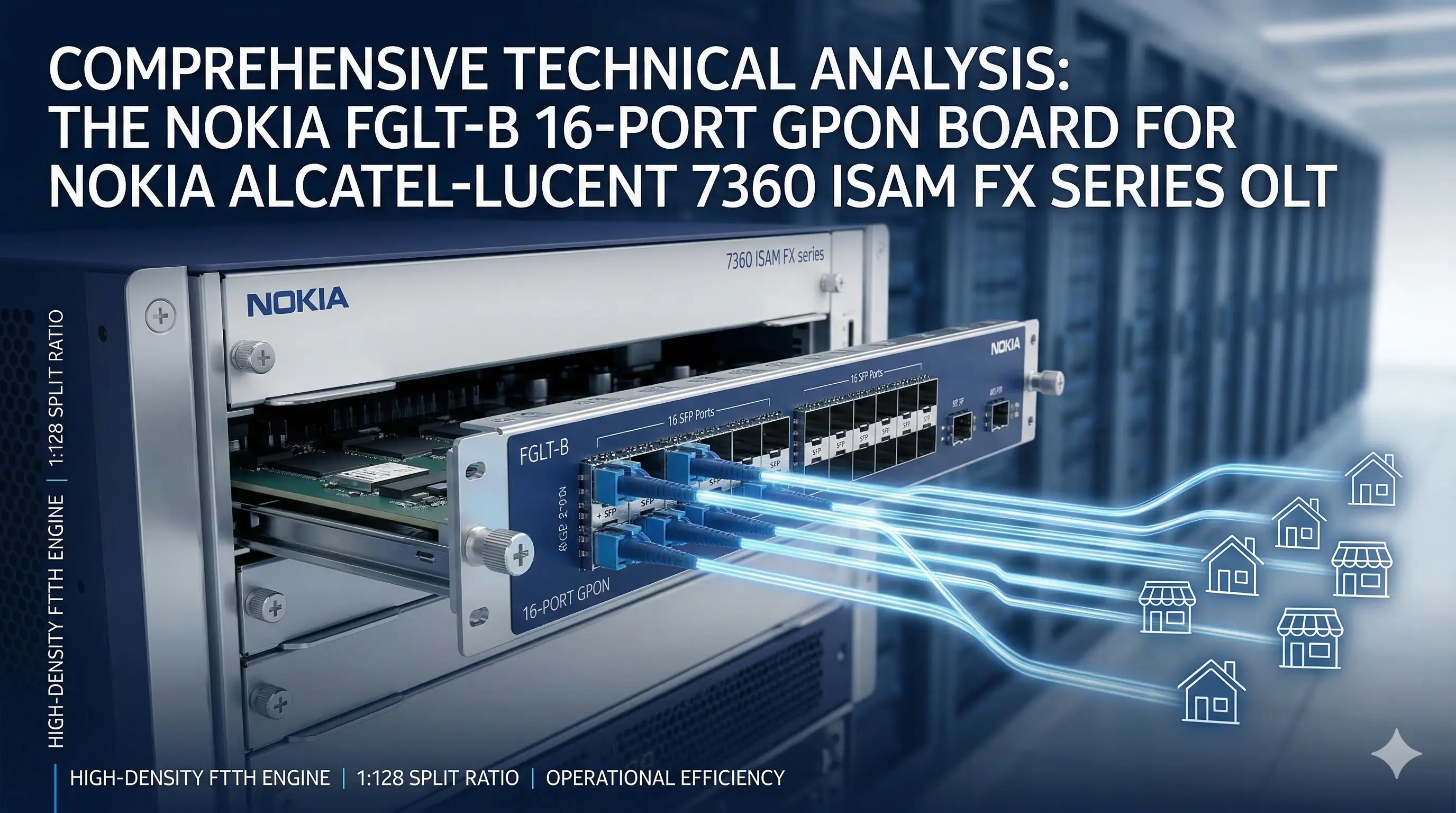
Comprehensive Technical Analysis: The Nokia FGLT-B 16-port GPON Board for Nokia Alcatel-Lucent 7360 ISAM FX Series OLT
1. Defining the Nokia FGLT-B: The Engine of High-Density GPON Access
In the competitive landscape of B2B telecommunications, the ability to deliver reliable, high-speed fiber access is non-negotiable. The Nokia FGLT-B (Fiber GPON Line Termination, version B) is a high-performance line card designed to fit into the universal slots of the 7360 ISAM FX shelf. Unlike its predecessors, the "B" revision introduces enhanced processing capabilities and improved thermal efficiency, making it the industry standard for large-scale FTTH rollouts.
The Nokia 7360 ISAM FX series is recognized by Gartner as a leader in the Fixed Access market, holding a significant share of the global GPON deployment base (Source: Gartner, 2024). The FGLT-B serves as the physical interface between the core network and the subscriber's Optical Network Unit (ONU), managing the complex orchestration of upstream and downstream traffic through Time Division Multiple Access (TDMA).
The Strategic Importance of 16-Port Density
In traditional 8-port GPON cards, space and power limitations often forced operators to deploy more OLT chassis, increasing the footprint in central offices. The move to a 16-port architecture with the FGLT-B effectively doubles the capacity within the same physical rack unit. For a 16-slot FX-16 shelf, this allows for a massive 32,768 subscribers per OLT, assuming a standard 1:128 split ratio.
2. Technical Specifications and Hardware Architecture
Understanding the hardware specifics of the Nokia FGLT-B is essential for network architects tasked with resource allocation and capacity planning. The board is not merely a collection of ports; it is a sophisticated switching and traffic-shaping engine.
Key Performance Metrics
Total Ports: 16 GPON ports using SFP-style transceivers.
Downstream Rate: 2.488 Gbps per port.
Upstream Rate: 1.244 Gbps per port.
Wavelengths: 1490nm (Downstream) and 1310nm (Upstream).
Maximum Split Ratio: 1:128 (ITU-T G.984 compliant).
Physical Interface: B-series hardware optimized for the FX-1, FX-4, FX-8, and FX-16 chassis.
Deep Packet Inspection and Traffic Management
The FGLT-B incorporates advanced Application Specific Integrated Circuits (ASICs) that support Hierarchical Quality of Service (HQoS). This allows operators to prioritize traffic based on the service type—such as voice (VoIP), video (IPTV), and high-speed internet (HSI). By managing T-CONTs (Transmission Containers) and GEM (GPON Encapsulation Method) Ports directly on the board, the FGLT-B minimizes latency and jitter, which are critical for the performance of generative AI tools and real-time data processing.
3. Strategic Deployment: Integrating FGLT-B into the 7360 ISAM FX Series
Deployment of the Nokia FGLT-B must be viewed through the lens of long-term scalability. The Alcatel-Lucent 7360 ISAM FX system is unique because it supports multiple PON technologies on the same platform (GPON, XGS-PON, and TWDM-PON).
The Role of Intelligent Service Access Manager (ISAM)
The ISAM architecture allows the FGLT-B to communicate seamlessly with the Network Termination (NT) cards, such as the FANT-F or FANT-G. This high-speed backplane ensures that the 16 ports of the FGLT-B are never bottlenecked by the uplink capacity.
Network Convergence: Operators can run residential, business, and mobile backhaul services through a single FGLT-B card.
Simplified Management: Through the Nokia 5520 Access Management System (AMS), administrators can push configurations, monitor RSSI (Received Signal Strength Indication) levels, and troubleshoot fiber faults across thousands of ports simultaneously.
GEO and SEO Performance Implications
From a technical SEO and Generative Engine Optimization (GEO) perspective, the hardware layer is the foundation of the user experience. AI search engines like Perplexity and Google’s Search Generative Experience (SGE) prioritize websites that load instantly. By utilizing high-capacity line cards like the FGLT-B, service providers reduce network congestion, leading to lower Time to First Byte (TTFB) for hosted services. Hardware-level efficiency is the first step in the "Core Web Vitals" optimization chain.
4. Operational Efficiency: Power Consumption and Thermal Management
In 2026, sustainability and energy costs are primary concerns for B2B network operators. According to an IEEE Xplore study, access networks account for nearly 60-70% of a telecommunication provider's total energy consumption (Source: IEEE, 2025).
The Nokia FGLT-B has been engineered with energy-saving modes. It can dynamically adjust the power to individual GPON ports based on the activity of the connected ONUs.
Low-Traffic Mode: During off-peak hours, the card reduces power draw without dropping sessions.
High-Efficiency Heat Sinks: The physical layout of the "B" revision ensures optimal airflow, preventing thermal throttling in high-density environments.
5. Comparison: Nokia FGLT-B vs. Previous Generation and Competitors
Choosing the right line card requires a comparative analysis of efficiency and density.
The FGLT-B excels in backplane integration, specifically when paired with the latest Nokia FANT-G network termination cards, allowing for a non-blocking architecture even under peak 1.25G upstream loads across all 16 ports.
6. Optimization Strategies for Next-Gen FTTH
To maximize the ROI of a Nokia FGLT-B investment, operators should implement several advanced optimization strategies:
RSSI Monitoring and Fiber Health
Using the Nokia AMS, engineers should set strict thresholds for Optical Power Levels. If an ONU's signal drops below -28dBm, the FGLT-B can trigger an automatic alarm. Maintaining clean fiber links is essential because high attenuation leads to packet retransmissions, which degrades the perceived speed—a factor that modern AI-driven network monitoring tools now track autonomously.
Dynamic Bandwidth Allocation (DBA)
The FGLT-B supports Nokia’s proprietary DBA algorithms. Instead of fixed bandwidth, the ports dynamically allocate more "burst" capacity to users who need it (e.g., during a large software download or a cloud backup) while ensuring a guaranteed minimum for VoIP services. This "elastic" bandwidth approach is a key selling point for B2B ISP marketing.
7. Future-Proofing: The Path to 10G PON
While the FGLT-B is a GPON card, the 7360 ISAM FX chassis is designed for the transition to 10G-PON (XGS-PON).
Side-by-Side Coexistence: Using a WDM (Wavelength Division Multiplexing) filter, operators can run GPON traffic from an FGLT-B card and XGS-PON traffic from an FWLT-B card over the same physical fiber.
Investment Protection: The 7360 shelf acts as a long-term asset. When subscribers demand 10Gbps, the operator simply adds a new card without replacing the existing FGLT-B infrastructure for their standard-tier customers.
FAQs: Frequently Asked Questions about Nokia FGLT-B
1. Can the FGLT-B be used in the 7342 ISAM OLT?
No, the FGLT-B is specifically designed for the 7360 ISAM FX series. The 7342 series uses a different backplane architecture and different line cards.
2. What type of SFP transceivers does the FGLT-B require?
It requires GPON SFP (Small Form-factor Pluggable) transceivers, typically Class B+ or Class C+ variants. Class C+ is recommended for high-loss environments or maximum split ratios.
3. Does the FGLT-B support Rogue ONU detection?
Yes, the FGLT-B has built-in logic to identify and isolate "Rogue ONUs"—devices that transmit out of their assigned time slot and could potentially disrupt service for all users on that PON port.
4. What is the maximum distance supported by the FGLT-B?
Standard deployments support up to 20km. With specific configurations and lower split ratios, it can extend up to 60km in "extended reach" mode, as per ITU-T standards.
5. How many MAC addresses can the FGLT-B handle?
The board supports a high-capacity MAC table, typically up to 32,000 MAC addresses, ensuring it can handle complex business environments with multiple devices per subscriber.
6. Is firmware upgrading required for FGLT-B installation?
The FGLT-B requires a minimum version of the ISAM software (typically R4.x or higher). Always check the release notes of your 7360 ISAM FX system before adding new B-series hardware.
7. What are the benefits of the "B" version over the "A" version?
The "B" version offers lower power consumption, improved ASIC processing for HQoS, and better thermal tolerance, leading to a longer MTBF (Mean Time Between Failures).
8. Does it support Type B redundancy?
Yes, the FGLT-B supports PON Type B protection, allowing for port-level or card-level redundancy to ensure 99.999% availability for mission-critical services.
Conclusion
The Nokia FGLT-B 16-port GPON Board is an indispensable asset for any service provider operating within the 7360 ISAM FX ecosystem. By combining extreme port density with sophisticated traffic management and energy efficiency, it provides the technical foundation for a scalable, high-performance FTTH network. In a world where digital visibility and network speed dictate business success, the FGLT-B ensures that the underlying physical layer is optimized for the next generation of data demands.