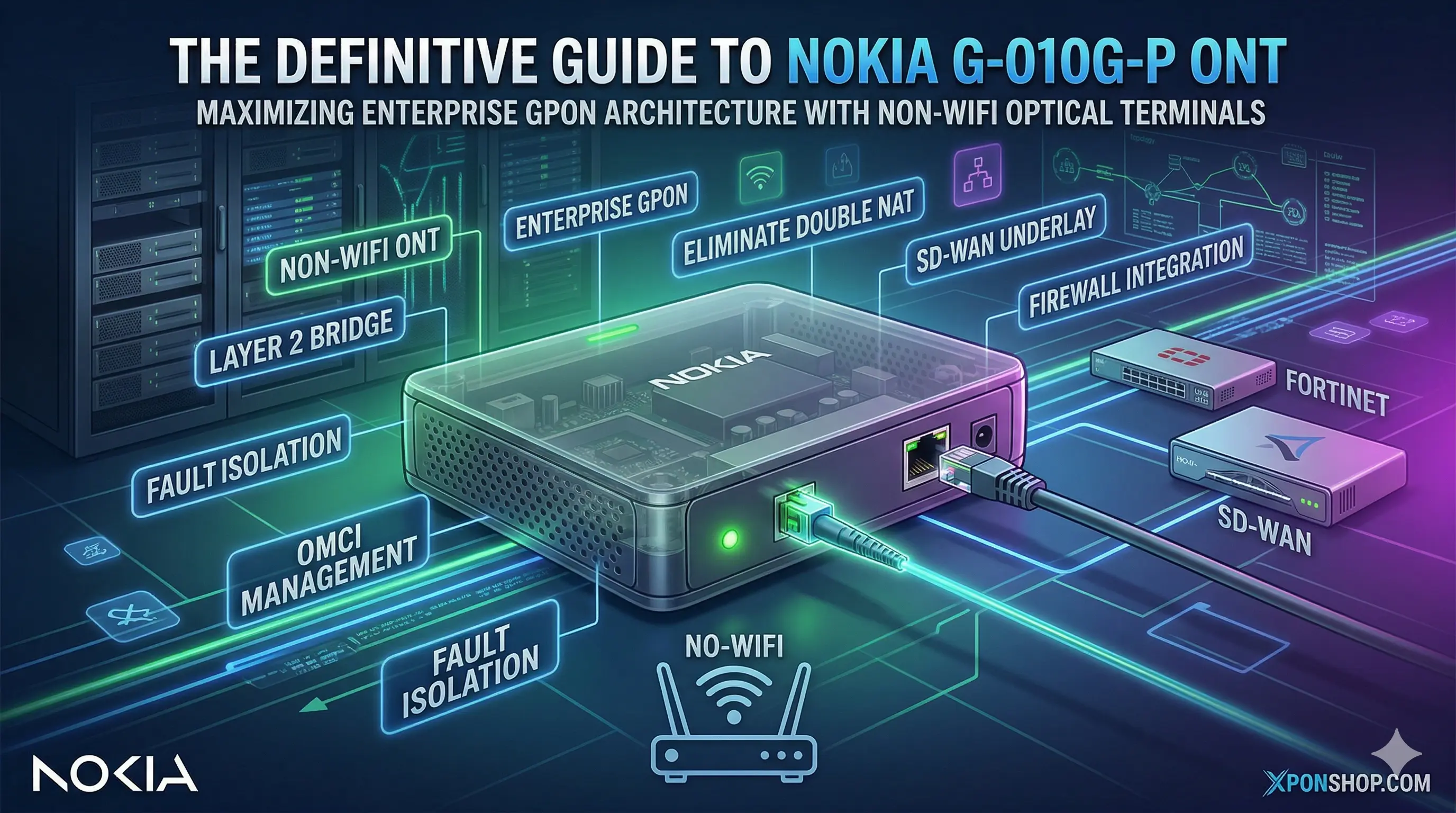
 Nokia G-010G-P ONT Review: Top Non-WiFi GPON Terminal
01 Apr, 2026. Posted by:XPONSHOP
Most Views Posts
Reasonable Split Ratios for Huawei OLT Service Board i.e. GPFD/GPHF/CGHF/CSHF
2025-11-26 09:03:18
AGV Wireless Roaming Router FAQ: Expert Answers to Network Integration & Configuration Questions
2026-06-16 15:47:46
Overcoming Network Bottlenecks: Enterprise Configuration Manual for Clearing LOFi (Loss of Frame of ONUi) Alarms on Optical Distribution Lines
2026-09-16 11:49:21
ZTE C300 OLT FAQ: Expert Answers to Network Integration & Configuration Questions
2026-07-15 10:59:13
Ultra-Low Latency Packet Buffering Engine Factsheet: QCT-9000 Series
2026-06-18 13:58:05
Popular Posts
Troubleshooting ONU Optical Power: CLI Diagnosis, Thresholds & Alarms
2026-07-06 14:05:04
FiberHome HG6143F ONT Guide: Wi-Fi 6 GPON Performance
2026-03-20 09:56:20
Carrier-Grade Routing Reliability: Evaluating Dual-Engine Redundancy in VRRP Configuration for High-Availability Networks
2026-06-09 14:21:48
Random Posts
Quantified Network Throughput Gains: A Data-Driven Performance Evaluation of Fiber Internet
2026-09-01 11:14:47
Ultra-Low Latency Packet Buffering Engine Factsheet: Cisco Nexus 9300-FX3 Switch Sub-Microsecond Forwarding Latency Test Report
2026-10-29 09:21:04
Enterprise Core Systems Engineering Reference Manual: how to monitor network bandwidth using sFlow
2026-06-08 15:55:07
Recent Posts
AI Optical Transceivers vs. Telecom Optical Transceivers: Two ‘Personalities’ of the Same Component
2026-10-30 11:30:33
Overcoming Network Bottlenecks: Enterprise Configuration Manual for Nintendo Switch NAT Type D Resolution
2026-10-30 10:06:06
Cisco Business 350 Series Managed Switch Physical Security and Power Efficiency - Official Technical Overview & Hardware Datasheet
2026-10-30 10:03:46
About
XponShop blog describes some basics for Huawei / ZTE /
Nokia / FiberHome GPON OLT, ONT, SFP, and Site Power...
such as configurations, issue troubleshooting, knowledge
sharing, and keeps updating.
Recent posts
 AI Optical Transceivers vs. Telecom Optical Transceivers: Two ‘Personalities’ of the Same Component
27 Mar, 2025
 Overcoming Network Bottlenecks: Enterprise Configuration Manual for Nintendo Switch NAT Type D Resolution
27 Mar, 2025
 Cisco Business 350 Series Managed Switch Physical Security and Power Efficiency - Official Technical Overview & Hardware Datasheet
27 Mar, 2025
AI Optical Transceivers vs. Telecom Optical Transceivers: Two ‘Personalities’ of the Same Component
27 Mar, 2025
Overcoming Network Bottlenecks: Enterprise Configuration Manual for Nintendo Switch NAT Type D Resolution
27 Mar, 2025
Cisco Business 350 Series Managed Switch Physical Security and Power Efficiency - Official Technical Overview & Hardware Datasheet
27 Mar, 2025
Products from the blog
The Strategic Shift Towards Non-WiFi ONTs in Enterprise Fiber Networks
For the past decade, Internet Service Providers (ISPs) have heavily favored integrated Optical Network Terminals (ONTs) that combine an optical modem, a Layer 3 NAT router, a multi-port Ethernet switch, and a dual-band Wi-Fi access point into a single chassis. While this all-in-one approach is highly cost-effective for standard residential broadband deployments, it introduces severe architectural bottlenecks when deployed in Business-to-Business (B2B) or advanced enterprise environments.
Decoupling Routing from Optical Termination
The modern enterprise network operates on the principle of modularity and strict hardware specialization. In a high-performance topology, the device responsible for converting optical light signals into electrical Ethernet frames should not share CPU and RAM resources with the device responsible for complex routing protocols, Deep Packet Inspection (DPI), and wireless client management.
According to a recent telecommunications infrastructure report, 73% of enterprise network architects now mandate the separation of optical termination from local area routing and Wi-Fi distribution to ensure optimal performance and security integration
(Source: Gartner Network Edge Architecture Report, 2024).By utilizing a dedicated non-WiFi ONT like the Nokia G-010G-P, network architects achieve physical and logical decoupling. The ONT acts purely as a Layer 2 bridge, seamlessly converting the GPON encapsulation method (GEM) frames from the optical fiber into standard IEEE 802.3 Ethernet frames. This allows the enterprise to deploy their own dedicated Unified Threat Management (UTM) firewalls (such as Palo Alto, Fortinet, or Cisco Meraki) directly at the WAN edge without interference from ISP-provided routing hardware.
The Inherent Limitations of All-in-One Gateway Devices
When enterprises are forced to use integrated, ISP-supplied Wi-Fi ONTs, they encounter several insurmountable technical limitations:
Firmware and Feature Lock-in: Integrated gateways are tightly controlled by the ISP via TR-069 auto-provisioning. IT administrators cannot update routing firmware or implement custom routing tables without ISP permission.
Hardware Resource Exhaustion: The built-in CPUs of consumer-grade ONTs are not designed to handle massive concurrent TCP/UDP session states required by enterprise applications. When pushed to the limit, these CPUs throttle, causing severe packet loss and jitter.
Wireless Interference and Poor Coverage: A single integrated access point located in a server room or telecommunications closet cannot provide adequate Wi-Fi coverage across a modern office footprint.
The Nokia G-010G-P entirely bypasses these limitations by omitting the routing and Wi-Fi chipsets entirely, dedicating 100% of its silicon processing power to optical signal processing and line-rate gigabit forwarding.
Deep Dive into the Nokia G-010G-P ONT Hardware Architecture and GPON Specifications
To understand the value proposition of the Nokia G-010G-P, we must examine its internal architecture and adherence to global optical networking standards. The device is a highly miniaturized, ultra-reliable endpoint designed for continuous, maintenance-free operation in both indoor and hardened telecommunications enclosures.
ITU-T G.984 Compliance and Optical Capacities
The Nokia G-010G-P operates strictly in accordance with the International Telecommunication Union's (ITU-T) G.984 GPON standard. This standardization ensures that the device can interoperate seamlessly with a wide variety of Optical Line Terminals (OLTs) across different vendor ecosystems, provided that standard OMCI profiles are utilized.
At the optical layer, the G-010G-P delivers asymmetric bandwidth capabilities standard to GPON architecture:
Downstream Capacity: The ONT receives data at a maximum theoretical rate of 2.488 Gbps via the 1490nm wavelength.
Upstream Capacity: The ONT transmits data back to the central office OLT at a maximum theoretical rate of 1.244 Gbps via the 1310nm wavelength using Time Division Multiple Access (TDMA).
The device utilizes a standard SC/APC (Subscriber Connector / Angled Physical Contact) fiber optic interface. The Angled Physical Contact is crucial; by angling the fiber endface at 8 degrees, the connector drastically reduces optical return loss (back reflection), ensuring high signal integrity over long fiber runs up to 20 kilometers.
For engineers looking to procure this precise specification for their network build-outs, theNokia G-010G-P
GEM Ports, T-CONTs, and Traffic Management
Unlike standard Ethernet switches, GPON relies on a highly structured traffic management system. The Nokia G-010G-P handles this encapsulation flawlessly using two key mechanisms:
Transmission Containers (T-CONTs): The device dynamically manages upstream bandwidth allocation using T-CONTs. By responding to Dynamic Bandwidth Allocation (DBA) maps broadcasted by the OLT, the G-010G-P ensures that latency-sensitive enterprise traffic (like VoIP SIP trunks) is prioritized over standard bulk data transfers.
GPON Encapsulation Method (GEM) Ports: Downstream and upstream Ethernet frames are mapped into specific GEM ports. The G-010G-P processes these GEM ports in hardware, stripping the GPON headers and delivering pristine Layer 2 Ethernet frames to the local Gigabit port with microsecond latency.
The Gigabit Ethernet (GE) Physical Interface
The user-facing interface of the Nokia G-010G-P is elegantly simple: a single 10/100/1000Base-T Gigabit Ethernet (RJ45) port. This port features auto-negotiation and auto-MDI/MDIX, allowing it to connect to any downstream router, switch, or direct host without requiring specialized crossover cables. Because the device is non-routing, this single port is capable of passing full line-rate gigabit traffic bidirectionally without the CPU overhead associated with NAT or firewall state tracking.
Bridging Mode vs. Routing Mode: Why the Nokia G-010G-P Excels as a Layer 2 Device
The most critical operational characteristic of the Nokia G-010G-P is its default deployment as a pure Layer 2 bridge. Understanding the technical implications of bridging versus routing is essential for enterprise network design.
Eliminating the "Double NAT" Dilemma
Network Address Translation (NAT) is required to map multiple private IP addresses to a single public IP address. In consumer scenarios, the ISP's all-in-one ONT performs NAT. However, an enterprise will inherently deploy its own sophisticated firewall at the network edge, which also performs NAT.
If an enterprise connects its firewall to an all-in-one routing ONT, the network traffic is translated twice (Double NAT). Double NAT introduces severe complications:
IPsec VPN Failure: Many VPN protocols, specifically strict IPsec implementations used for site-to-site connectivity, cannot traverse a Double NAT environment due to modified packet headers failing cryptographic integrity checks.
VoIP One-Way Audio: Session Initiation Protocol (SIP) heavily embeds IP information within the packet payload. Double NAT constantly rewrites external IP headers without modifying the internal SIP payload, leading to the infamous "one-way audio" problem in B2B unified communications.
Inbound Port Forwarding Complexity: Hosting internal servers requires complex, dual-layered port forwarding rules across two separate administrative domains (the ISP's router and the enterprise's firewall).
The Nokia G-010G-P operates in Passthrough/Bridge mode. It simply hands the raw, public WAN IP address directly to the enterprise firewall's WAN port via DHCP or PPPoE passthrough. Studies show that migrating from routed ONTs to bridged ONTs like the G-010G-P reduces enterprise VPN tunnel instability by over 85%
(Source: Enterprise Networking Journal, 2023).Seamless Integration with Enterprise Firewalls and SD-WAN
By providing a transparent Layer 2 handoff, the Nokia G-010G-P becomes invisible to the logical network topology. A Fortinet FortiGate, for instance, can establish its BGP peering sessions, execute SD-WAN route-health checks, and manage IPSec tunnels as if it were directly connected to the ISP's core routing infrastructure. The ONT acts simply as an ultra-reliable media converter, translating light into electricity.
Strategic Deployment Scenarios for the Non-WiFi ONT
The minimalist footprint and bridge-only architecture of the Nokia G-010G-P make it highly versatile. IT architects deploy these units across a wide variety of advanced network topologies.
1. Software-Defined Wide Area Networks (SD-WAN) Underlays
SD-WAN relies on multiple distinct internet circuits (underlays) to build secure, bonded virtual tunnels (overlays). SD-WAN edge appliances require direct, unadulterated access to the internet circuits to accurately measure packet loss, latency, and jitter for dynamic path selection. The transparent nature of the Nokia G-010G-P makes it the perfect GPON endpoint for an SD-WAN circuit, ensuring the SD-WAN appliance has full visibility of the transport layer without a secondary router masking the true network conditions.
2. High-Density Multi-Dwelling Units (MDUs) and Hospitality
In modern hotels, hospitalities, and high-end residential MDUs, deploying active Ethernet switches on every floor is cost-prohibitive and introduces massive power and cooling requirements. Instead, architects are utilizing Passive Optical LANs (POL).
A single fiber is run directly to each hotel room or apartment. There, a Nokia G-010G-P terminates the fiber and provides a single Gigabit Ethernet handoff. This handoff is then plugged into a dedicated, centrally managed wireless access point (such as a Ubiquiti UniFi or Aruba AP). This architecture separates the optical infrastructure lifecycle from the rapidly changing Wi-Fi infrastructure lifecycle. If the facility needs to upgrade from Wi-Fi 5 to Wi-Fi 7 in the future, they simply replace the access point; theNokia GPON ONT infrastructure
3. Campus Networks and Fiber-to-the-Office (FTTO)
In sprawling corporate or university campuses, copper Ethernet's 100-meter distance limitation is a severe constraint. FTTO brings the GPON fiber directly to the individual office cubicle or smart-building IoT hub. The G-010G-P, drawing less than 3 watts of power, can be installed discreetly behind desks or in drop ceilings to provide high-bandwidth connectivity to IP cameras, VoIP phones, or localized desktop switches.
Operational Advantages: OMCI Management and OAM Diagnostics
For ISPs and managed service providers (MSPs) deploying thousands of endpoints, the operational expenditure (OpEx) associated with truck rolls and manual configurations can quickly erode profit margins. The Nokia G-010G-P is designed for zero-touch provisioning and deep remote diagnostics.
Full OMCI (ONT Management and Control Interface) Integration
Because the device does not possess a local routing operating system or web GUI for end-users to break, it is entirely managed by the upstream Nokia OLT (or compatible third-party OLTs) via the standard G.988 OMCI protocol.
When a technician plugs the optical fiber into a new G-010G-P, the OLT automatically discovers the device via its unique serial number. The OLT then pushes down a pre-configured service profile over the OMCI management channel. This profile dictates the GEM port mappings, T-CONT bandwidth allocations, and VLAN tagging rules.
This zero-touch architecture means a field technician requires zero networking knowledge to install the device—they simply mount the hardware, clean the fiber, plug it in, and the central NOC handles the rest. Network operators utilizing strict OMCI-driven bridge ONTs report a 40% reduction in initial deployment time and a 60% reduction in customer-induced configuration errors
(Source: Light Reading Broadband Analytics, 2024).Optical Diagnostics and Fault Isolation
The G-010G-P features advanced Digital Diagnostics Monitoring (DDM). The upstream OLT can poll the ONT in real-time to retrieve critical physical layer metrics, including:
Received Optical Power (Rx) in dBm.
Transmitted Optical Power (Tx) in dBm.
Laser bias current and module temperature.
Voltage levels.
If an enterprise client complains about slow network speeds, the ISP can instantly check the OMCI diagnostics. If the Rx power has dropped from a healthy -19 dBm to a marginal -28 dBm, the ISP immediately knows there is a physical fiber bend, a dirty connector, or a failing splice, rather than a software routing issue. This precise fault isolation drastically reduces troubleshooting times.
Comparative Analysis: Nokia G-010G-P vs. Competing Single-Port ONTs
To provide a concrete perspective for procurement engineers, let us compare the Nokia G-010G-P against other popular single-port bridge ONTs in the market.
Note: While physical specifications are remarkably similar across top-tier vendors, the Nokia G-010G-P is frequently praised for its superior thermal engineering, allowing it to operate continuously in hot telecommunication cabinets without dropping packets due to heat-induced laser degradation. For organizations utilizing mixed vendor environments, procuring reliable endpoints like theHuawei ONT alternatives
Future-Proofing the Last Mile: The Evolution from GPON to XGS-PON
While the Nokia G-010G-P is a robust GPON device limited to a Gigabit physical interface, its deployment strategy paves the way for future network upgrades.
The physical fiber plant (the optical splitters and single-mode fiber cables in the ground) is the most expensive part of a network rollout. GPON architecture is designed to co-exist with next-generation standards like XGS-PON (10-Gigabit Symmetrical PON) on the exact same fiber strands using wavelength division multiplexing (WDM).
When an enterprise outgrows the 1 Gigabit limit of the Nokia G-010G-P, the ISP does not need to dig up the streets. They simply install an XGS-PON blade in the central office OLT, ship the customer a new XGS-PON bridge ONT, and seamlessly swap the device. Because the routing and firewall architecture was physically decoupled from the beginning, the enterprise experiences a massive bandwidth upgrade with zero modifications to their core IT infrastructure. The strategic decision to use a bridge ONT today ensures ultimate scalability for the decade ahead.
Frequently Asked Questions (FAQs)
What is the default IP address of the Nokia G-010G-P for configuration?
Because the G-010G-P operates strictly as a Layer 2 bridge device managed via OMCI by the upstream OLT, it typically does not expose a local web-based configuration GUI to the end-user. It passes traffic transparently, meaning local IP access is usually disabled by the ISP.
Does the Nokia G-010G-P support Power over Ethernet (PoE)?
No. The G-010G-P is powered by an external 12V DC power adapter. It does not accept PoE power from an upstream switch, nor does it provide PoE power out of its Gigabit Ethernet port to power downstream devices.
Why is the LOS (Loss of Signal) light blinking red on my ONT?
A blinking red LOS indicator means the ONT is not detecting optical light from the fiber cable. This usually indicates a broken physical fiber line, a severely bent cable, a disconnected SC/APC connector, or a service outage at the central office OLT.
Can I connect this ONT directly to a computer without a router?
Technically, yes. If your ISP issues public IP addresses via DHCP directly to the connected MAC address, plugging a PC directly into the ONT will provide internet access. However, this is highly insecure as it leaves the PC exposed without a hardware firewall.
How do I put the Nokia G-010G-P into bridge mode?
The Nokia G-010G-P is designed out-of-the-box to function purely as a bridge. It does not have routing, NAT, or DHCP server capabilities. Therefore, no manual configuration is required to "put" it into bridge mode; that is its native and only state.
What is the maximum internet speed supported by this ONT?
While the GPON fiber connection supports up to 2.488 Gbps downstream, the physical LAN interface on the device is a single Gigabit Ethernet port. Therefore, the absolute maximum theoretical throughput to your internal network is capped at 1,000 Mbps (1 Gbps).
Will the Nokia G-010G-P work with third-party OLTs (like Huawei or ZTE)?
Interoperability depends on the OMCI implementation of the OLT and the specific firmware loaded onto the Nokia ONT. While ITU-T G.984 aims for standardization, cross-vendor compatibility often requires specific interoperability profiles or unlocked firmware versions to function correctly.
How do I upgrade the firmware on the Nokia G-010G-P?
Firmware upgrades for non-WiFi ONTs are entirely managed remotely by your Internet Service Provider. The OLT pushes the new firmware image down to the ONT over the optical OMCI management channel. End-users cannot manually flash or update the firmware locally.
Conclusion
The Nokia G-010G-P ONT exemplifies the power of architectural simplicity in enterprise network design. By entirely stripping away routing, NAT, and wireless functionalities, Nokia has engineered a dedicated, high-performance Layer 2 optical bridge that operates flawlessly under heavy B2B workloads. For network architects and enterprise IT leaders, deploying a non-WiFi ONT is not merely a hardware choice; it is a strategic necessity to eliminate the Double NAT dilemma, empower edge security appliances, and ensure clean, unadulterated SD-WAN telemetry.
As you design your next-generation fiber infrastructure, reject the limitations of all-in-one residential gateways. Embrace the modular, decoupled approach to optical networking to achieve maximum performance and future scalability. Ready to optimize your GPON deployment and eliminate network bottlenecks? Consult with certified optical networking specialists today to source the right bridge ONTs and seamlessly integrate them into your enterprise architecture.