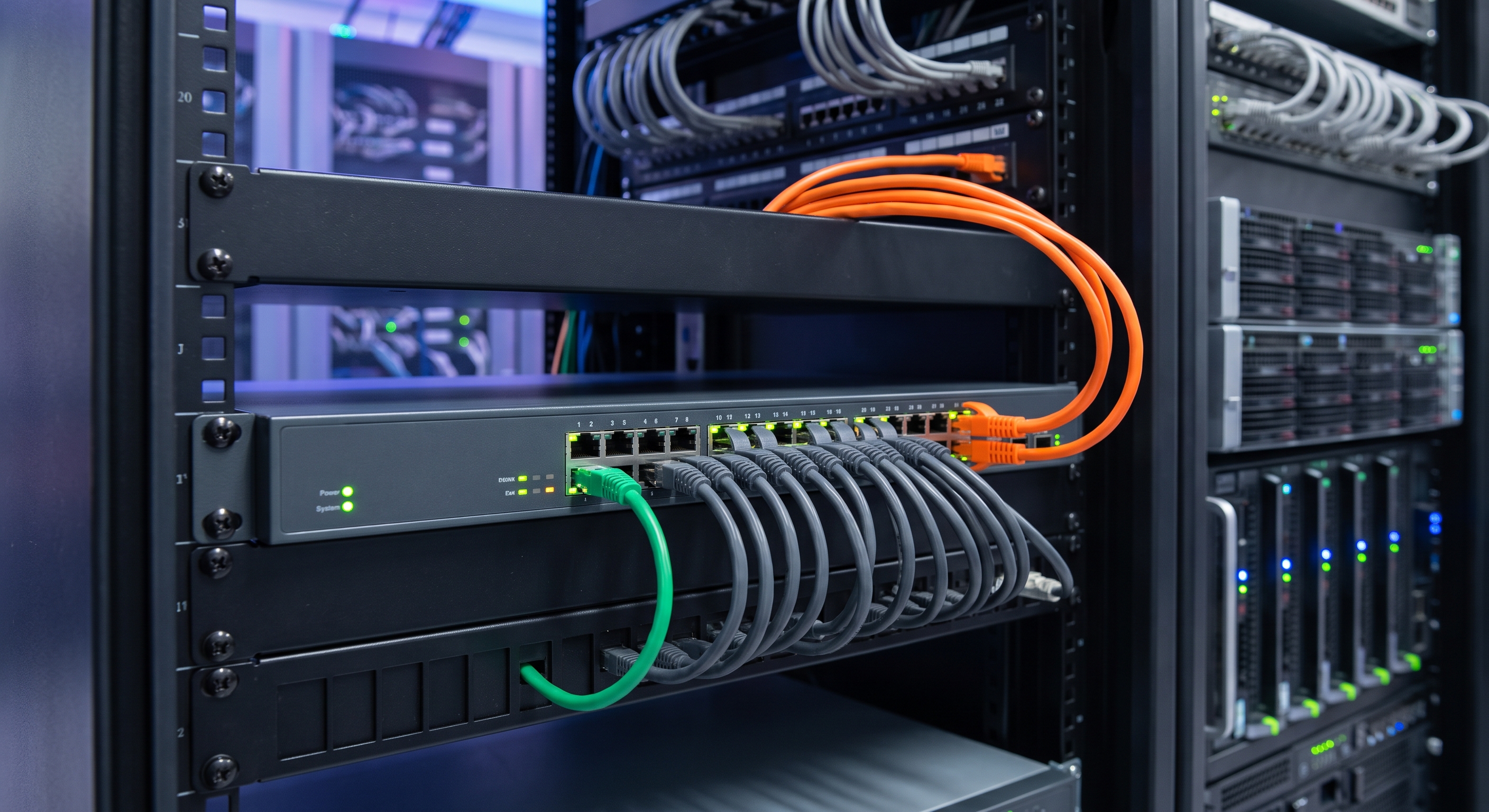
 OEM 24-Port Switch VLAN Trunking and Native VLAN Assignment Configuration - Official Technical Overview & Hardware Datasheet
01 Sep, 2026. Posted by:XPONSHOP
Most Views Posts
Cisco Nexus Switch vPC (Virtual Port Channel) High-Availability Blueprint - Official Technical Overview & Hardware Datasheet
2026-08-25 10:34:29
Line-Rate Packet Forwarding Architecture Reference Document: Cisco ASR 1002-HX Edge Router Line-Rate Encryption Engine Capabilities
2026-10-23 09:15:13
Ultra-Low Latency Packet Buffering Engine Factsheet: ZTE ZXR10 5960 Series All-Flash Switch Interface Latency Performance Sheet
2026-07-14 11:41:44
XPON TG8247C5 CATV ONT: The Definitive B2B Architecture and ISP Deployment Guide
2026-02-26 22:57:09
Popular Posts
Troubleshooting ONT 'Optical Power High' (Overload): Optical Interfaces, OLT Compatibility & L3 Protocols FAQ
2026-09-20 10:08:31
Are Dual-Band Wi-Fi ONUs Compatible with Standard Mesh Extenders from Other Brands? FAQ: Expert Answers to Network Integration & Configuration Questions
2026-09-24 09:23:18
Troubleshooting Nokia 7360 ISAM OLT: Optical Interfaces, Stacking Errors & L3 Protocols
2026-07-10 10:47:02
Random Posts
Can I Deploy a 1:128 Optical Split Ratio on a Standard Class B+ Optical Power Link? A Definitive Architecture Guide
2026-10-09 09:24:22
The Ultimate Guide to ruggedized ethernet switch cost: Architecture, Backplane Bandwidth, and Deployment
2026-05-22 15:48:25
Nokia G-010G-A Single-Port GPON ONT - Official Technical Overview & Hardware Datasheet
2026-07-02 13:05:50
Recent Posts
AI Optical Transceivers vs. Telecom Optical Transceivers: Two ‘Personalities’ of the Same Component
2026-10-30 11:30:33
Overcoming Network Bottlenecks: Enterprise Configuration Manual for Nintendo Switch NAT Type D Resolution
2026-10-30 10:06:06
Cisco Business 350 Series Managed Switch Physical Security and Power Efficiency - Official Technical Overview & Hardware Datasheet
2026-10-30 10:03:46
About
XponShop blog describes some basics for Huawei / ZTE /
Nokia / FiberHome GPON OLT, ONT, SFP, and Site Power...
such as configurations, issue troubleshooting, knowledge
sharing, and keeps updating.
Recent posts
 AI Optical Transceivers vs. Telecom Optical Transceivers: Two ‘Personalities’ of the Same Component
27 Mar, 2025
 Overcoming Network Bottlenecks: Enterprise Configuration Manual for Nintendo Switch NAT Type D Resolution
27 Mar, 2025
 Cisco Business 350 Series Managed Switch Physical Security and Power Efficiency - Official Technical Overview & Hardware Datasheet
27 Mar, 2025
AI Optical Transceivers vs. Telecom Optical Transceivers: Two ‘Personalities’ of the Same Component
27 Mar, 2025
Overcoming Network Bottlenecks: Enterprise Configuration Manual for Nintendo Switch NAT Type D Resolution
27 Mar, 2025
Cisco Business 350 Series Managed Switch Physical Security and Power Efficiency - Official Technical Overview & Hardware Datasheet
27 Mar, 2025
Products from the blog
EXECUTIVE SUMMARY
The OEM 24-Port Switch represents a paradigm shift in access-layer and aggregation-layer networking, delivering an optimal fusion of high-density port architecture and advanced Layer 2 switching intelligence. Engineered for enterprise campus networks, carrier-grade metropolitan area networks (MANs), and secure government infrastructure, this platform provides a robust, non-blocking architecture capable of line-rate forwarding for all packet sizes. The cornerstone of its feature set lies in the sophisticated IEEE 802.1Q VLAN implementation, supporting comprehensive trunking protocols and granular native VLAN assignment capabilities. This ensures seamless integration with existing multi-vendor environments while facilitating streamlined network segmentation, enhanced security postures, and optimized broadcast domain management.
The switch is purpose-built for critical network segments requiring deterministic performance, high availability, and simplified operational management. By integrating a cutting-edge switch fabric ASIC with deep packet buffering, the platform guarantees zero packet loss during micro-burst traffic conditions, a common occurrence in converged voice, video, and data networks. The hardware design emphasizes energy efficiency without compromising throughput, incorporating intelligent power scaling and variable-speed fan technology to reduce total cost of ownership (TCO) and operational expenses (OPEX). This document details the technical architecture, hardware specifications, and advanced configuration capabilities of the VLAN trunking and native VLAN assignment engine, serving as a definitive reference for network engineers, system integrators, and procurement specialists.
HARDWARE ARCHITECTURE & SILICON
The OEM 24-Port Switch is built upon a purpose-designed, high-performance network processor that implements a distributed forwarding architecture. Central to the system is a 128 Gbps non-blocking switch fabric, capable of full-duplex wire-speed switching on all 24 ports simultaneously. This architecture is complemented by a dedicated control plane processor (an ARM Cortex-A72 core running at 1.6 GHz) that manages operating system tasks, routing protocol state machines, and management interfaces without interfering with the data plane's forwarding capacity. The separation of control and data planes ensures deterministic latency and jitter performance, critical for real-time applications like VoIP and video conferencing.
The switching silicon integrates a sophisticated VLAN Lookup Engine (VLE) that supports up to 4,096 active VLANs simultaneously. For trunk port operation, the ASIC performs 802.1Q tag insertion, stripping, and prioritization entirely in hardware. An advanced feature of this silicon is its native VLAN assignment logic, which can be configured on a per-port basis. When a trunk port receives an untagged frame, the hardware-based classifier automatically applies the configured native VLAN ID and forwards the packet, bypassing the CPU for optimal performance. Conversely, the silicon inspects tagged frames for the native VLAN ID and strips the tag before forwarding it out the access port, ensuring end-devices operate seamlessly without 802.1Q awareness. This hardware-level offload ensures that native VLAN processing occurs at line rate, preventing any performance degradation commonly associated with software-based VLAN manipulation.
KEY FEATURES & ROUTING LOGIC
- VLAN Trunking (802.1Q): Provides comprehensive support for IEEE 802.1Q VLAN tagging, enabling the transport of multiple VLANs across a single physical link. The switch supports industry-standard Dynamic Trunking Protocol (DTP) for automatic negotiation of trunk links with compatible Cisco and third-party devices, as well as manual trunk configuration for deterministic control in locked-down network environments.
- Native VLAN Assignment: Advanced per-port native VLAN configuration allows administrators to designate an untagged VLAN for each trunk or access port. The hardware enforcement ensures that untagged ingress frames are classified into the specified native VLAN, while egress traffic from the native VLAN is transmitted untagged, facilitating interoperability with legacy devices and simplifying Layer 2 network designs.
- Port-Based and Protocol-Based VLAN Classification: Beyond standard port-based assignments, the switch supports VLAN classification based on Ethernet protocol type, enabling the creation of protocol-specific VLANs (e.g., IP, IPX, AppleTalk) and enhancing network segmentation granularity. Additionally, the platform supports Voice VLAN automatic detection and assignment for seamless IP phone deployment.
- Rapid Spanning Tree Protocol (RSTP) and Multiple Spanning Tree Protocol (MSTP): Enhanced Layer 2 resilience is achieved through the implementation of IEEE 802.1w RSTP and 802.1s MSTP. MSTP enables VLAN-aware load balancing across multiple links, allowing the creation of multiple spanning tree instances where specific VLANs are mapped to different instances for optimal path utilization and rapid convergence.
- Link Aggregation (LACP): This feature supports IEEE 802.3ad Link Aggregation Control Protocol, allowing up to 8 ports to be bundled into a single logical link. This capability increases aggregate bandwidth, provides link-level redundancy, and can be configured to carry VLAN trunking traffic to maximize backbone capacity.
- Advanced Traffic Policing and Shaping: The integrated QoS engine provides granular traffic policing capabilities, allowing network administrators to rate-limit traffic on a per-port or per-VLAN basis. Hardware-based traffic shaping ensures that mission-critical traffic, such as that on native management VLANs, receives appropriate bandwidth guarantees.
- Hardware-Based MAC Address Table: The switch includes a comprehensive MAC address table supporting up to 16,000 entries, enabling secure and efficient forwarding in dense edge deployments. The hardware aging mechanism prevents MAC table flooding and enhances security against MAC flooding attacks.
- Security Features: The platform integrates port security with MAC address locking, limiting the number of MAC addresses learned on a per-port basis. In addition, the hardware supports DHCP Snooping, Dynamic ARP Inspection (DAI), and IP Source Guard (IPSG) to mitigate Layer 2 attacks and ensure that only legitimate traffic passes through the network, particularly across VLAN trunk links.
COMPLIANCE & STANDARDS
The OEM 24-Port Switch is designed to meet the rigorous standards of carrier-grade and enterprise-grade networking equipment. It fully complies with all relevant IEEE, ITU-T, and ETSI specifications for Ethernet switching and environmental operation. The following is a summary of the key compliance accreditations:
- IEEE Compliance: IEEE 802.1Q (VLAN Tagging), IEEE 802.1p (Class of Service), IEEE 802.1D/802.1w/802.1s (STP/RSTP/MSTP), IEEE 802.3ad (Link Aggregation), IEEE 802.3ab (1000BASE-T), IEEE 802.3z (1000BASE-X), IEEE 802.3x (Flow Control), IEEE 802.1AB (LLDP).
- Industry Standards: SNMP v1/v2c/v3, RMON, SYSLOG, RADIUS and TACACS+ authentication protocols for secure management access.
- Environmental Certifications: RoHS (Restriction of Hazardous Substances) compliant, WEEE (Waste Electrical and Electronic Equipment) compliant. The platform is certified to operate within an ambient temperature range of 0°C to 50°C and a humidity range of 5% to 95% (non-condensing).
- Emissions & Safety: Certified to FCC Part 15 Class A, VCCI Class A, EN 55022 Class A, and CISPR 22 Class A. Safety certifications include UL 60950-1, CSA C22.2 No. 60950-1, EN 60950-1, and IEC 60950-1.
TECHNICAL SPECIFICATIONS
Form Factor: 1RU Standard Rack-Mountable
Total Ports: 24 x 10/100/1000BASE-T Copper Gigabit Ethernet RJ-45
Uplink Slots: 4 x SFP+ Combo Slots (Shared/ Dedicated, supporting 1G and 10G SFP/SFP+ modules)
Switching Capacity: 128 Gbps (Non-Blocking)
Forwarding Rate: 96 Mpps (Million Packets Per Second) for 64-byte packets
MAC Address Table Size: 16,000 entries
Maximum VLANs Supported: 4,096
Jumbo Frame Support: Up to 9,216 bytes
Packet Buffer Memory: 12 MB Shared
Power Supply: Dual Hot-Swappable Redundant Power Supplies (Option for AC or DC input)
Power Consumption: 45W (Maximum Typical) / 28W (Idle)
MTBF: Over 350,000 Hours at 25°C ambient
Operating Temperature: 0°C to 50°C
Storage Temperature: -20°C to 70°C
Operating Humidity: 5% to 95% non-condensing
Weight: 5.1 kg (with single PSU) / 6.2 kg (with dual PSU)
Management Interfaces: 1 x RJ45 Console Port, 1 x 10/100/1000 Management Ethernet Port, 1 x USB Type-C
📥 Download Technical Specification
Click the button below to view or download the full official PDF datasheet.
⬇️ Download Official PDF