 OLT vs ONT/ONU: Understanding the Two Pillars of Your Fiber Network
29 May, 2026. Posted by:XPONSHOP
Most Views Posts
Troubleshooting NAT Type 3 (Strict) on Gaming Consoles Connected to an ONT: Expert Answers to Port Forwarding, UPnP & DMZ Questions
2026-09-14 09:33:02
The Ultimate Guide to Using a Nokia ONT with a Huawei OLT: Architecture, Interoperability, and Deployment
2026-09-04 09:35:53
Ultra-Low Latency Packet Buffering Engine Factsheet: OEM 24-Port Gigabit Managed Switch Internal Memory Buffer Architecture Guide
2026-07-29 09:55:16
The Ultimate Guide to Big Brand Telecom Equipment: Architecture, Backplane Bandwidth, and Deployment
2026-07-31 10:19:49
PDF Document
2026-07-08 09:58:04
Popular Posts
Technical Support FAQ: Everything Network Architects Ask About OEM SFP Transceivers with Cisco IE Switches
2026-08-26 09:47:55
How to Configurate Telnet Login for Huawei Switch?
2025-10-22 09:06:36
Security Access FAQ: Configuring ACLs, Port Security & MAC Filtering on ONT Wi-Fi Network
2026-10-26 12:38:16
Random Posts
Deep Dive into the ZTE F668 ONT: Architecting Triple-Play GPON Networks with Integrated CATV
2026-04-30 09:57:18
Overcoming Network Bottlenecks: Enterprise Configuration Manual for Clearing LOFi (Loss of Frame of ONUi) Alarms on Optical Distribution Lines
2026-09-16 11:49:21
ZXA10 C600 High-Capacity Optical Access Platform - Official Technical Overview & Hardware Datasheet
2026-10-12 11:04:22
Recent Posts
AI Optical Transceivers vs. Telecom Optical Transceivers: Two ‘Personalities’ of the Same Component
2026-10-30 11:30:33
Overcoming Network Bottlenecks: Enterprise Configuration Manual for Nintendo Switch NAT Type D Resolution
2026-10-30 10:06:06
Cisco Business 350 Series Managed Switch Physical Security and Power Efficiency - Official Technical Overview & Hardware Datasheet
2026-10-30 10:03:46
About
XponShop blog describes some basics for Huawei / ZTE /
Nokia / FiberHome GPON OLT, ONT, SFP, and Site Power...
such as configurations, issue troubleshooting, knowledge
sharing, and keeps updating.
Recent posts
 AI Optical Transceivers vs. Telecom Optical Transceivers: Two ‘Personalities’ of the Same Component
27 Mar, 2025
 Overcoming Network Bottlenecks: Enterprise Configuration Manual for Nintendo Switch NAT Type D Resolution
27 Mar, 2025
 Cisco Business 350 Series Managed Switch Physical Security and Power Efficiency - Official Technical Overview & Hardware Datasheet
27 Mar, 2025
AI Optical Transceivers vs. Telecom Optical Transceivers: Two ‘Personalities’ of the Same Component
27 Mar, 2025
Overcoming Network Bottlenecks: Enterprise Configuration Manual for Nintendo Switch NAT Type D Resolution
27 Mar, 2025
Cisco Business 350 Series Managed Switch Physical Security and Power Efficiency - Official Technical Overview & Hardware Datasheet
27 Mar, 2025
Products from the blog
 ZXA10 C600 OLT 19inch Chassis
Bulk Inquiry
 ZXA10 C620 OLT 19inch Chassis
Bulk Inquiry
 ZXA10 C650 OLT 19inch Chassis
Bulk Inquiry
 Huawei HS8346X6-C ONT
Bulk Inquiry
ZXA10 C600 OLT 19inch Chassis
Bulk Inquiry
ZXA10 C620 OLT 19inch Chassis
Bulk Inquiry
ZXA10 C650 OLT 19inch Chassis
Bulk Inquiry
Huawei HS8346X6-C ONT
Bulk Inquiry

0.162786s

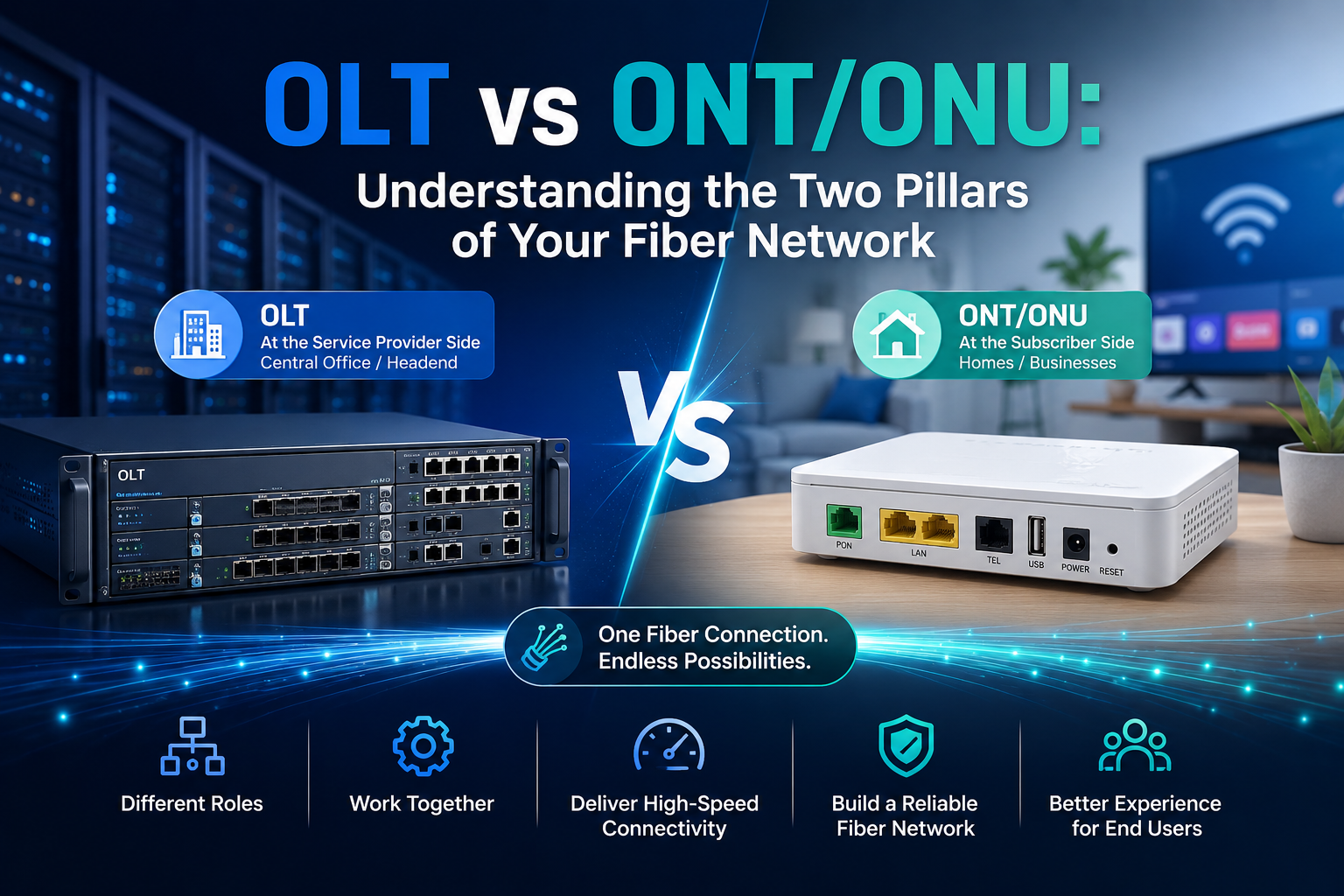
If you've ever built or managed a fiber broadband network, you've run into these three letters OLT, ONT, ONU, constantly. They appear in datasheets, quotes, and configuration guides. But what do they actually mean, and why does understanding the difference matter for your ISP or network project?
Let's break it down in plain language, and then show you how these two device types work together to deliver fiber internet to end users.
The Big Picture: How a PON Network Works
A PON (Passive Optical Network) is the backbone of most modern fiber-to-the-home (FTTH) deployments. The word "passive" is key — unlike traditional networks that use powered repeaters and switches at every node, a PON uses simple optical splitters to branch a single fiber into dozens of connections, with no electricity required in the field.
The entire system relies on just two active device types at either end of the fiber:
OLT — at the ISP's central office (the "head end")
ONT/ONU — at the subscriber's location (the "tail end")
Everything in between, the fiber cables, patch panels, and splitters, is passive infrastructure.
What Is an OLT?
OLT stands for Optical Line Terminal. Think of it as the brain of the PON network. It sits in your central office or data center and manages all the communication going out to subscribers.
The OLT:
Converts electrical signals from your core network into optical signals sent over fiber
Manages hundreds or even thousands of subscriber connections from a single chassis
Controls upstream/downstream bandwidth allocation using a mechanism called DBA (Dynamic Bandwidth Allocation)
Handles authentication, provisioning, and monitoring of every ONT/ONU on the network
Connects upward to your core IP network via high-speed uplink ports (10GE, 100GE)
In short, the OLT is where your ISP infrastructure meets the fiber plant.
Example: The ZTE ZXA10 C600 series OLT (including the C620, C650, and C600), is a popular choice for ISPs of all sizes. The compact C620 is ideal for small-to-medium deployments, while the larger C600 supports up to 17 service card slots and can handle GPON, XG-PON, XGS-PON, Combo PON, and more. Huawei's MA5800 series OLT is another enterprise-grade option for high-density networks requiring carrier-class reliability.
What Is an ONT? What Is an ONU?
ONT stands for Optical Network Terminal, and ONU stands for Optical Network Unit. In everyday use, these two terms are often used interchangeably — and for good reason. Both refer to the device installed at or near the subscriber's location that terminates the fiber connection.
Technically, there's a subtle distinction in standards:
An ONT typically refers to a device installed at a single home or business (FTTH), combining the fiber termination and CPE functions in one unit.
An ONU is sometimes used for devices that serve a building or MDU (Multi-Dwelling Unit), where the fiber terminates at a common point and last-mile distribution is done via copper or Ethernet.
In practice, most vendors and engineers use ONT and ONU interchangeably, especially for residential FTTH deployments.
The ONT/ONU:
Receives the optical signal from the OLT (via splitters) and converts it to electrical signals for the subscriber's devices
Provides LAN ports (GE), phone ports (VoIP/POTS), and often built-in Wi-Fi
Is managed and provisioned by the OLT using OMCI (ONT Management and Control Interface) or TR-069
Is the device your subscribers physically interact with — or the one your techs install on-site
Example: For residential subscribers, the Huawei HS8346X6-C (WiFi 6, GPON) and HG8245H (2.4G WiFi) are reliable. For subscribers needing future-proof 10G speeds, XponShop also carries a range of XG-PON ONTs that work with 10G-capable OLTs.
How They Work Together: A Simple Flow
Here's what happens when a subscriber streams a video:
The video data travels from the internet into your core network, then arrives at the OLT.
The OLT converts the data into optical signals and sends them down the fiber at 1490nm (downstream wavelength for GPON).
Passive optical splitters in the field (typically 1:32 or 1:64) distribute the signal to multiple subscribers simultaneously.
Each subscriber's ONT receives the signal, identifies the data meant for it (using a unique identifier called PLOAM/OMCI), and converts it back to electrical signals.
The subscriber's device — a TV, laptop, phone — gets the data via the ONT's LAN or Wi-Fi interface.
The same process happens in reverse for upstream traffic (from subscriber to internet), with the OLT carefully scheduling each ONT's transmission window to avoid signal collisions — this is called TDMA (Time Division Multiple Access).
Why This Matters for Your ISP
Understanding OLT and ONT/ONU roles isn't just academic — it has real purchasing and operational implications:
Capacity planning: Your OLT determines how many subscribers you can serve per chassis and per port. Choose the right OLT size from day one to avoid costly upgrades later.
Compatibility: Not every ONT works with every OLT out of the box. Third-party ONTs need to be provisioned correctly.
Technology migration: As you plan to upgrade from GPON to XGS-PON (10G), your OLT choice matters. Combo PON boards in OLTs like the ZTE C600 series allow you to serve both GPON and XGS-PON ONTs on the same fiber plant, protecting your investment.
Subscriber experience: The ONT is the last mile device your subscribers see and use. Choosing ONTs with good Wi-Fi coverage, stable firmware, and VoIP support directly impacts customer satisfaction.
OLT and ONT/ONU are complementary — neither works without the other. The OLT is your investment in network capacity and control; the ONT is your investment in subscriber experience. Getting both right, and ensuring they're compatible, is the foundation of a reliable fiber network.
At XponShop, we carry a full range of OLTs, ONTs, and ONUs from Huawei, ZTE, Nokia, FiberHome, and quality OEM alternatives, all globally shipped with competitive pricing. Whether you're building your first fiber network or scaling an existing one, our team can help you find the right combination.
Have questions about OLT and ONT for your deployment? Contact the XponShop team at sales@xponshop.com, we're happy to help you spec the right solution.