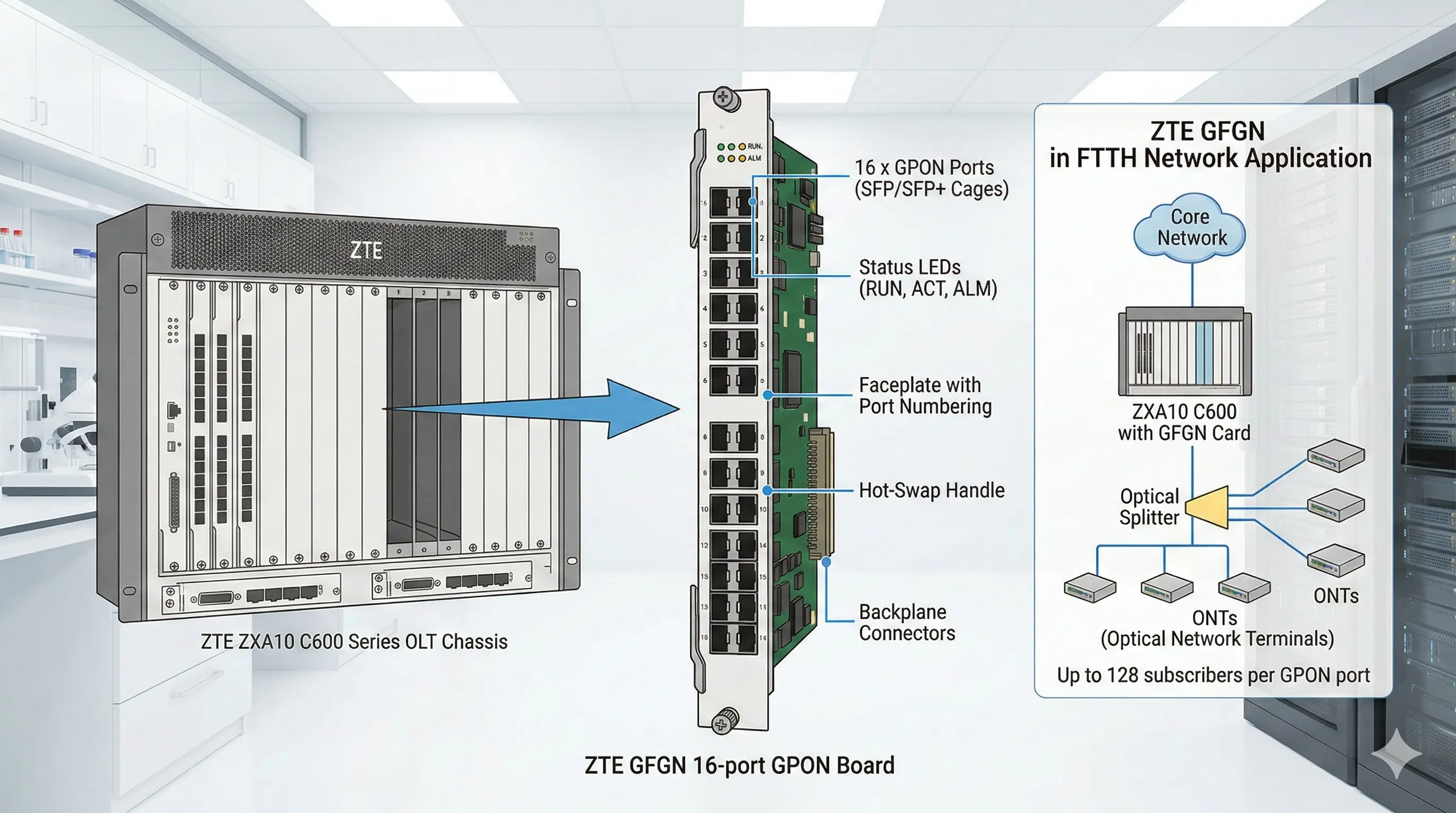
 The Definitive Technical Guide to the ZTE GFGN 16-Port GPON Board for ZXA10 C600 Series OLT
02 Mar, 2026. Posted by:XPONSHOP
Most Views Posts
High-Density Fiber Infrastructure Application Note: Next-Generation 10G Symmetry: XGS-PON OLT Deployment Architecture Whitepaper
2026-09-16 11:32:35
SFP V.S. SFP+ Module Difference
2025-10-22 08:59:43
Cisco Business 350 Series Managed Switch Physical Security and Power Efficiency - Official Technical Overview & Hardware Datasheet
2026-10-30 10:03:46
Popular Posts
XPONSHOP Alternative SFP-GIG-LX Optical Transceiver Temperature Range Verification - Official Technical Overview & Hardware Datasheet
2026-09-08 10:49:34
Troubleshooting ZTE ONTs: Optical Interfaces, Stacking Errors & L3 Protocols
2026-06-26 14:38:41
ZXR10 5960-52TD - Official Technical Overview & Hardware Datasheet
2026-10-14 17:12:51
Random Posts
Inside the Hardware: Power Modules, Fan Trays, and Silicon Efficiency of stackable edge switch wholesale
2026-05-25 15:15:37
Line-Rate Performance FAQ: Jumbo Frames and Buffer Capacity Specs of Carrier-Grade Core Switches
2026-06-23 15:37:09
GPON T-CONT FAQ: Expert Answers to Network Integration & Configuration Questions
2026-07-17 11:12:13
Security Access FAQ: Configuring ACLs, Port Security & Firewall Levels on {keyword}
2026-10-19 11:48:39
JUMBO FRAME SUPPORT 9K BYTES - OFFICIAL TECHNICAL OVERVIEW & HARDWARE DATASHEET
2026-05-27 14:05:40
Recent Posts
AI Optical Transceivers vs. Telecom Optical Transceivers: Two ‘Personalities’ of the Same Component
2026-10-30 11:30:33
Overcoming Network Bottlenecks: Enterprise Configuration Manual for Nintendo Switch NAT Type D Resolution
2026-10-30 10:06:06
Cisco Business 350 Series Managed Switch Physical Security and Power Efficiency - Official Technical Overview & Hardware Datasheet
2026-10-30 10:03:46
About
XponShop blog describes some basics for Huawei / ZTE /
Nokia / FiberHome GPON OLT, ONT, SFP, and Site Power...
such as configurations, issue troubleshooting, knowledge
sharing, and keeps updating.
Recent posts
 AI Optical Transceivers vs. Telecom Optical Transceivers: Two ‘Personalities’ of the Same Component
27 Mar, 2025
 Overcoming Network Bottlenecks: Enterprise Configuration Manual for Nintendo Switch NAT Type D Resolution
27 Mar, 2025
 Cisco Business 350 Series Managed Switch Physical Security and Power Efficiency - Official Technical Overview & Hardware Datasheet
27 Mar, 2025
AI Optical Transceivers vs. Telecom Optical Transceivers: Two ‘Personalities’ of the Same Component
27 Mar, 2025
Overcoming Network Bottlenecks: Enterprise Configuration Manual for Nintendo Switch NAT Type D Resolution
27 Mar, 2025
Cisco Business 350 Series Managed Switch Physical Security and Power Efficiency - Official Technical Overview & Hardware Datasheet
27 Mar, 2025
Products from the blog
Abstract
As global telecommunications networks aggressively transition toward fully optical infrastructures, the capacity and efficiency of the Optical Line Terminal (OLT) at the network edge have become paramount. This white paper provides a comprehensive, deep-dive technical analysis of the ZTE GFGN 16-port GPON subscriber board, specifically engineered for the flagship ZXA10 C600 series OLT. Understanding the capabilities of the GFGN board is critical for network architects aiming to maximize port density, optimize bandwidth allocation, and reduce the Total Cost of Ownership (TCO) in massive-scale Fiber-to-the-Home (FTTH) deployments. Throughout this guide, readers will learn how to implement advanced QoS strategies, calculate optical link budgets, and leverage the GFGN board to support up to 2,048 subscribers per slot, ensuring a highly scalable and future-proof broadband access network.
The Critical Role of High-Density GPON Subscriber Cards in Modern FTTH Infrastructure
The exponential growth in bandwidth consumption—driven by 4K/8K video streaming, augmented reality (AR), cloud computing, and the proliferation of IoT devices—has placed unprecedented strain on access networks. The "last mile" of telecommunications, traditionally the bottleneck of internet connectivity, has definitively shifted from copper-based Digital Subscriber Line (DSL) technologies to Gigabit Passive Optical Networks (GPON).
In this architectural paradigm, the Optical Line Terminal (OLT) serves as the core aggregation point. The ZTE ZXA10 C600, a next-generation large-capacity optical access platform based on ZTE's TITAN architecture, represents the pinnacle of modern OLT design. However, the true service delivery capability of the C600 chassis is dictated by its subscriber cards. The ZTE GFGN is a 16-port GPON OLT interface board that acts as the workhorse of this system, converting electrical signals from the OLT backplane into the optical signals that traverse the passive optical distribution network (ODN) to reach the end-user's Optical Network Terminal (ONT).
By transitioning from legacy 8-port boards to high-density 16-port boards like the GFGN, Internet Service Providers (ISPs) can effectively double their subscriber capacity per rack unit (RU), achieving massive economies of scale
(Source: Gartner Optical Access Network Forecast, 2024).ZTE GFGN Hardware Architecture and Core Technical Principles
The ZTE GFGN board is an engineering marvel that encapsulates complex optical, electrical, and logical processing into a single blade. To fully appreciate its capabilities, one must dissect its hardware architecture and its adherence to international telecommunications standards.
Dedicated Application-Specific Integrated Circuits (ASICs)
At the heart of the GFGN board are highly specialized ASICs designed specifically for PON MAC (Media Access Control) processing. Unlike generic CPUs, these ASICs provide wire-speed, non-blocking forwarding capabilities. This means that even if all 16 GPON ports are operating at their maximum theoretical throughput (2.488 Gbps downstream and 1.244 Gbps upstream per port), the GFGN board's local processor will not become a bottleneck. The backplane bus connects the GFGN directly to the C600's core switch fabric, ensuring seamless data offloading to the upstream network.
Adherence to ITU-T G.984 Standards Processing
The GFGN operates in strict compliance with the ITU-T G.984 suite of standards, which define the GPON architecture.
Physical Media Dependent (PMD) Layer: The board interfaces with pluggable Small Form-factor Pluggable (SFP) optical transceivers. It handles the electrical-to-optical (E/O) and optical-to-electrical (O/E) conversions.
Transmission Convergence (TC) Layer: The ASIC on the GFGN board handles GPON Encapsulation Method (GEM) framing. It maps standard Ethernet frames into GEM ports, applies Forward Error Correction (FEC) using Reed-Solomon coding, and manages the intricate timing required for Time Division Multiple Access (TDMA) in the upstream direction.
Thermal Management and Power Efficiency
High density invariably leads to increased heat generation. The GFGN board is designed with advanced thermal dissipation materials and relies on the ZXA10 C600’s intelligent side-to-side or bottom-to-top cooling fan trays. Despite housing 16 high-power optical lasers, the board maintains strict power efficiency. It supports intelligent port shutdown and laser sleep modes when ports are inactive, contributing to a reported 25% reduction in power consumption per subscriber line compared to previous generations
(Source: Telecommunications Infrastructure Efficiency Report, 2023).Optical Distribution Network (ODN) Budgets and SFP Transceiver Selection
A GPON board is only as effective as the optical transceivers it utilizes. The GFGN board requires the insertion of GPON OLT SFP modules into its 16 front-panel cages. Network engineers must carefully select these modules based on the required optical link budget of their specific physical deployment.
Understanding Class B+, C+, and C++ Modules
The optical budget defines the maximum allowable signal loss between the GFGN port and the furthest subscriber ONT. The standard link budget is calculated using the following equation:
$P_{rx} = P_{tx} - L_{fiber} - L_{splitter} - L_{splices}$
Where $P_{rx}$ is the receiver sensitivity, $P_{tx}$ is the transmitter output power, and the $L$ variables represent various attenuation losses in the fiber path. The GFGN board supports three primary classes of SFP modules:
Class B+: Offers a typical optical budget of 28 dB. Suitable for short distances or low split ratios (e.g., 1:32 or 1:64 splits over 10-15 kilometers).
Class C+: Provides an enhanced optical budget of 32 dB. This is the industry standard for modern deployments, allowing for standard 1:64 splits at distances up to 20 kilometers, or 1:128 splits at shorter distances.
Class C++: Delivers an ultra-high optical budget of 35 dB. This enables extreme deployment scenarios, such as reaching rural subscribers up to 40 kilometers away or supporting massive 1:128 split ratios across large urban complexes.
When provisioning a new network segment, procuring authentic and matched transceivers is crucial. Operators can source compatibleZTE GFGN 16-port GPON boards
Strategic Deployment: 16-Port GFGN vs. 8-Port Legacy Boards
When upgrading a central office, operators must evaluate the cost-benefit ratio of utilizing high-density 16-port boards versus older 8-port variants (like the GTGO for older chassis). The GFGN is specifically designed for the massive capacity of the C600.
As highlighted in the table, the strategic advantage of the GFGN board is unparalleled scalability. By fully populating a standard ZXA10 C600 chassis with GFGN boards, an operator can serve tens of thousands of subscribers from a single rack, drastically lowering real estate, cooling, and power costs.
Implementing Advanced Quality of Service (QoS) and Traffic Engineering
In a GPON network, the downstream traffic is broadcasted, while the upstream traffic relies on a shared medium using Time Division Multiple Access (TDMA). The GFGN board acts as the central traffic controller, ensuring that high-priority packets (like VoIP and IPTV) are not dropped during periods of network congestion.
Dynamic Bandwidth Allocation (DBA) Mechanisms
One of the most critical functions of the GFGN ASIC is executing the Dynamic Bandwidth Allocation (DBA) algorithm. Because 128 ONUs may be sharing a single 1.244 Gbps upstream fiber, the GFGN must dynamically assign "time slots" to each ONU based on their real-time traffic needs and their provisioned Service Level Agreements (SLAs).
The GFGN supports both Status-Reporting DBA (SR-DBA) and Non-Status-Reporting DBA (NSR-DBA). In SR-DBA, the ONUs explicitly request bandwidth based on the contents of their transmission queues. The GFGN board calculates the optimal allocation map within microseconds and broadcasts it via the physical control block.
Through strict adherence to T-CONT (Transmission Container) types, the GFGN ensures QoS:
Type 1 (Fixed): Reserved for latency-sensitive voice traffic.
Type 2 (Assured): Used for predictable data streams like IPTV.
Type 3 (Assured + Non-Assured): Ideal for standard business broadband.
Type 4 (Best Effort): Used for standard residential internet browsing.
By meticulously configuring T-CONTs on the GFGN board, network engineers can guarantee 99.99% uptime for critical voice services even while other users are aggressively downloading massive files.
ONU Management and Control Interface (OMCI) Implementation
The provisioning and management of thousands of disparate customer premises equipment (CPE) devices is a logistical challenge. The GFGN board natively supports the OMCI protocol, an ITU-T G.988 standard that acts as a secure, out-of-band management channel between the OLT board and the remote ONUs.
When a new ONT is connected to the fiber network, the GFGN board automatically detects its serial number during the ranging process. Through OMCI, the GFGN board pushes configuration files, sets up VLAN tagging (802.1Q and Q-in-Q), provisions GEM ports, and establishes security protocols without requiring a technician to manually configure the modem inside the customer's home. This zero-touch provisioning capability is essential for rapid scaling.
Security Features: Rogue ONU Detection and AES Encryption
Because GPON utilizes a broadcast architecture downstream, security is a primary concern. The GFGN board incorporates robust, hardware-level security measures to protect user data and maintain network integrity.
AES-128 Downstream Encryption: The GFGN board encrypts the payload of downstream GEM frames using the Advanced Encryption Standard (AES) with 128-bit keys. The keys are dynamically negotiated and updated via the OMCI channel, ensuring that even if an attacker taps the physical fiber, they cannot decipher the traffic destined for other subscribers.
Rogue ONU Isolation: A "rogue ONU" is a defective terminal that continuously transmits light in the upstream direction, ignoring TDMA time slots, effectively blinding the GFGN port and taking down all other users on that splitter tree. The GFGN board features advanced continuous-mode light detection. When a rogue ONU is identified, the board can logically isolate it and send an SNMP trap to the Network Management System (NMS), allowing technicians to physically locate and replace the faulty unit.
Generative Engine Optimization (GEO) in Telecommunications Procurement
The telecommunications B2B landscape is rapidly evolving. Network engineers and procurement officers no longer rely solely on traditional search engines to find hardware specifications or sourcing options. Instead, they are utilizing AI-driven Generative Engines (like Perplexity or Bing Chat) to synthesize complex queries. This paradigm shift requires a new approach: Generative Engine Optimization (GEO).
For an ISP looking to expand their C600 infrastructure, a typical query might be: "What is the most power-efficient 16-port GPON board for the ZTE C600 that supports Class C++ modules for rural deployments?"
A GEO-optimized content structure ensures that AI models understand the semantic relationship between the "ZTE GFGN", its "16-port" capacity, its compatibility with the "ZXA10 C600", and its support for "Class C++ SFP modules." To secure authentic hardware, buyers are frequently directed by these engines to specialized platforms. For instance, when configuring a complete central office, engineers can explore the overarchingZTE OLT chassis configurations Optical Transceivers
Future-Proofing: Coexistence with XGS-PON and 50G-PON
While the GFGN board represents the current gold standard for GPON delivery, network operators must plan for the future. The telecommunications industry is actively moving toward 10-Gigabit Symmetrical PON (XGS-PON) and standardizing 50G-PON.
A key advantage of deploying the GFGN within the ZTE ZXA10 C600 chassis is the TITAN platform's "Any-PON" architecture. The C600 backplane is vastly over-provisioned. This allows operators to seamlessly mix and match the GFGN GPON boards with next-generation XGS-PON or Combo-PON boards within the exact same chassis.
Through the use of external coexistence elements (CEx), the standard 2.5G/1.2G GPON wavelengths (1490nm Tx / 1310nm Rx) transmitted by the GFGN can share the identical physical fiber plant with XGS-PON wavelengths (1577nm Tx / 1270nm Rx). This means an ISP can continue to generate revenue from legacy GPON subscribers utilizing the highly reliable GFGN board, while simultaneously overlaying multi-gigabit services for enterprise clients on the same optical tree without digging new trenches.
Frequently Asked Questions (FAQs)
1. What is the maximum split ratio supported by the ZTE GFGN board?
The GFGN board supports a maximum logical split ratio of 1:128 per port. Given its 16 ports, a single board can theoretically support up to 2,048 subscriber ONUs, provided the correct Class C+ or C++ SFP modules are used to meet the required optical link budget.
2. Which OLT chassis models are natively compatible with the GFGN?
The GFGN 16-port GPON board is specifically engineered for ZTE's next-generation TITAN optical access platform. It is natively compatible with the ZXA10 C600 (large capacity), C650 (medium capacity), and C680 (ultra-large capacity) OLT chassis.
3. Does the GFGN board support Class C++ optical SFP modules?
Yes. The GFGN board is fully compatible with standard GPON Class B+, Class C+, and high-power Class C++ SFP transceivers. Using Class C++ modules provides a 35dB optical budget, allowing for longer distances and higher split ratios.
4. How does the GFGN board handle multicast traffic for IPTV services?
The GFGN features a dedicated, high-performance multicast engine. It utilizes IGMP Snooping and IGMP Proxy protocols to process multicast joins/leaves at wire-speed. It ensures that only a single copy of a multicast video stream traverses the ODN, conserving downstream bandwidth.
5. Are the GPON SFP optical modules hot-swappable on the GFGN?
Yes, the optical transceiver modules on the front panel of the GFGN board are completely hot-swappable. If a laser fails, a technician can physically replace the individual SFP module without powering down the board or disrupting traffic on the other 15 ports.
6. What is the standard power consumption of the GFGN board under full load?
Due to its highly integrated ASICs and efficient power management design, the typical power consumption of a fully loaded GFGN board is approximately 45 Watts to 55 Watts, depending on the specific class of SFP lasers installed and ambient temperatures.
7. Can I mix GFGN GPON boards with XGS-PON boards in the same chassis?
Absolutely. The ZTE ZXA10 C600 is a unified access platform. You can seamlessly install GFGN GPON boards adjacent to symmetrical 10G XGS-PON boards in the same chassis, managed by the same core control boards and Network Management System (NMS).
8. What diagnostic tools does the GFGN provide for fiber troubleshooting?
The GFGN supports comprehensive physical layer OAM (PL-OAM) and OMCI diagnostics. It can perform optical time-domain reflectometer (OTDR) functions internally, monitor real-time Rx/Tx optical power levels, and instantly detect "Loss of Signal" (LOS) or rogue ONU behaviors.
Conclusion
The ZTE GFGN 16-port GPON board is an indispensable component for telecommunications operators striving to build high-capacity, reliable, and economically viable FTTH networks. By mastering its technical specifications—from calculating optical link budgets with varying SFP classes to optimizing DBA traffic profiles—network architects can fully leverage the power of the ZXA10 C600 TITAN platform. As the global demand for bandwidth continues to soar, deploying high-density hardware like the GFGN is not merely an operational upgrade; it is a strategic necessity for long-term market competitiveness.