 The Ultimate Guide to mining underground rugged network deployment: Architecture, Backplane Bandwidth, and Deployment
12 Jun, 2026. Posted by:XPONSHOP
Most Views Posts
VXLAN Gateway Deployment on Hardware Core Switches for Multi-Tenant Clouds - Official Technical Overview & Hardware Datasheet
2026-09-30 10:46:46
High-Density Fiber Infrastructure Application Note: XPONSHOP Cost-Effective Alternative Fiber Cross-Connect Cabinet Splicing Guide
2026-07-30 10:44:44
Overcoming Network Bottlenecks: Enterprise Configuration Manual for Detecting High Insertion Loss Caused by Unaligned Mechanical Fiber Splices
2026-10-19 11:42:46
Carrier-Grade Routing Reliability: Evaluating Dual-Engine Redundancy in ONT Sharing a Distribution Fiber with RF Video Overlays
2026-10-14 19:08:40
ZXA10 C320 OLT 19inch Chassis: Specs, Architecture & Guide
2026-02-28 09:56:33
Popular Posts
Overcoming Network Bottlenecks: Enterprise Configuration Manual for Disabling TR-069 Auto-Update Features to Prevent Firmware Changes Mid-Workday
2026-09-29 09:34:22
FiberHome ONT TR-069 Management FAQ: Expert Answers to Network Integration & Configuration Questions
2026-08-05 09:07:57
XGS-PON OLT Board FAQ: Expert Answers to Network Integration & Configuration Questions
2026-07-22 10:42:14
Random Posts
Layer 3 Interface IP Routing Configuration Deep Dive: Internal ASIC Forwarding, Packet Pipelines, and Latency Limits
2026-06-02 16:30:55
Overcoming Network Bottlenecks: Enterprise Configuration Manual for Nintendo Switch NAT Type D Resolution
2026-10-30 10:06:06
Unlocking Next-Generation FTTH: The Complete Technical Guide to the Fiberhome AN6000-17 OLT Chassis
2026-04-02 09:30:49
Recent Posts
AI Optical Transceivers vs. Telecom Optical Transceivers: Two ‘Personalities’ of the Same Component
2026-10-30 11:30:33
Overcoming Network Bottlenecks: Enterprise Configuration Manual for Nintendo Switch NAT Type D Resolution
2026-10-30 10:06:06
Cisco Business 350 Series Managed Switch Physical Security and Power Efficiency - Official Technical Overview & Hardware Datasheet
2026-10-30 10:03:46
About
XponShop blog describes some basics for Huawei / ZTE /
Nokia / FiberHome GPON OLT, ONT, SFP, and Site Power...
such as configurations, issue troubleshooting, knowledge
sharing, and keeps updating.
Recent posts
 AI Optical Transceivers vs. Telecom Optical Transceivers: Two ‘Personalities’ of the Same Component
27 Mar, 2025
 Overcoming Network Bottlenecks: Enterprise Configuration Manual for Nintendo Switch NAT Type D Resolution
27 Mar, 2025
 Cisco Business 350 Series Managed Switch Physical Security and Power Efficiency - Official Technical Overview & Hardware Datasheet
27 Mar, 2025
AI Optical Transceivers vs. Telecom Optical Transceivers: Two ‘Personalities’ of the Same Component
27 Mar, 2025
Overcoming Network Bottlenecks: Enterprise Configuration Manual for Nintendo Switch NAT Type D Resolution
27 Mar, 2025
Cisco Business 350 Series Managed Switch Physical Security and Power Efficiency - Official Technical Overview & Hardware Datasheet
27 Mar, 2025
Products from the blog
Introduction
Mining operations, whether for precious metals or critical minerals, face an unforgiving environment that is fundamentally hostile to standard enterprise networking equipment. High concentrations of conductive dust, extreme humidity, vibration, temperature fluctuations, and physical shock are the norm. In this comprehensive guide, we analyze the specialized architecture of mining underground rugged network deployment, focusing on the hardware engineering, backplane design, and switching logic required to maintain deterministic latency and zero packet loss in sub-level shafts and stopes. A standard commercial Ethernet switch has an MTBF (Mean Time Between Failures) of roughly 50,000 hours in a data center; in a mine, that figure collapses to under 5,000 hours due to corrosion and thermal stress. Conversely, purpose-built ruggedized switches for mining underground rugged network deployment deliver verified MTBF values exceeding 500,000 hours when tested against MIL-STD-810G shock/vibration profiles and IP67 or IP68 ingress protection ratings.
Core Architecture & Switching Logic
Hardened Chassis and Backplane Design
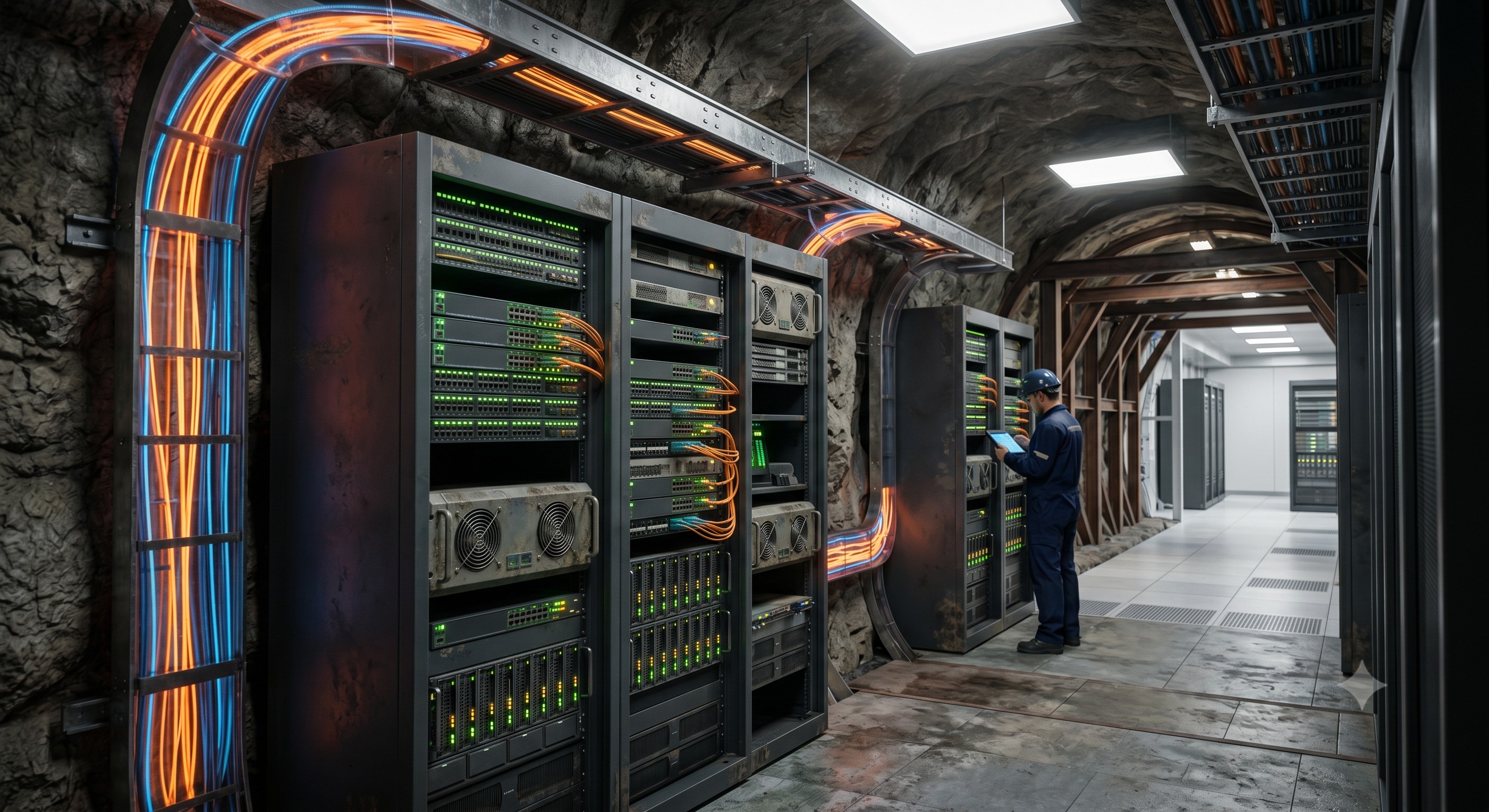
The foundation of any reliable mining underground rugged network deployment is a conduction-cooled, fanless chassis architecture. By eliminating mechanical fans, the system avoids a primary point of failure and prevents the ingestion of coal dust or metallic particulate. The backplane, typically a multi-layer PCB with 2 oz or heavier copper traces, supports a non-blocking switching fabric. For example, a typical rugged aggregation switch for mining offers a switching capacity of 176 Gbps to 1.28 Tbps, with a corresponding packet forwarding rate of 132 Mpps to 952 Mpps at 64-byte frame size. This backplane must be hardened against galvanic corrosion; therefore, all connectors are gold-plated and conformally coated per IPC-CC-830B.
ASIC Pipeline and Low-Latency Forwarding
Network latency in underground tunnels must be bounded and predictable, especially for real-time telemetry from continuous miners, rock bolt robots, and ventilation-on-demand systems. Merchant silicon ASICs (e.g., Broadcom StrataXGS or Marvell Prestera) are preferred for their mature feature sets, but they must be mounted with underfill epoxy to survive repeated shock. The internal packet processing pipeline supports cut-through switching, achieving a port-to-port latency of 2–5 microseconds for Gigabit Ethernet and sub-2 microseconds for 10GbE interfaces. To handle micro-bursts from IP cameras and vibration sensors, the device incorporates 4 MB to 12 MB of shared packet buffer. The Layer 2 forwarding database (MAC table) holds 16K to 32K entries, while the Layer 3 routing table (IPv4/IPv6) supports 8K to 16K routes, sufficient for segmented mining networks with multiple ventilation and production zones.
Power Redundancy and Industrial Connectors
Power integrity is non-negotiable. Standard 48V DC input with dual feed (1+1 redundancy) is mandatory, often complemented by a 24V DC option for legacy mining telemetry. Terminal blocks with captive screw clamps and vibration-resistant locking mechanisms replace standard RJ45 jacks for DC power entry. For data interfaces, M12 X-coded connectors (IP67-rated) dominate over standard RJ45, providing 10/100/1000BASE-T with secure screw locking. For fiber backhaul, M12 D-coded or Harting PushPull connectors are used, accommodating 1000BASE-SX/LX (up to 550m/10km) and 10GBASE-SR/LR (300m/10km) optics.
Technical Specifications
Below is a representative specification matrix for a high-end mining switch aggregating 4-8 access switches in a trunk decline.
Deployment Scenarios
Effective mining underground rugged network deployment follows a hierarchical topology. At the face, small form-factor IP67 switches (6 to 8 ports) with PoE+ (up to 30W per port) power Wi-Fi access points and environmental sensors. These connect back via hardened Gigabit SFP fiber links in a redundant ring, implementing ITU-T G.8032 Ethernet Ring Protection Switching (ERPS) for sub-50ms failover. At the main decline junction, an aggregation switch with 4x 10GbE uplinks and 24x Gigabit M12 ports performs QoS remarking and ACL filtering. For long haul (over 2km to surface control room), 1000BASE-ZX (80km) or 10GBASE-ER (40km) optics are deployed. An example: a copper mine with 12 km of tunnels deployed 22 rugged switches, achieving 99.999% availability for their autonomous haulage system (AHS) over 18 months. The network sustained 8.2 Gbps of aggregate telemetry traffic with a maximum jitter of 123 microseconds.
Another critical scenario is intrinsically safe (IS) deployments in coal mines where explosive methane gas is present. Here, mining underground rugged network deployment requires barrier modules that limit current and voltage even under fault conditions. Ex-rated switches with hermetically sealed enclosures and potting compound are mandatory. These units typically offer lower port density (4-8 ports) and reduced PoE budget (12W per port) but maintain the same switching performance. For backbone links, armored fiber optic cables with double steel tape armoring (SWA) are employed to resist rodent and rockfall damage.
Conclusion
Deploying a high-availability network in sub-surface mining environments demands more than just ruggedized enclosures; it requires a complete re-engineering of thermal management, connector systems, power filtering, and shock mounting. The mining underground rugged network deployment outlined here—featuring fanless conduction cooling, M12/M23 connectors, 48V DC redundant power, and ring protection protocols—forms the backbone of digital transformation in the extractive industries. By prioritizing MTBF (500,000+ hours), deterministic latency (<5 μs), and compliance with standards like IEEE 802.3 (Power over Ethernet), ITU-T G.8032, and MIL-STD-810G, mining operators can achieve the same five-nines reliability as a Tier III data center, even at depths of 2,000 meters below the surface. As autonomous mining equipment and 5G underground private networks proliferate, the rugged switching layer will remain the mission-critical foundation for real-time control, safety systems, and operational analytics.