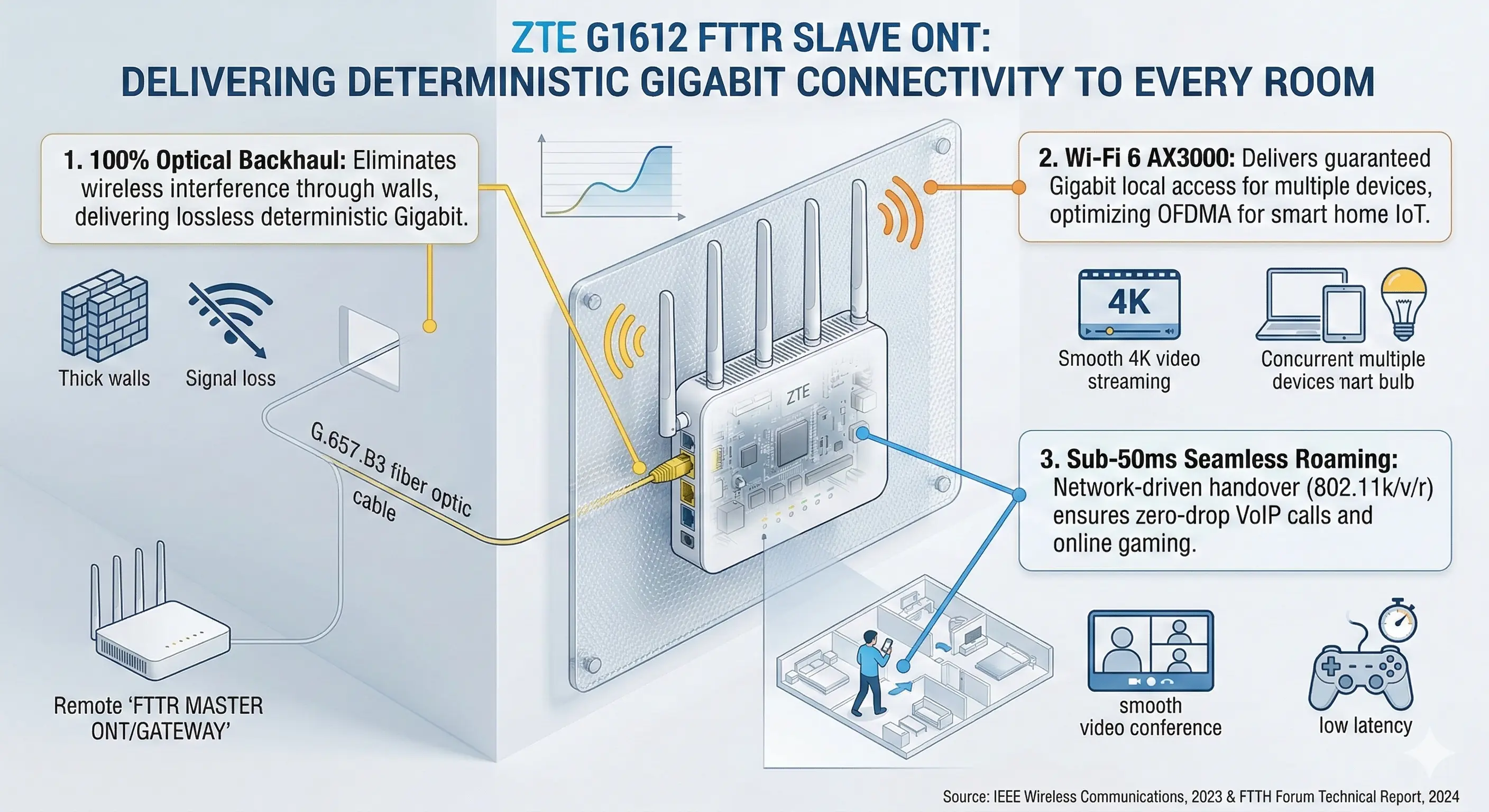
 ZTE G1612 FTTR Slave ONT: Revolutionizing Smart Home Gigabit Connectivity
05 Mar, 2026. Posted by:XPONSHOP
Most Views Posts
The Ultimate Guide to Sourcing Hard-to-Find Spare Parts for Legacy Huawei/ZTE Systems: Architecture, Backplane Bandwidth, and Deployment
2026-09-14 09:39:00
Remote Huawei ONT Firmware Upgrade via OMCI FAQ: Expert Answers to Network Integration & Configuration Questions
2026-07-07 13:24:03
GPON ONU on 10G EPON Network FAQ: Compatibility Answers for Network Architects
2026-09-29 09:22:52
Popular Posts
Smart Managed Switches Distributor FAQ: Expert Answers to Network Integration & Configuration Questions
2026-05-20 16:17:38
ZTE 240G control board FAQ: Expert Answers to Network Integration & Configuration Questions
2026-07-30 10:28:57
Why Does the Terminal Drop All Connections When the Physical Casing Is Touched? A Hardware and Grounding Deep Dive
2026-09-24 09:36:35
Random Posts
XPONSHOP Unbranded Wi-Fi 7 Premium ONU RF Shielding and Thermal Dissipation Profile - Official Technical Overview & Hardware Datasheet
2026-09-04 09:32:52
Troubleshooting ZTE OLT ONU IPTV: Multicast VLAN, IGMP Snooping & Optical Interface FAQ
2026-09-22 09:34:55
Understanding Layer 3 Switching Processing Capacity FAQ: Expert Answers to Network Integration & Configuration Questions
2026-06-18 13:44:58
Cisco Catalyst 3850 Series Layer 3 Switch - Official Technical Overview & Hardware Datasheet
2026-07-10 10:59:30
FiberHome HG6143F ONT Guide: Wi-Fi 6 GPON Performance
2026-03-20 09:56:20
Recent Posts
AI Optical Transceivers vs. Telecom Optical Transceivers: Two ‘Personalities’ of the Same Component
2026-10-30 11:30:33
Overcoming Network Bottlenecks: Enterprise Configuration Manual for Nintendo Switch NAT Type D Resolution
2026-10-30 10:06:06
Cisco Business 350 Series Managed Switch Physical Security and Power Efficiency - Official Technical Overview & Hardware Datasheet
2026-10-30 10:03:46
About
XponShop blog describes some basics for Huawei / ZTE /
Nokia / FiberHome GPON OLT, ONT, SFP, and Site Power...
such as configurations, issue troubleshooting, knowledge
sharing, and keeps updating.
Recent posts
 AI Optical Transceivers vs. Telecom Optical Transceivers: Two ‘Personalities’ of the Same Component
27 Mar, 2025
 Overcoming Network Bottlenecks: Enterprise Configuration Manual for Nintendo Switch NAT Type D Resolution
27 Mar, 2025
 Cisco Business 350 Series Managed Switch Physical Security and Power Efficiency - Official Technical Overview & Hardware Datasheet
27 Mar, 2025
AI Optical Transceivers vs. Telecom Optical Transceivers: Two ‘Personalities’ of the Same Component
27 Mar, 2025
Overcoming Network Bottlenecks: Enterprise Configuration Manual for Nintendo Switch NAT Type D Resolution
27 Mar, 2025
Cisco Business 350 Series Managed Switch Physical Security and Power Efficiency - Official Technical Overview & Hardware Datasheet
27 Mar, 2025
Products from the blog
What: This comprehensive technical whitepaper delivers an in-depth architectural and operational analysis of the ZTE G1612 FTTR Slave ONT, a foundational technology driving next-generation Fiber-to-the-Room (FTTR) network deployments.
Why: As household demands for 4K/8K video streaming, augmented reality (AR), and cloud gaming escalate exponentially, traditional Wi-Fi mesh architectures are hitting an insurmountable physical wall—suffering from severe backhaul interference, bandwidth degradation, and unacceptable latency spikes. FTTR technology mitigates these issues entirely by pushing the optical fiber boundary directly into every single room. The G1612 acts as the ultimate terminal edge, ensuring a lossless, deterministic gigabit experience regardless of physical obstructions, building materials, or distance from the primary residential gateway.
How: Network engineers, ISP architects, and infrastructure procurement teams will discover highly actionable strategies for seamlessly integrating the G1612 into existing GPON and XGS-PON frameworks. By mastering the device’s advanced Wi-Fi 6 optimizations, optical link budget planning, and centralized multi-node synchronization protocols, operators can guarantee sub-50ms seamless roaming handovers and significantly future-proof their premium residential service tiers against escalating multi-gigabit demands.
The Paradigm Shift: From FTTH to FTTR Architecture
For over a decade, Fiber-to-the-Home (FTTH) has been the gold standard for residential broadband access. In a traditional FTTH topology, a single Optical Network Terminal (ONT) is installed at the entry point of the residence. From this central hub, data is distributed throughout the home using either legacy Cat5e/Cat6 copper Ethernet cables or, more commonly, via wireless Wi-Fi signals. However, as the telecom industry pushes beyond gigabit service tiers into multi-gigabit territory, the "last 10 meters" inside the home have emerged as the most critical bottleneck.
The attenuation of high-frequency radio waves (specifically in the 5GHz and emerging 6GHz bands) is a fundamental law of physics. Studies indicate that traditional wireless backhaul loses approximately 40% to 60% of its throughput when penetrating standard drywall, and up to 90% when passing through brick or concrete floors (Source: IEEE Wireless Communications, 2023). While Wi-Fi mesh systems attempt to solve this by relaying signals across multiple wireless nodes, each wireless hop fundamentally halves the available spectrum and introduces compounding latency jitter.
Enter Fiber-to-the-Room (FTTR). FTTR represents a radical architectural shift where the optical distribution network (ODN) is extended beyond the home's demarcation point directly into individual rooms.
In this ecosystem, the ZTE G1612 FTTR Slave ONT serves as the critical endpoint. Unlike a standard mesh repeater that relies on an unstable wireless backhaul, the G1612 connects back to a "Master ONT" via a dedicated, hair-thin optical fiber. This provides an absolute, zero-interference, full-duplex gigabit backhaul to every room, effectively transforming each room into a dedicated gigabit cell site. This transition is critical for Internet Service Providers (ISPs) looking to reduce support tickets related to "slow Wi-Fi" and to monetize premium, guaranteed-bandwidth service Level Agreements (SLAs) for enterprise-grade remote workers and competitive gamers.
Core Hardware and Optical Engineering of the ZTE G1612
The ZTE G1612 is not merely a wireless access point; it is a highly integrated optical network terminal engineered specifically for the micro-environments of residential rooms and small office spaces. Its hardware architecture must balance high-performance packet processing with strict thermal constraints and aesthetic requirements.
The Micro-Optical Transceiver and P2MP Topology
At the heart of the G1612 is its optical transceiver module. In an FTTR deployment, the Master ONT acts as a localized Optical Line Terminal (OLT) for the home network. It creates a secondary, miniaturized Point-to-Multi-Point (P2MP) passive optical network inside the residence. The G1612 interfaces with this internal network via an asymmetric optical link, typically utilizing specialized downstream and upstream wavelengths designed specifically for short-reach indoor applications, preventing any cross-talk with the external carrier-grade GPON/XGS-PON network.
The optical receiver within the G1612 is calibrated for highly sensitive avalanche photodiode (APD) operation, ensuring that even if the internal fiber undergoes sharp bends around corners, the link remains stable. The optical budget inside an FTTR deployment is uniquely different from an outside plant (OSP) deployment. While OSP networks must account for 20km distances, FTTR fiber runs rarely exceed 100 meters. However, the internal optical budget must account for multiple passive splitters (e.g., a 1:4 or 1:8 optical splitter hidden in a smart home structured wiring panel) and the potential for micro-bending losses.
For the primary external backbone connecting the central office to the Master ONT, network architects must ensure robust upstream capacity. Utilizing high-quality optical modules at the OLT side, such as theZTE GE 10km SFP module
Invisible Fiber and Aesthetic Deployment Logistics
One of the greatest barriers to enterprise-grade networking in residential spaces is the aesthetic disruption of running thick Cat6 cables. The ZTE G1612 FTTR solution circumvents this through the use of G.657.B3 bend-insensitive optical fiber. This specific ITU-T standard fiber possesses a minimum bend radius of just 5mm, allowing it to be routed tightly around 90-degree wall corners, along baseboards, and through existing micro-conduits without suffering catastrophic macro-bending signal loss.
Furthermore, deployment teams utilize "invisible" or transparent fiber cables. These micro-cables, often less than 1.2mm in diameter, have a transparent outer jacket and are affixed to walls using specialized hot-melt adhesives. When installed correctly, the fiber backbone connecting the Master ONT to the G1612 is practically imperceptible to the naked eye. This drastically reduces homeowner friction during installation and accelerates FTTR adoption rates.
Next-Generation Wi-Fi 6 (802.11ax) Capabilities
While the backhaul of the ZTE G1612 is purely optical, its primary interface with user devices is wireless. The G1612 is equipped with an advanced System-on-Chip (SoC) that drives a robust Wi-Fi 6 (IEEE 802.11ax) radio subsystem, typically configured as AX3000 (providing theoretical aggregate speeds of up to 3000 Mbps across the 2.4GHz and 5GHz bands).
OFDMA: Deterministic Airtime for IoT Ecosystems
Traditional Wi-Fi standards (802.11ac and older) utilized Orthogonal Frequency-Division Multiplexing (OFDM), where an entire frequency channel was dedicated to a single device for a specific time slot. In a modern smart home with dozens of IoT devices (smart bulbs, thermostats, sensors), this causes massive queuing delays.
The G1612 leverages Orthogonal Frequency-Division Multiple Access (OFDMA). This technology subdivides a standard 20MHz, 40MHz, or 80MHz Wi-Fi channel into much smaller Resource Units (RUs). The G1612 can simultaneously transmit small chunks of data to a smart thermostat, a smartwatch, and a mobile phone in the exact same transmission window. By eliminating airtime contention, the G1612 drastically reduces baseline latency, which is crucial for real-time smart home automation and voice-over-IP (VoIP) applications.
1024-QAM and 160MHz Channel Bandwidth
To achieve true gigabit speeds over the air, the G1612 utilizes 1024-Quadrature Amplitude Modulation (1024-QAM). Compared to the 256-QAM of Wi-Fi 5, 1024-QAM packs 25% more data into every symbol transmitted over the air. When combined with the device's ability to operate on wide 160MHz channels in the 5GHz spectrum, the G1612 can easily deliver real-world, TCP-verified throughputs exceeding 1.2 Gbps to a single compatible client device, such as a modern laptop or flagship smartphone.
Overcoming Latency: The Mechanics of Seamless Roaming
Perhaps the most significant engineering triumph of the ZTE FTTR ecosystem is its approach to client roaming. In a standard Wi-Fi network with multiple access points, the decision to roam (switch from one AP to another) is entirely up to the client device (the phone or laptop). Client devices are notoriously "sticky"—they will cling to a weak Wi-Fi signal from the living room AP even when the user is standing right next to the bedroom AP, resulting in dead zones and dropped video calls.
The combination of the ZTE Master ONT and the G1612 Slave ONT shifts this paradigm from client-driven roaming to network-driven coordinated roaming. The Master ONT acts as a localized Wireless LAN Controller (WLC). It continuously monitors the Received Signal Strength Indicator (RSSI) and physical layer data rates of all connected clients via the G1612 nodes.
IEEE 802.11k/v/r Optimization Framework
The G1612 utilizes a triad of IEEE standards to execute flawless handovers:
802.11k (Radio Resource Measurement): The G1612 constantly provides the client device with an optimized "neighbor report," so the client always knows the exact frequency and channel of the next nearest FTTR node, eliminating the need for the device to blindly scan the spectrum.
802.11v (BSS Transition Management): If the Master ONT detects that a user walking down the hallway is experiencing a dropping RSSI on Slave Node A, it uses 802.11v to actively instruct the client device to transition to the G1612 (Slave Node B) located in the target room.
802.11r (Fast BSS Transition): This is the crucial protocol for latency. During a handover, the client must normally re-authenticate via WPA3, which takes time and causes dropped packets. 802.11r allows the encryption keys to be pre-shared between the FTTR nodes over the optical backhaul. When the client jumps to the G1612, the authentication step is bypassed.
Through this centralized coordination over a zero-latency optical backhaul, the ZTE FTTR system consistently achieves roaming handover times of less than 50 milliseconds. At this speed, real-time applications like WhatsApp voice calls, Microsoft Teams video conferences, and competitive mobile gaming experience zero perceptible interruption as the user traverses the physical space.
ISP Provisioning and Centralized Network Management
From an operational expenditure (OPEX) standpoint, managing an FTTR deployment must be as automated and frictionless as managing a single FTTH gateway. ISPs cannot afford to send field technicians to troubleshoot individual room nodes.
When evaluating the broader ecosystem ofZTE GPON ONT solutions
OMCI and TR-069 Proxies
The Optical Line Terminal (OLT) at the central office communicates exclusively with the Master ONT using the standard ONU Management and Control Interface (OMCI) protocol for optical layer provisioning. The Master ONT then proxies these configurations down to the G1612 slave units via a proprietary internal management channel over the FTTR fiber.
Similarly, for higher-layer services (Wi-Fi SSID configuration, firmware updates, QoS policies), the ISP’s Auto-Configuration Server (ACS) uses the TR-069 or the newer TR-369 (USP) protocol to communicate with the Master ONT. The Master acts as the controller, pushing synchronized firmware updates and Wi-Fi channel optimizations to all G1612 units simultaneously. This ensures that the entire home network remains in a cohesive, non-conflicting state. Furthermore, advanced AI-driven telemetry can be extracted from the G1612, allowing ISP support agents to view historical Wi-Fi interference graphs, optical attenuation logs, and client drop rates, enabling proactive, remote fault resolution.
Comparative Analysis: FTTR Architecture vs. Traditional Wi-Fi Mesh
To clearly understand the leap in capability provided by the ZTE G1612, network architects must compare FTTR directly against the prevailing alternative: high-end Wireless Mesh Networks (WMN).
Strategic ROI for Telecommunications Operators
The deployment of FTTR solutions heavily featuring the ZTE G1612 represents a massive strategic opportunity for ISPs. While the initial Capital Expenditure (CAPEX) for the hardware and the labor for invisible fiber routing is higher than simply mailing a consumer a mesh router in a box, the long-term Return on Investment (ROI) is substantial.
According to recent telecom industry analyses, ISPs deploying FTTR experience a dramatic reduction in OPEX. Specifically, customer service calls related to poor Wi-Fi coverage—which account for up to 60% of all broadband support tickets—are virtually eliminated (Source: BroadBand Forum Technical Report, 2024). Furthermore, FTTR enables ISPs to introduce ultra-premium "Guaranteed Gigabit Everywhere" service tiers, increasing Average Revenue Per User (ARPU) while simultaneously locking in high-value customers and reducing subscriber churn. Network procurement teams can explore comprehensive FTTH equipment options atxponshop.com
Frequently Asked Questions (FAQs)
1. What is the fundamental difference between a Master ONT and the ZTE G1612 Slave ONT?
The Master ONT connects directly to the ISP’s external carrier network (GPON/XGS-PON) and acts as the central router and controller for the home. The ZTE G1612 Slave ONT connects strictly to the Master ONT via an internal optical fiber, serving solely to extend localized Wi-Fi 6 and Ethernet connectivity into specific rooms.
2. How does the ZTE G1612 FTTR Slave ONT handle Wi-Fi backhaul differently than mesh routers?
Traditional mesh routers use wireless radio frequencies to transmit data back to the main router, which suffers massive speed losses when passing through walls. The G1612 uses a dedicated, physical optical fiber for its backhaul, ensuring 100% lossless, full-duplex gigabit speeds back to the Master ONT, completely immune to wireless interference.
3. Can the ZTE G1612 be powered directly through the optical fiber (Power over Fiber)?
Standard optical fiber used for data transmission cannot carry electrical current. Therefore, the ZTE G1612 requires a localized standard DC power adapter plugged into a room's electrical outlet. However, specialized composite cables (incorporating both fiber and microscopic copper wire) are emerging in the market to deliver both data and remote power simultaneously.
4. What are the specific optical fiber requirements for deploying the G1612 inside a home?
FTTR installations utilize ITU-T G.657.B3 bend-insensitive single-mode fiber. This fiber is exceptionally flexible, featuring a minimum bend radius of just 5 millimeters. This allows technicians to route the transparent fiber tightly around 90-degree corners and along baseboards without breaking the glass or causing signal attenuation.
5. How does the G1612 achieve sub-50ms seamless roaming for mobile devices?
It utilizes the IEEE 802.11k, 802.11v, and 802.11r protocols. Coordinated by the Master ONT, these protocols provide the mobile device with a map of nearby access points, instruct the device exactly when to switch based on signal strength, and pre-authenticate security keys so the handover happens in milliseconds without dropping data packets.
6. Is the ZTE G1612 compatible with third-party Optical Line Terminals (OLTs)?
The ZTE G1612 slave unit interacts directly with the ZTE Master ONT, not the external OLT. As long as the Master ONT is compatible and successfully authenticated on a third-party OLT (following standard OMCI interoperability guidelines), the internal FTTR network comprising the G1612 units will function correctly.
7. How many ZTE G1612 Slave ONTs can be connected to a single Master ONT?
The exact number depends on the specific model of the Master ONT and the optical split ratio used in the home. Typically, residential FTTR architectures support up to 16 slave units (using a 1:16 optical splitter), which is more than sufficient to cover expansive mansions, multi-story homes, or small-to-medium enterprise (SME) office environments.
8. What role does OMCI play in managing the ZTE G1612 Slave ONT?
The ONU Management and Control Interface (OMCI) is used by the central office OLT to configure the Master ONT. The Master ONT then utilizes a localized, vendor-specific OMCI proxy or proprietary protocol over the internal FTTR fiber to configure the optical parameters, VLANs, and performance monitoring metrics of the G1612 slave devices automatically.
Conclusion
The transition toward multi-gigabit societal infrastructure demands that the final physical bottleneck—the interior walls of the end-user's premises—be completely bypassed. The ZTE G1612 FTTR Slave ONT stands as a masterclass in telecommunications engineering, successfully pushing carrier-grade optical reliability and advanced Wi-Fi 6 spatial routing into the granular level of individual rooms. By abandoning the inherently flawed wireless backhaul models of traditional mesh networks in favor of a deterministic, transparent fiber backhaul, the G1612 delivers an uncompromising, ultra-low-latency gigabit experience. For operators, it is no longer merely a piece of customer premises equipment; it is a strategic asset essential for protecting SLA integrity and driving next-generation broadband revenue.
Ready to future-proof your network architecture and eliminate Wi-Fi dead zones permanently? Begin evaluating your FTTR deployment strategy today and explore the necessary optical components to bridge your core network to the ultimate room-level edge.