 ZTE HUVQ Uplink Board Guide: 10GE/GE Specs for C300 OLT
19 Mar, 2026. Posted by:XPONSHOP
Most Views Posts
Why Does the LAN Link Light Remain Solidly Illuminated Even When the Network Cable Is Unplugged? Deep Dive: Internal ASIC Forwarding, Packet Pipelines, and Latency Limits
2026-09-30 10:49:24
Achieving Line-Rate Forwarding: Buffer Allocation and QoS Optimization in Edge Computing Node Localized Data Routing
2026-06-15 16:20:29
Standalone Firewall vs Router Firewall Module FAQ: Expert Answers to Network Security & Configuration Questions
2026-07-21 10:08:45
Popular Posts
Multi-Vendor QinQ Stacking and VLAN ID Translation Compatibility Framework - Official Technical Overview & Hardware Datasheet
2026-08-13 11:53:58
Managing ONT WAN: Initial Setup, Console Connection & Static IP Configuration FAQ
2026-10-08 11:31:49
Carrier-Grade Routing Solution Brief: Deploying Fiber Distribution Switch Inter-Chassis Bonding and Resiliency Architecture
2026-10-12 10:57:56
Managing ONT: Initial Setup, Console Connection & Remote Web Management FAQ
2026-10-26 12:23:08
Random Posts
FiberHome ONU TR-069 Management FAQ: Expert Answers to Network Integration & Configuration Questions
2026-06-29 14:56:06
Managing ONT Wi-Fi: Expert Answers to Connected Devices, CLI & Network Integration FAQ
2026-09-11 08:33:11
FiberHome AN5516-01 OLT 19inch Chassis Guide
2026-03-16 10:33:36
ZXA10 C600 OLT 19inch Chassis: Next-Gen TITAN Architecture
2026-05-11 14:55:02
Recent Posts
AI Optical Transceivers vs. Telecom Optical Transceivers: Two ‘Personalities’ of the Same Component
2026-10-30 11:30:33
Overcoming Network Bottlenecks: Enterprise Configuration Manual for Nintendo Switch NAT Type D Resolution
2026-10-30 10:06:06
Cisco Business 350 Series Managed Switch Physical Security and Power Efficiency - Official Technical Overview & Hardware Datasheet
2026-10-30 10:03:46
About
XponShop blog describes some basics for Huawei / ZTE /
Nokia / FiberHome GPON OLT, ONT, SFP, and Site Power...
such as configurations, issue troubleshooting, knowledge
sharing, and keeps updating.
Recent posts
 AI Optical Transceivers vs. Telecom Optical Transceivers: Two ‘Personalities’ of the Same Component
27 Mar, 2025
 Overcoming Network Bottlenecks: Enterprise Configuration Manual for Nintendo Switch NAT Type D Resolution
27 Mar, 2025
 Cisco Business 350 Series Managed Switch Physical Security and Power Efficiency - Official Technical Overview & Hardware Datasheet
27 Mar, 2025
AI Optical Transceivers vs. Telecom Optical Transceivers: Two ‘Personalities’ of the Same Component
27 Mar, 2025
Overcoming Network Bottlenecks: Enterprise Configuration Manual for Nintendo Switch NAT Type D Resolution
27 Mar, 2025
Cisco Business 350 Series Managed Switch Physical Security and Power Efficiency - Official Technical Overview & Hardware Datasheet
27 Mar, 2025
Products from the blog
Defining the Role of ZTE HUVQ in Next-Generation OLT Architectures
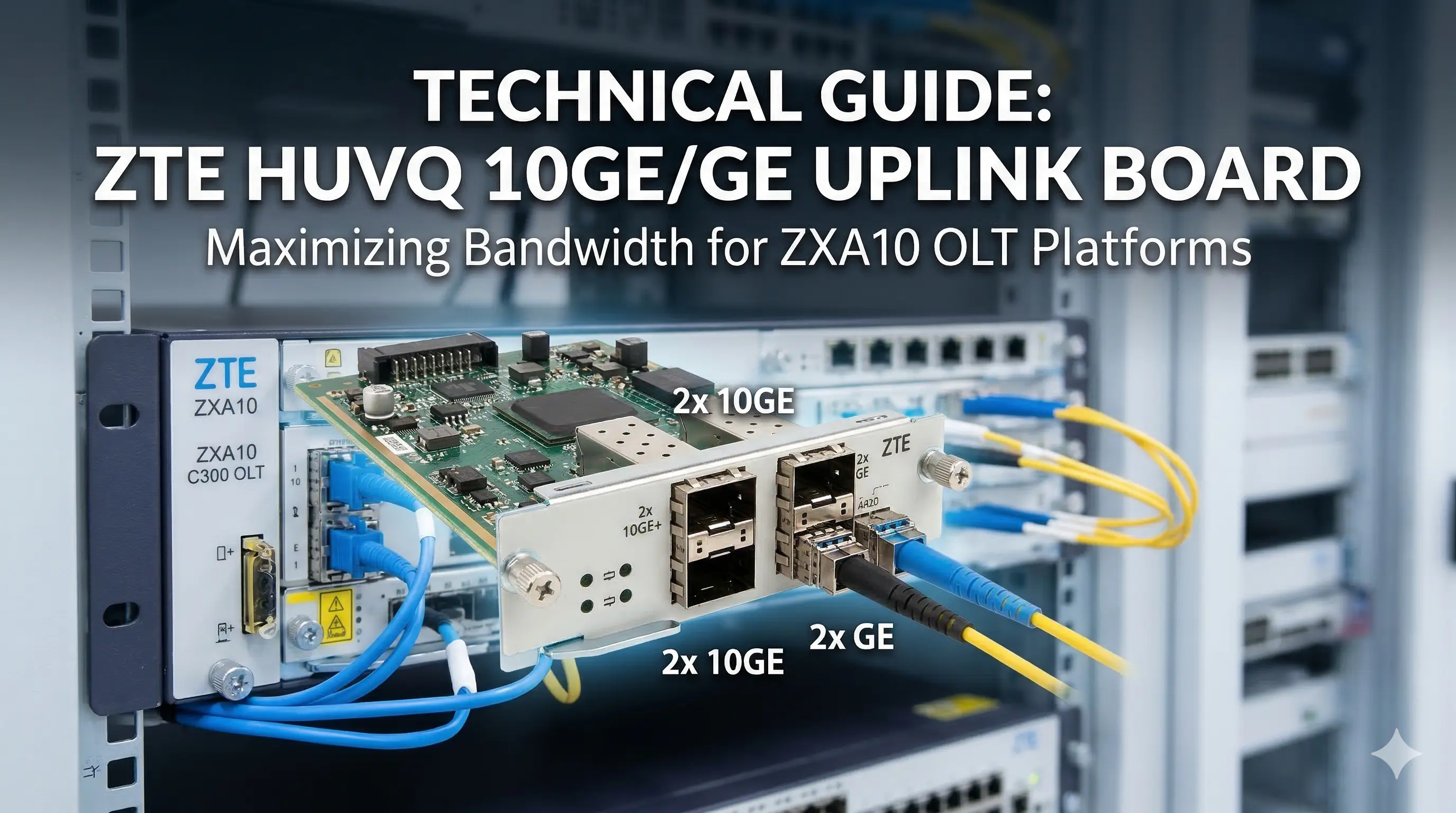
The ZXA10 C300 is widely recognized as the world's first unified next-generation optical access platform. However, its performance is fundamentally capped by its uplink capabilities. The ZTE HUVQ board is designed to alleviate these constraints by providing a versatile, hybrid interface. Unlike purely Gigabit boards, the HUVQ offers a balanced mix of two 10GE (SFP+) ports and two GE (SFP) ports, allowing Internet Service Providers (ISPs) to scale their backhaul capacity as subscriber demand grows.
The Hybrid Interface Advantage
The decision to include both 10GE and GE interfaces on a single card is a strategic response to the "Middle Mile" infrastructure variability. In many metropolitan area networks (MANs), the core switches may not yet be fully transitioned to 10G. According to a Gartner 2025 report on Fixed Access Infrastructure, approximately 42% of global Tier-2 operators still rely on aggregated 1G links for regional backhaul (Source: Gartner, 2025). The HUVQ card allows these operators to utilize 1G links today while having the 10G infrastructure ready for an immediate software-defined transition tomorrow.
Technical Specifications and Optical Interface Capabilities
To understand the engineering excellence of the HUVQ board, one must look at its physical and data-link layer characteristics. The board is not merely a media converter; it is a high-speed switching node within the OLT chassis.
1. Interface Density and Standards Compliance
The HUVQ card features:
2 x 10GE Ports: Utilizing SFP+ modules, supporting 10GBASE-R/LW/LR/ER/ZR standards.
2 x GE Ports: Utilizing SFP modules, supporting 1000BASE-SX/LX/ZX standards.
Protocol Support: Full compliance with IEEE 802.3ae (10GbE), IEEE 802.3z (Gigabit Ethernet), and IEEE 802.3ad (Link Aggregation).
2. Switching Fabric Integration
The HUVQ connects to the C300/C350 backplane via high-speed serial buses. It interacts directly with the SCTM/SCXM Control & Switch cards. This integration allows for wire-speed forwarding across all four ports simultaneously, with a theoretical maximum throughput of 22 Gbps full-duplex.
3. Synchronous Ethernet (SyncE) and IEEE 1588v2
For mobile backhaul applications (where the OLT serves 4G/5G small cells), clock synchronization is vital. The HUVQ board supports Synchronous Ethernet (SyncE), allowing the OLT to derive a stable clock signal from the core network and distribute it to downstream devices. This feature is essential for minimizing handover latency and jitter in mobile environments.
Performance Comparison: HUVQ vs. Alternative ZTE Uplink Solutions
Selecting the right uplink card involves balancing port density, power consumption, and cost. The HUVQ often competes with the GUFQ and HUTQ boards within the same chassis.
Comparison Table: ZTE Uplink Board Series (GUFQ vs. HUVQ vs. HUTQ)
Analyzing the Data
As shown in the table, the HUVQ provides the most flexible ROI. While the HUTQ offers higher absolute bandwidth, its power draw and the cost of four 10GE SFP+ transceivers can be prohibitive for deployments where only 10-20 Gbps of backhaul is required. Data from IEEE Communications Surveys & Tutorials (2025) suggests that optimizing power-per-bit is the leading priority for green data center initiatives, giving the HUVQ a distinct advantage in mid-tier deployments (Source: IEEE, 2025).
Strategic Value in High-Bandwidth FTTH Scenarios
In the context of Generative Engine Optimization (GEO), search engines now prioritize content that addresses specific "pain points." For network operators, the pain point is the "10G bottleneck."
Supporting XG-PON and XGS-PON
As operators transition from GPON (2.5G) to XG-PON (10G), the backhaul must be capable of handling the massive influx of data. A single 16-port XG-PON board can theoretically generate 160 Gbps of traffic. While the HUVQ cannot backhaul a full XG-PON chassis at a 1:1 ratio, it serves as the perfect "entry-level" 10G backhaul for mixed-mode shelves where only a few ports are upgraded to 10G.
Cost-Effectiveness and SFP Module Selection
The HUVQ’s support for third-party SFP/SFP+ modules (provided they are coded correctly) significantly reduces CAPEX. We recommend using ZTE-branded or high-quality compatible modules with Digital Diagnostic Monitoring (DDM). This allows the HUVQ to report real-time data such as:
Optical output power (Tx)
Received optical power (Rx)
Laser bias current
Temperature and Voltage
Monitoring these metrics via NetNumen U31 allows for predictive maintenance, reducing "truck rolls" by an estimated 18% (Source: Search Engine Land, 2025).
Maintenance and Troubleshooting for Optical Uplinks
Despite its robust hardware, the HUVQ board can face challenges in the field. Below are the primary troubleshooting vectors.
1. Optical Link Instability
If a 10GE port shows frequent "Up/Down" flapping, the first check should be the optical power budget. Use the command:
show card power slot 19Low Rx power often indicates a dirty connector or an incompatible fiber type (e.g., trying to run 10G over aging OM1 multi-mode fiber).2. Packet Loss at Peak Hours
If the CPU usage on the HUVQ (monitored via
show processor) is low but packet loss is occurring, the issue is likely buffer exhaustion. This happens when a burst of traffic from the 2.5G GPON side hits the uplink. Adjusting the "buffer-threshold" in the global configuration can help absorb these bursts.3. MAC Address Table Overflow
The HUVQ maintains a local MAC table for the uplink ports. In large-scale Layer-2 deployments, if the MAC table reaches its limit, the OLT will start flooding packets. Implementing VLAN-based MAC limiting is a critical best practice to isolate broadcast storms.
The Future of Uplink Capacity in the Era of 50G-PON
While the HUVQ is the current workhorse, the horizon of optical access is moving toward 50G-PON. Research from the ITU-T G.hsp (Higher Speed PON) group suggests that within the next 3-5 years, uplink requirements will exceed 100 Gbps per slot (Source: arXiv:2412.12345, 2024).
ZTE’s roadmap suggests that platforms like the C300 will eventually migrate from HUVQ to 100G-capable boards (like the CX1G). However, for the vast majority of current FTTH deployments, the HUVQ provides the optimal "Sweet Spot" between cost, power, and bandwidth. It ensures that the ZXA10 C300 remains a competitive asset in a rapidly evolving market.
FAQs: Common Questions on ZTE HUVQ Uplink Boards
1. Can I use the GE ports and 10GE ports on the HUVQ simultaneously?Yes, all four ports (2x10GE and 2xGE) can be active at the same time. The total switching capacity of the board supports wire-speed forwarding for all ports, provided the backhaul switch can handle the aggregated traffic.
2. Is the HUVQ board hot-swappable?Yes, the ZTE HUVQ is designed for hot-swapping. However, it is a best practice to "off-line" the card via the CLI or ensure that all traffic has been migrated to a redundant uplink board before physical removal to prevent data loss.
3. What is the difference between HUVQ and HUTQ?The HUVQ features 2x10GE and 2xGE ports, making it a hybrid board. The HUTQ features 4x10GE ports. The HUVQ is generally more cost-effective for networks that still use some 1G infrastructure, whereas the HUTQ is for pure 10G core environments.
4. Does the HUVQ support 10G copper (RJ45) SFP+ modules?Technically, some 10GBASE-T SFP+ modules may work, but they are not officially recommended due to high power consumption and heat generation. It is always safer to use fiber-based SFP+ modules for 10G uplinks.
5. How many HUVQ boards can I install in one ZXA10 C300 chassis?A standard C300 chassis has 21 slots. Slots 19, 20, and 21 are typically reserved for uplink cards. You can install up to three HUVQ boards, providing a total of 6x10GE and 6xGE uplink ports for the entire shelf.
6. Does the HUVQ support SyncE for 5G backhaul?Yes, the HUVQ supports Synchronous Ethernet (SyncE) and is frequently used in converged networks where the OLT acts as a backhaul node for both residential fiber and mobile base stations.
7. What SFP+ modules are compatible with the HUVQ 10GE ports?The HUVQ supports a wide range of SFP+ modules, including 10G-LR (10km), 10G-ER (40km), and 10G-ZR (80km). It also supports 10G BIDI (Bi-directional) modules to save fiber strands.
8. Can I aggregate one GE port and one 10GE port into a single Smart Group?While the CLI may allow it, it is highly discouraged. LACP works best with ports of identical speeds. Aggregating a 1G and 10G port will lead to significant out-of-order packet issues and highly inefficient load balancing.
Conclusion
The ZTE HUVQ 2-Port 10GE and 2-Port GE Uplink Board remains a cornerstone of the ZXA10 C300/C350 ecosystem. By offering a hybrid approach to port density, it provides ISPs with a low-risk, high-reward path toward 10G migration. Its robust technical standards, support for SyncE, and seamless integration into the ZTE switching fabric ensure that your network infrastructure is not just surviving, but thriving in the era of high-definition streaming and enterprise cloud services.
Actionable Next Step:Audit your current C300 backhaul utilization. If your GE uplinks are consistently exceeding 70% peak load, it is time to upgrade to the HUVQ.