

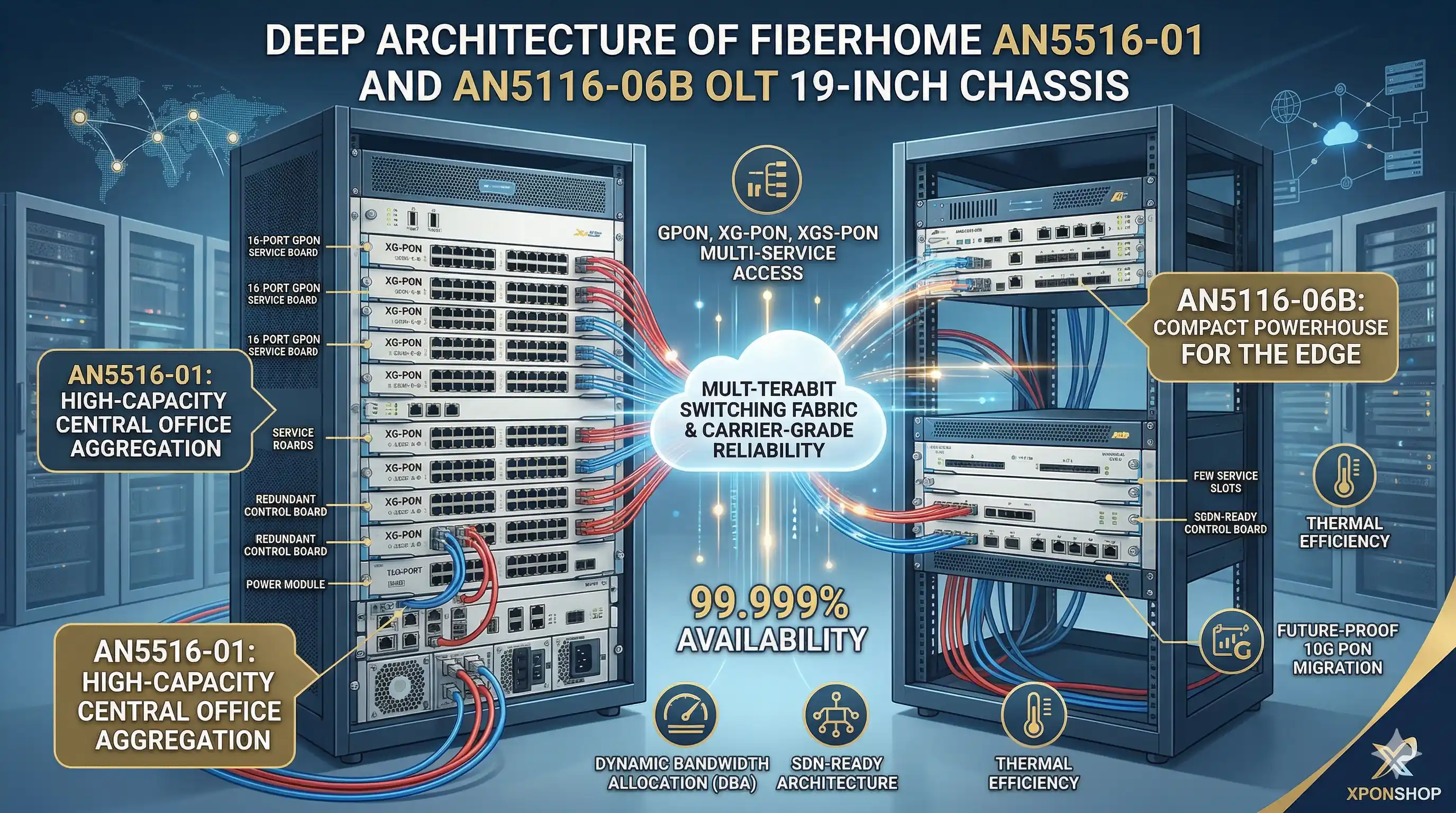
This comprehensive engineering whitepaper examines the core technical architecture, hardware specifications, and deployment strategies of the FiberHome AN5516-01 and AN5116-06B Optical Line Terminal (OLT) 19-inch chassis platforms. What: These platforms represent carrier-grade, highly integrated optical access solutions designed to deliver high-density GPON, XG-PON, and XGS-PON services within a standardized 19-inch rack environment. Why: As global fiber-to-the-home (FTTH) and enterprise broadband adoption accelerates—projected to reach a 65% global penetration rate by 2026—telecom operators desperately require scalable, non-blocking switching architectures that can handle terabit-level backplane traffic while minimizing physical footprint and power consumption. How: Through a rigorous analysis of chassis modularity, core switching fabrics, redundancy protocols, and thermal management, network architects will learn how to optimize optical line terminal deployments, ensure 99.999% carrier-class reliability, and strategically migrate from legacy GPON to next-generation 10G PON networks without requiring a forklift upgrade of their physical infrastructure.
Read more
As fiber-to-the-home (FTTH) and enterprise broadband networks evolve from gigabit to multi-gigabit access, the aggregation layer must possess uncompromised bandwidth and reliability. This comprehensive technical whitepaper explores the critical role of the Nokia 10G 10KM SFP+ 10GBASE-LR optical transceiver as the standard uplink solution for Nokia Optical Line Terminals (OLTs). We will analyze the underlying optical engineering, including the 1310nm distributed feedback (DFB) laser technology required for zero-dispersion 10-kilometer transmission over single-mode fiber (SMF). With GPON and XGS-PON deployments growing at a 22% CAGR (Source: Dell'Oro Group Broadband Access Report, 2024), understanding how to architect robust, high-capacity 10G backhaul links is no longer optional—it is a mandatory requirement for network survival. By the end of this guide, network architects and IP engineers will learn how to precisely calculate optical link budgets, implement LACP redundancy protocols, and utilize Digital Diagnostic Monitoring (DDM) to future-proof their Nokia ISAM access networks.
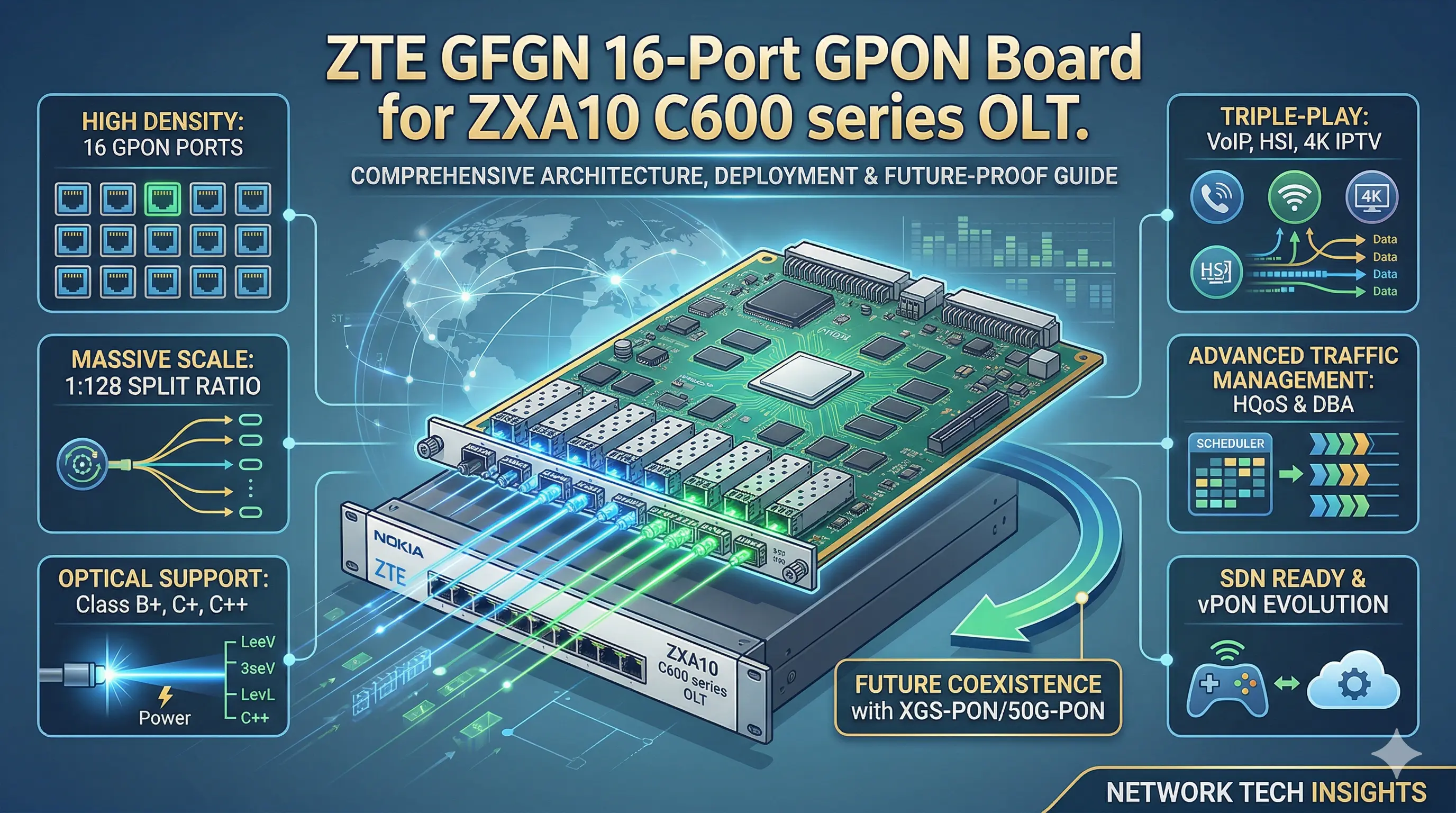
The evolution of multi-gigabit access networks requires robust, high-density line cards to manage the exponential growth in subscriber bandwidth. This technical whitepaper provides an in-depth analysis of the ZTE GFGN 16-port GPON subscriber board, designed explicitly for the flagship ZTE ZXA10 C600 series Optical Line Terminal (OLT). Why is this critical now? As global Internet Service Providers (ISPs) transition from legacy aggregation nodes to SDN-enabled, high-capacity platforms, optimizing the Gigabit Passive Optical Network (GPON) layer remains the most cost-effective strategy for mass-market residential and enterprise Fiber-to-the-Home (FTTH) rollouts. By reading this guide, network architects and infrastructure engineers will learn actionable strategies for maximizing optical split ratios, configuring advanced Hierarchical Quality of Service (HQoS), and executing seamless provisioning via the ONU Management and Control Interface (OMCI). We will explore the hardware silicon advantages, traffic management capabilities, and optical link budget calculations necessary to fully leverage the GFGN board in next-generation optical distribution networks.
Read more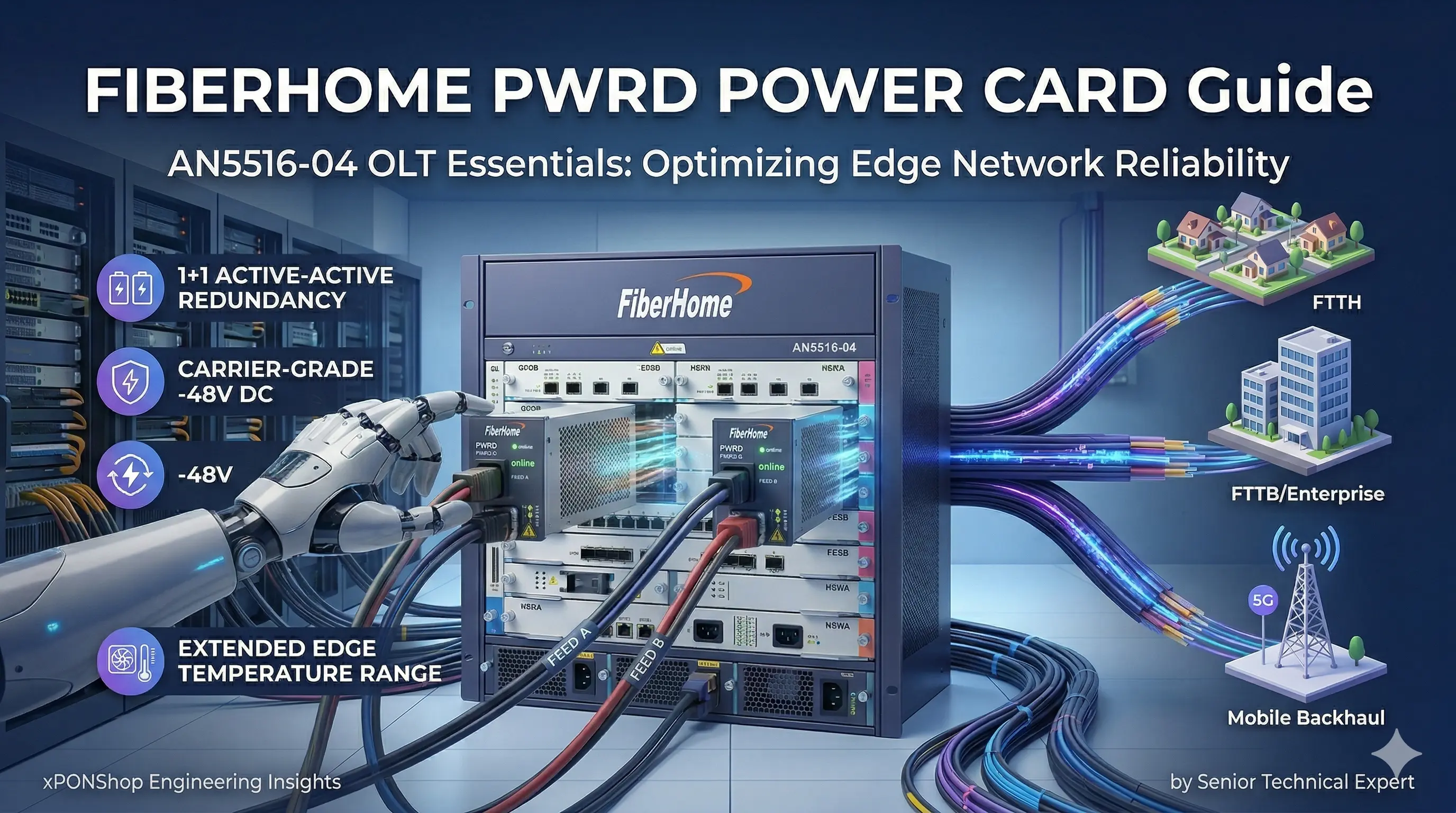
What: This comprehensive B2B technical whitepaper provides an in-depth analysis of the FiberHome PWRD Power Card, the premier Direct Current (DC) power management module engineered specifically for the compact FiberHome AN5516-04 Optical Line Terminal (OLT). We dissect its hardware architecture, electro-mechanical specifications, and its role in modern broadband access networks.Why: In the era of Gigabit Passive Optical Networks (GPON) and 10G-PON evolution, Internet Service Providers (ISPs) are pushing active telecommunications equipment deeper into the network edge. Deploying 2U subracks like the AN5516-04 in space-constrained street cabinets demands flawless power stability. Hardware-level power failures account for nearly 45% of unplanned edge node outages. Understanding the redundancy, load-sharing capabilities, and thermal management of the PWRD module is critical for operators bound by strict 99.999% Service Level Agreements (SLAs) and stringent OpEx constraints.How: Network architects and deployment engineers will learn how to design fault-tolerant power architectures using 1+1 redundancy, how to integrate the PWRD module into centralized network telemetry systems, and how to adhere to international installation standards for maximized hardware lifecycle and uninterrupted FTTx service delivery.
Read more
What: This comprehensive B2B technical white paper provides an in-depth analysis of the Fiberhome AN6000-17 OLT Chassis, a premier next-generation Optical Line Terminal designed for high-density, carrier-grade telecommunications environments. We dissect its hardware architecture, multi-terabit switching capabilities, and forward-looking software ecosystem.Why: As global bandwidth consumption surges due to enterprise cloud migrations, 5G deployments, and AI-driven applications, legacy optical networks are experiencing critical backplane bottlenecks. Transitioning to a distributed, SDN-ready architecture is no longer optional; it is an infrastructural imperative. The AN6000-17 empowers network operators to scale seamlessly from GPON to 10G PON, and ultimately to 50G PON, without requiring forklift upgrades or chassis replacements.How: Telecommunications architects and network engineers will learn how to engineer high-capacity edge networks using the AN6000-17's distributed architecture, how to optimize OpEx via automated zero-touch provisioning, and how to seamlessly implement Combo PON strategies to migrate subscriber bases efficiently. By mastering this platform, Internet Service Providers (ISPs) can achieve a 35% reduction in total cost of ownership (TCO) while maximizing their long-term optical network investments.
Read more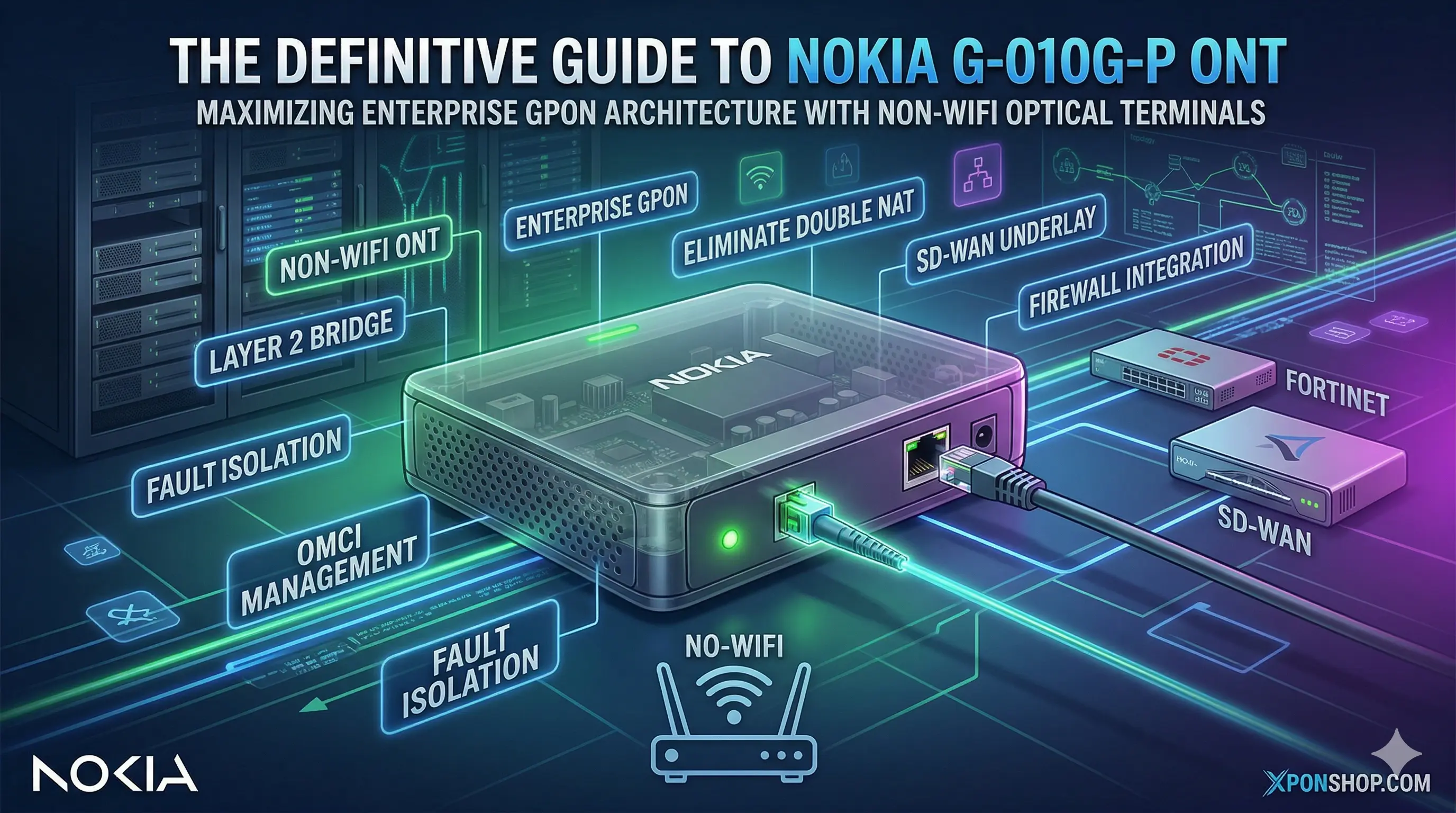
As global enterprise networks transition toward fully decoupled, software-defined architectures, the role of the customer premises equipment (CPE) is undergoing a profound transformation. This comprehensive technical white-paper explores the Nokia G-010G-P ONT, a strictly non-WiFi, single-port Gigabit Optical Network Terminal. We analyze what makes this Layer 2 bridge device a cornerstone for modern Fiber-to-the-Premises (FTTP) and Fiber-to-the-Office (FTTO) deployments, specifically focusing on its hardware architecture, ITU-T G.984 compliance, and GPON capabilities. Readers will understand why enterprise IT architects are actively abandoning all-in-one residential gateways in favor of dedicated optical terminators to eliminate double NAT, improve firewall integration, and reduce network overhead. Furthermore, this guide will detail how network engineers can leverage the Nokia G-010G-P alongside advanced SD-WAN topologies and enterprise-grade routing appliances to achieve uncompromised line-rate throughput, enhanced security, and streamlined OMCI-based provisioning.
Read more