 Line-Rate Packet Forwarding Architecture Reference Document: Line-Rate Layer 2 Frame Processing Over Sub-Ten-Gigabit Metro Links
24 Sep, 2026. Posted by:XPONSHOP
Most Views Posts
Why Can't Some Devices Connect to 2.4G/5G WiFi?
2025-10-19 20:54:06
Cisco Catalyst SFP+ FAQ: Expert Answers to Network Integration & Configuration Questions
2026-07-31 10:23:10
The Ultimate Guide to Aggregation Switch for OLTs: Architecture, Backplane Bandwidth, and Deployment
2026-07-16 14:08:56
Troubleshooting ONT VoIP Calls FAQ: Static Noise, Echo & Line Faults Explained
2026-10-14 11:03:37
The Ultimate Guide to Outdoor OLT Cabinets: Cooling and Protection Strategies
2026-09-08 10:44:37
Popular Posts
Quantified Network Throughput Gains: A Data-Driven Performance Evaluation of Enterprise Core Switch Lifespan
2026-06-10 13:55:25
ZTE G1612 FTTR Slave ONT: Revolutionizing Smart Home Gigabit Connectivity
2026-03-05 10:54:14
Troubleshoot Frequent ONU Offline on ZTE ZXA10 Cxx OLT
2025-12-22 16:22:33
The Potential of WDM-PON
2025-10-22 09:02:46
Random Posts
The Ultimate Guide to FiberHome AN5516 OLT: Architecture, Backplane Bandwidth, and Deployment
2026-09-09 10:17:56
Overcoming Network Bottlenecks: Enterprise Configuration Manual for Troubleshooting Common ZTE ONU Connectivity Issues
2026-07-09 13:45:50
IEEE & MEF Compliance Masterclass: Advanced Protocol Handling of Can an OEM ONT synchronize with an OLT operating on an external BITS clock reference?
2026-10-22 10:31:33
Recent Posts
AI Optical Transceivers vs. Telecom Optical Transceivers: Two ‘Personalities’ of the Same Component
2026-10-30 11:30:33
Overcoming Network Bottlenecks: Enterprise Configuration Manual for Nintendo Switch NAT Type D Resolution
2026-10-30 10:06:06
Cisco Business 350 Series Managed Switch Physical Security and Power Efficiency - Official Technical Overview & Hardware Datasheet
2026-10-30 10:03:46
About
XponShop blog describes some basics for Huawei / ZTE /
Nokia / FiberHome GPON OLT, ONT, SFP, and Site Power...
such as configurations, issue troubleshooting, knowledge
sharing, and keeps updating.
Recent posts
 AI Optical Transceivers vs. Telecom Optical Transceivers: Two ‘Personalities’ of the Same Component
27 Mar, 2025
 Overcoming Network Bottlenecks: Enterprise Configuration Manual for Nintendo Switch NAT Type D Resolution
27 Mar, 2025
 Cisco Business 350 Series Managed Switch Physical Security and Power Efficiency - Official Technical Overview & Hardware Datasheet
27 Mar, 2025
AI Optical Transceivers vs. Telecom Optical Transceivers: Two ‘Personalities’ of the Same Component
27 Mar, 2025
Overcoming Network Bottlenecks: Enterprise Configuration Manual for Nintendo Switch NAT Type D Resolution
27 Mar, 2025
Cisco Business 350 Series Managed Switch Physical Security and Power Efficiency - Official Technical Overview & Hardware Datasheet
27 Mar, 2025
Products from the blog
TECHNOLOGY OVERVIEW
The evolution of metropolitan area networks (MANs) has placed unprecedented demands on service provider and enterprise edge infrastructure. As carriers strive to deliver Carrier Ethernet services with strict service level agreements (SLAs), the underlying hardware must perform deterministic, line-rate Layer 2 frame processing without introducing latency, jitter, or packet loss. This reference document specifies an optimized architecture for line-rate Layer 2 frame processing over sub-ten-gigabit metro links, specifically engineered for 1 Gbps and 2.5 Gbps uplinks that dominate mid-tier aggregation and access rings. The platform leverages a purpose-built forwarding ASIC that executes wire-speed bridging, VLAN manipulation, and class-of-service scheduling entirely in hardware, ensuring that every frame traversing the metro link is processed at the exact line rate of the interface. This architecture eliminates the need for software-based forwarding paths and provides the deterministic behavior required for mission-critical Carrier Ethernet and enterprise metro deployments.
SFP+/QSFP INTERFACE MAPPING
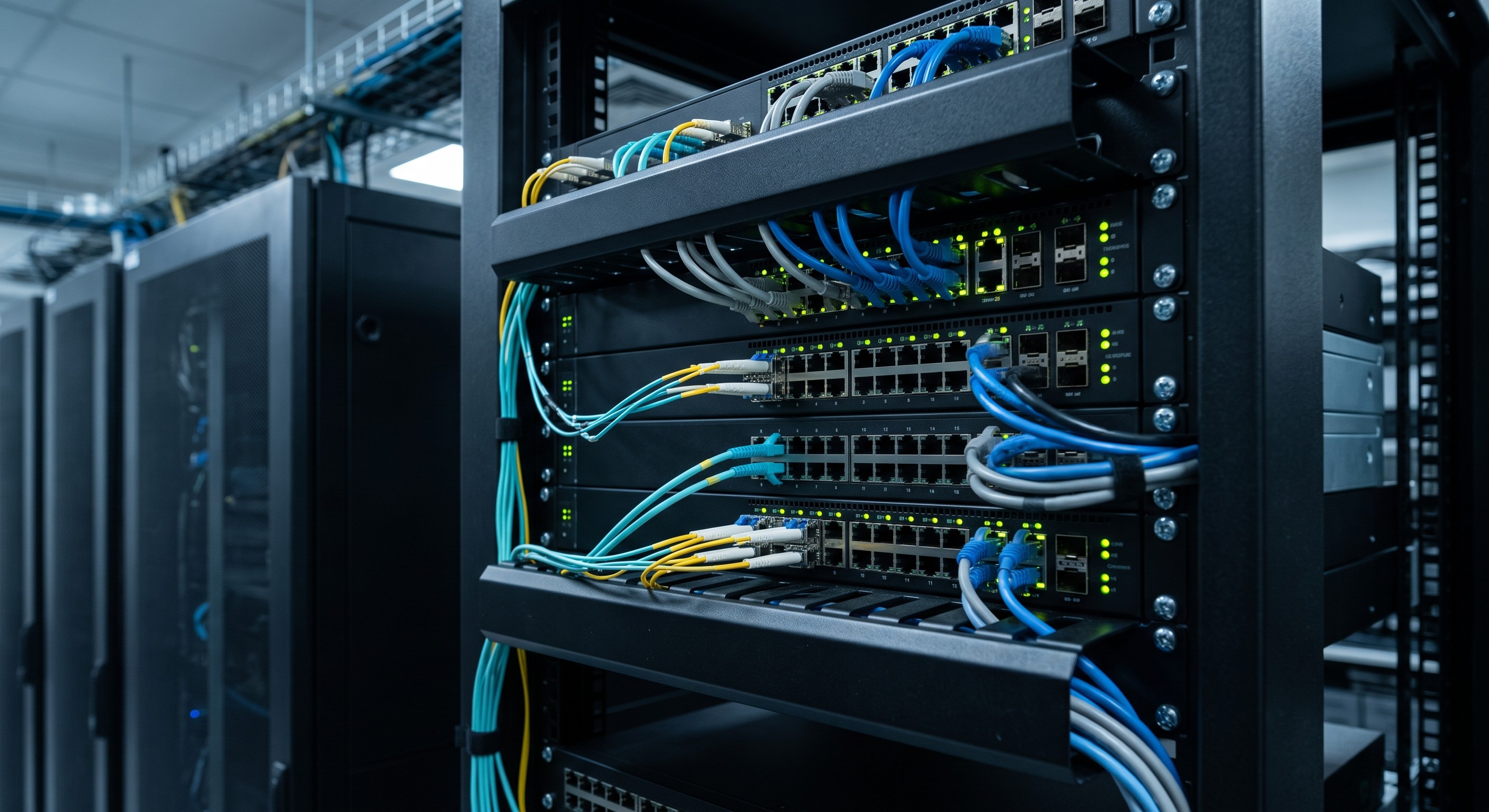
The hardware platform provides a flexible mix of small form-factor pluggable interfaces optimized for sub-ten-gigabit metro transport. The base system includes 24 fixed 10/100/1000BASE-T copper ports for customer premises and access aggregation, complemented by 4 dedicated SFP uplink cages that support 1000BASE-X and 2.5GBASE-X optical transceivers. The SFP+ cages are architecturally mapped directly to the forwarding ASIC's line-rate ingress pipelines, ensuring that no internal bottleneck exists between the optical transceiver and the packet buffer. Each SFP+ cage supports digital diagnostic monitoring (DDM) for real-time optical power, temperature, and voltage telemetry, enabling proactive link maintenance. The interface mapping also supports 2.5G operation over existing Cat5e/6 copper cabling via NBASE-T technology, allowing service providers to deliver sub-ten-gigabit metro services without costly fiber retermination. All uplink ports operate in a non-blocking configuration relative to the switching fabric, guaranteeing that aggregate uplink throughput never exceeds the backplane capacity under any traffic profile.
REDUNDANT POWER SYSTEM
To meet the stringent availability requirements of metro aggregation sites, the platform incorporates a fully redundant power architecture. The system accepts dual hot-swappable power supply units (PSUs) operating in 1+1 load-sharing mode. Each PSU is capable of powering the entire chassis independently, and the failure of a single PSU triggers an immediate, hitless failover to the remaining unit without affecting packet forwarding. The power subsystem supports both AC (100-240V) and DC (-48V) input options, enabling deployment in central office, street cabinet, and enterprise wiring closet environments. Inrush current limiting and overvoltage protection are integrated into each PSU to safeguard against grid anomalies. The platform also features an intelligent power management controller that monitors PSU health, fan tray status, and thermal sensors, reporting all telemetry via SNMP and syslog for integration into existing network management systems. This redundant power design ensures that the sub-ten-gigabit metro link remains operational even under single-point power infrastructure failures.
CAPABILITY METRICS
The following metrics define the performance envelope of the line-rate Layer 2 frame processing subsystem over sub-ten-gigabit metro links. All figures are measured under maximum load with 64-byte frames, the most demanding traffic profile for packet processing engines.
- Layer 2 bridging throughput: 100% line rate on all 1G and 2.5G ports simultaneously
- Frame forwarding rate: 1.488 Mpps per 1G port; 3.720 Mpps per 2.5G port
- Switching fabric capacity: 80 Gbps non-blocking
- Packet buffer: 1.5 MB shared across all ports with dynamic thresholding
- VLAN support: 4094 simultaneous VLANs per port, 802.1Q and 802.1ad
- MAC address table: 32K entries with hardware aging and learning
- Latency: < 3 microseconds port-to-port for 64-byte frames
- Jitter: < 500 nanoseconds under full line-rate load
- QoS queues: 8 hardware queues per port with strict priority and WRR scheduling
- Multicast: IGMP snooping v1/v2/v3, 1024 multicast groups
- Link aggregation: 802.3ad with 16 LAGs per stack, 8 ports per LAG
- Protection: 802.1w RSTP, 802.1s MSTP, ERP (G.8032) with < 50ms convergence
COMPLIANCE AUDIT
The platform has been audited against major international and industry standards to ensure interoperability and regulatory compliance in metro Carrier Ethernet deployments. The compliance posture includes the following certifications and conformance validations: IEEE 802.3, 802.3u, 802.3ab, 802.3z, 802.3ae, 802.3bz for physical and MAC layer operation; IEEE 802.1Q, 802.1ad, 802.1p for VLAN and priority handling; IEEE 802.1D, 802.1w, 802.1s for spanning tree and redundancy; IEEE 802.3ad for link aggregation; ITU-T G.8032 for Ethernet ring protection; MEF 2, MEF 6.1, MEF 10.2 for Carrier Ethernet service definitions; and MEF 9, MEF 14 for service performance and traffic management. The hardware also complies with FCC Part 15 Class A, CE EN 55022, EN 55024, and RoHS 2.0 directives. Safety certifications include UL 60950-1, IEC 60950-1, and EN 60950-1. Each unit undergoes a full compliance test during manufacturing, and test reports are available upon request for procurement and homologation purposes.
SCALING STRATEGY
The platform is designed to scale horizontally and vertically within sub-ten-gigabit metro architectures. Horizontal scaling is achieved through hardware stacking of up to 8 units using standard 10G SFP+ stacking ports, creating a single logical device with a unified control plane and a distributed forwarding plane. This allows metro aggregation sites to grow from 24 to 192 access ports without changing the management model or disrupting existing services. Vertical scaling is supported through the addition of expansion line cards in modular chassis variants, enabling a mix of copper, fiber, and 2.5G ports in the same system. The forwarding ASIC supports seamless firmware upgrades for future protocol enhancements, including IEEE 802.1CB frame replication and elimination for reliability (FRER) and IEEE 802.1Qcc for stream reservation. All scaling operations are hot-swappable and hitless, ensuring that the metro link remains operational during capacity upgrades. The architecture also supports multi-chassis link aggregation (MLAG) with peer devices, providing active-active redundancy across stacked systems for zero-downtime maintenance windows.
📥 Download Technical Specification
Click the button below to view or download the full official PDF datasheet.
⬇️ Download Official PDF