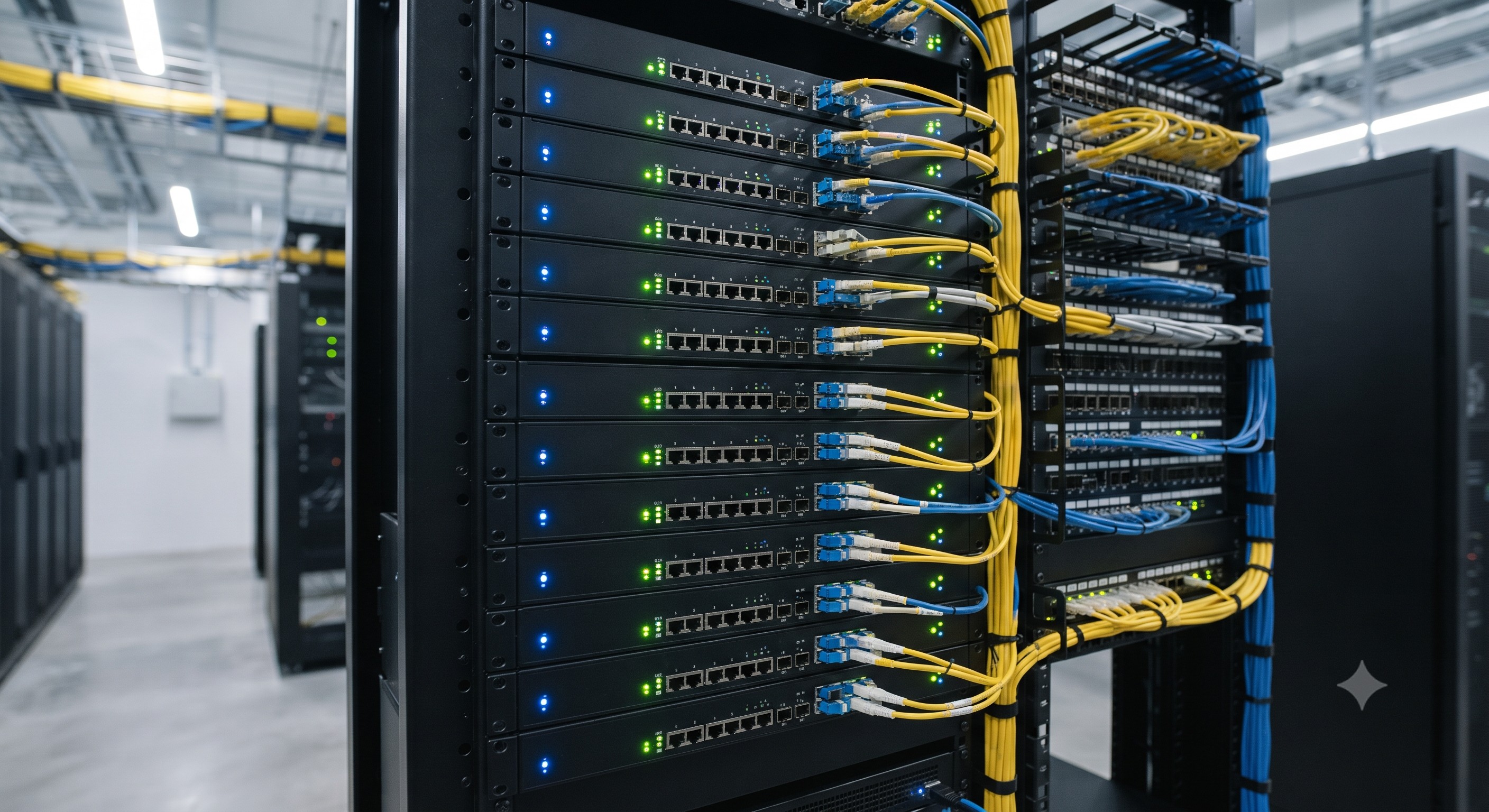
 OEM Mini MDU Box Subscriber Capacity and Multi-VLAN Hardware Limits - Official Technical Overview & Hardware Datasheet
30 Jul, 2026. Posted by:XPONSHOP
Most Views Posts
The Ultimate Guide to Binding Multiple Physical LAN Ports to Different PVC/WAN Connections on the ONT: Architecture, Backplane Bandwidth, and Deployment
2026-09-21 09:44:42
The Ultimate Guide to Managing Multiple OLTs with NMS: Architecture, Backplane Bandwidth, and Deployment
2026-09-02 10:37:28
iMaster OmniSight-T License Troubleshooting— OSN1800 Lack of License
2025-10-22 09:03:57
Popular Posts
Overcoming Network Bottlenecks: Enterprise Configuration Manual for Troubleshooting Continuous Ranging Failures Between an Access Terminal and an OLT Port
2026-10-15 17:07:49
Troubleshooting CATV RF Port Output on ONT: No TV Channels FAQ
2026-10-15 14:20:41
Optical Line Terminal Chassis Redundancy and Power Distribution Blueprint - Official Technical Overview & Hardware Datasheet
2026-09-16 11:46:33
Engineering Reliable Broadband with the 2.4G WiFi ONT: ZTE F668 ONT Deep Dive
2026-04-22 11:58:18
Nokia 10G 10KM SFP+: The Ultimate 10GBASE-LR Guide
2026-03-17 10:41:29
Random Posts
OEM Mini MDU Box Subscriber Capacity and Multi-VLAN Hardware Limits - Official Technical Overview & Hardware Datasheet
2026-07-30 10:39:03
In-Depth Architecture of the FiberHome AN5516-01 and AN5116-06B OLT 19-inch Chassis
2026-04-09 10:22:02
High-Quality Alternative CATV-Enabled GPON ONU Receiver Optical Sensitivity Ranges - Official Technical Overview & Hardware Datasheet
2026-07-24 13:05:32
Recent Posts
AI Optical Transceivers vs. Telecom Optical Transceivers: Two ‘Personalities’ of the Same Component
2026-10-30 11:30:33
Overcoming Network Bottlenecks: Enterprise Configuration Manual for Nintendo Switch NAT Type D Resolution
2026-10-30 10:06:06
Cisco Business 350 Series Managed Switch Physical Security and Power Efficiency - Official Technical Overview & Hardware Datasheet
2026-10-30 10:03:46
About
XponShop blog describes some basics for Huawei / ZTE /
Nokia / FiberHome GPON OLT, ONT, SFP, and Site Power...
such as configurations, issue troubleshooting, knowledge
sharing, and keeps updating.
Recent posts
 AI Optical Transceivers vs. Telecom Optical Transceivers: Two ‘Personalities’ of the Same Component
27 Mar, 2025
 Overcoming Network Bottlenecks: Enterprise Configuration Manual for Nintendo Switch NAT Type D Resolution
27 Mar, 2025
 Cisco Business 350 Series Managed Switch Physical Security and Power Efficiency - Official Technical Overview & Hardware Datasheet
27 Mar, 2025
AI Optical Transceivers vs. Telecom Optical Transceivers: Two ‘Personalities’ of the Same Component
27 Mar, 2025
Overcoming Network Bottlenecks: Enterprise Configuration Manual for Nintendo Switch NAT Type D Resolution
27 Mar, 2025
Cisco Business 350 Series Managed Switch Physical Security and Power Efficiency - Official Technical Overview & Hardware Datasheet
27 Mar, 2025
Products from the blog
PRODUCT IDENTIFICATION
Document Type: Official Technical Overview & Hardware Datasheet
Product Series: OEM Mini MDU Box (Multi-Dwelling Unit Aggregation Platform)
Target Application: High-density residential and enterprise multi-tenant access aggregation
Document Version: 1.0
Classification: Public - Unrestricted Distribution
This document serves as the definitive technical reference for the OEM Mini MDU Box platform, detailing its subscriber capacity, VLAN scaling limits, and hardware-level forwarding constraints. Designed for service providers and system integrators, this datasheet provides engineering-level specifications required for network planning, procurement, and deployment in Fiber-to-the-Home (FTTH) and Multi-Tenant Unit (MTU) environments.
CORE INTERNAL TOPOLOGY
The OEM Mini MDU Box is architected around a purpose-built, carrier-grade switching fabric that delivers deterministic performance across all subscriber interfaces. The internal topology is organized into three primary functional planes:
1. DATA PLANE: A non-blocking shared-memory switch fabric with integrated packet processor. The fabric employs a cut-through forwarding architecture with store-and-forward fallback, ensuring sub-microsecond latency for time-sensitive IPTV and VoIP traffic. The forwarding engine maintains a complete Layer 2/Layer 3 forwarding information base (FIB) with hardware acceleration for ACLs and QoS policies.
2. CONTROL PLANE: An integrated ARM-based network processor running a hardened Linux-based operating system. The control plane is isolated from the data plane via dedicated memory and bus interfaces, preventing control traffic storms from impacting subscriber forwarding performance. The management interface supports SNMPv3, CLI, and RESTCONF/NETCONF for full programmability.
3. MANAGEMENT PLANE: Out-of-band management via dedicated MGMT port with separate routing table. This plane includes a sophisticated telemetry engine capable of streaming sFlow/IPFIX data to external collectors for real-time subscriber usage analytics.
SWITCHING SUBSYSTEM CAPABILITIES
The switching subsystem is the heart of the Mini MDU Box, integrating a high-performance Ethernet switch ASIC that provides wire-speed forwarding across all ports simultaneously. Key architectural highlights include:
- SWITCHING FABRIC: The internal fabric operates at a maximum switching capacity of 56 Gbps for the 24-port model and 104 Gbps for the 48-port model, ensuring non-blocking performance under full line-rate traffic loads.
- FORWARDING RATE: The platform supports line-rate 64-byte packet forwarding at 1.488 Mpps per Gigabit port, with aggregate throughput reaching 41.66 Mpps for the 24-port configuration and 83.33 Mpps for the 48-port configuration.
- BUFFER MEMORY: A shared 2 MB packet buffer pool (expandable to 4 MB via internal memory upgrade) provides robust burst absorption capabilities, essential for handling simultaneous subscriber service activations and broadcast traffic.
- MAC ADDRESS TABLE: Hardware-based MAC learning supports up to 16,000 unique MAC addresses, enabling dense subscriber deployment per physical port.
OPERATIONAL ADVANTAGES
The OEM Mini MDU Box delivers significant operational advantages for service providers managing multi-tenant buildings:
1. SUBSCRIBER DENSITY OPTIMIZATION: The platform supports up to 48 active subscriber ports in a compact 1RU form factor, reducing rack space requirements in central offices and distribution hubs by up to 60% compared to traditional access switches.
2. ENERGY EFFICIENT DESIGN: Utilizing IEEE 802.3az Energy Efficient Ethernet (EEE), the platform dynamically adjusts port power consumption based on link utilization. Typical power consumption is rated at 25W for the 24-port configuration and 45W for the 48-port configuration, enabling deployment in environmentally sensitive locations.
3. ZERO-TOUCH PROVISIONING: The Mini MDU Box supports DHCP-based auto-configuration and Trivial File Transfer Protocol (TFTP) firmware upgrades, allowing for rapid, remote deployment without on-site technical intervention.
4. ENHANCED TELECOM RELIABILITY: Features such as per-port hardware-based loopback detection, broadcast/multicast storm control, and bidirectional forwarding detection (BFD) ensure network stability and rapid fault isolation.
SPECIFICATION MATRIX
HARDWARE OVERVIEW
The OEM Mini MDU Box is constructed with a ruggedized steel chassis designed for 19-inch rack or wall-mount installation. The front panel features modular port configurations, LED status indicators for link/activity and system health, and a console port for local management access.
KEY FEATURES
- Subscriber Capacity: Scalable from 8 to 48 subscriber ports per device, supporting both 10/100/1000Base-T copper and 1000Base-X SFP fiber interfaces for flexible last-mile connectivity.
- Multi-VLAN Scaling: Hardware supports up to 4,096 active VLANs (802.1Q) with full Q-in-Q (802.1ad) stacking capabilities for service segmentation. This allows for up to 4,096 unique virtual networks across the subscriber base, essential for multi-service delivery (voice, video, data, and Wi-Fi) per tenant.
- VLAN Limit Per Port: Each physical port can be assigned up to 512 VLAN sub-interfaces simultaneously via 802.1Q trunking, enabling complex multi-service profiles per subscriber.
- Link Aggregation: Support for up to 8 Link Aggregation Groups (LAGs), each containing up to 8 member ports, providing increased uplink bandwidth and link-level redundancy.
- QoS Capabilities: 8 hardware priority queues per port with strict priority and weighted round-robin (WRR) scheduling, ensuring service differentiation for latency-sensitive applications.
- Security: Hardware-based ACLs supporting up to 2,048 access control entries, port-based MAC address filtering, and DHCP snooping for subscriber access control.
- Multicast: Full IGMPv1/v2/v3 snooping with fast leave processing and MVR (Multicast VLAN Registration) for optimized IPTV traffic distribution.
COMPLIANCE & STANDARDS
- IEEE 802.3, 802.3u, 802.3ab, 802.3z, 802.3ae (10GBASE), 802.3x (Flow Control)
- IEEE 802.1D (STP), 802.1w (RSTP), 802.1s (MSTP)
- IEEE 802.1Q VLAN Tagging, 802.1ad Provider Bridges (Q-in-Q)
- IEEE 802.3ad Link Aggregation Control Protocol (LACP)
- IEEE 802.1p Class of Service, 802.1Qbb Priority Flow Control
- ITU-T G.8032 Ethernet Ring Protection Switching (ERPS) – compliant
- MEF 9, MEF 14 (Carrier Ethernet Service Definitions)
- EN 55022, EN 55024, FCC Part 15 Class A (EMC), RoHS Compliant
REGULATORY COMPLIANCE
The OEM Mini MDU Box adheres to global regulatory and safety standards, ensuring seamless integration into both commercial and residential network environments:
- SAFETY: UL 60950-1, CAN/CSA C22.2 No. 60950-1, EN 60950-1, IEC 60950-1. The power supplies feature built-in over-voltage and over-current protection.
- EMC COMPLIANCE: FCC Part 15 Subpart B Class A, EN 55032, EN 55024, VCCI Class A. The platform exhibits robust immunity to electrostatic discharge (ESD) and fast transients (burst), meeting EN 61000-4-2, -4, -5 standards.
- ENVIRONMENTAL: RoHS (Restriction of Hazardous Substances) compliant for all components. The device is rated for operation in temperatures from 0°C to 50°C (32°F to 122°F) and storage temperatures from -40°C to 70°C (-40°F to 158°F), supporting deployment in various environmental conditions from controlled data centers to outdoor street cabinets.
- TELECOM: NEBS Level 3 compliant, GR-1089-CORE for electromagnetic compatibility, and GR-63-CORE for physical protection, ensuring reliable operation in central office environments.
📥 Download Technical Specification
Click the button below to view or download the full official PDF datasheet.
⬇️ Download Official PDF