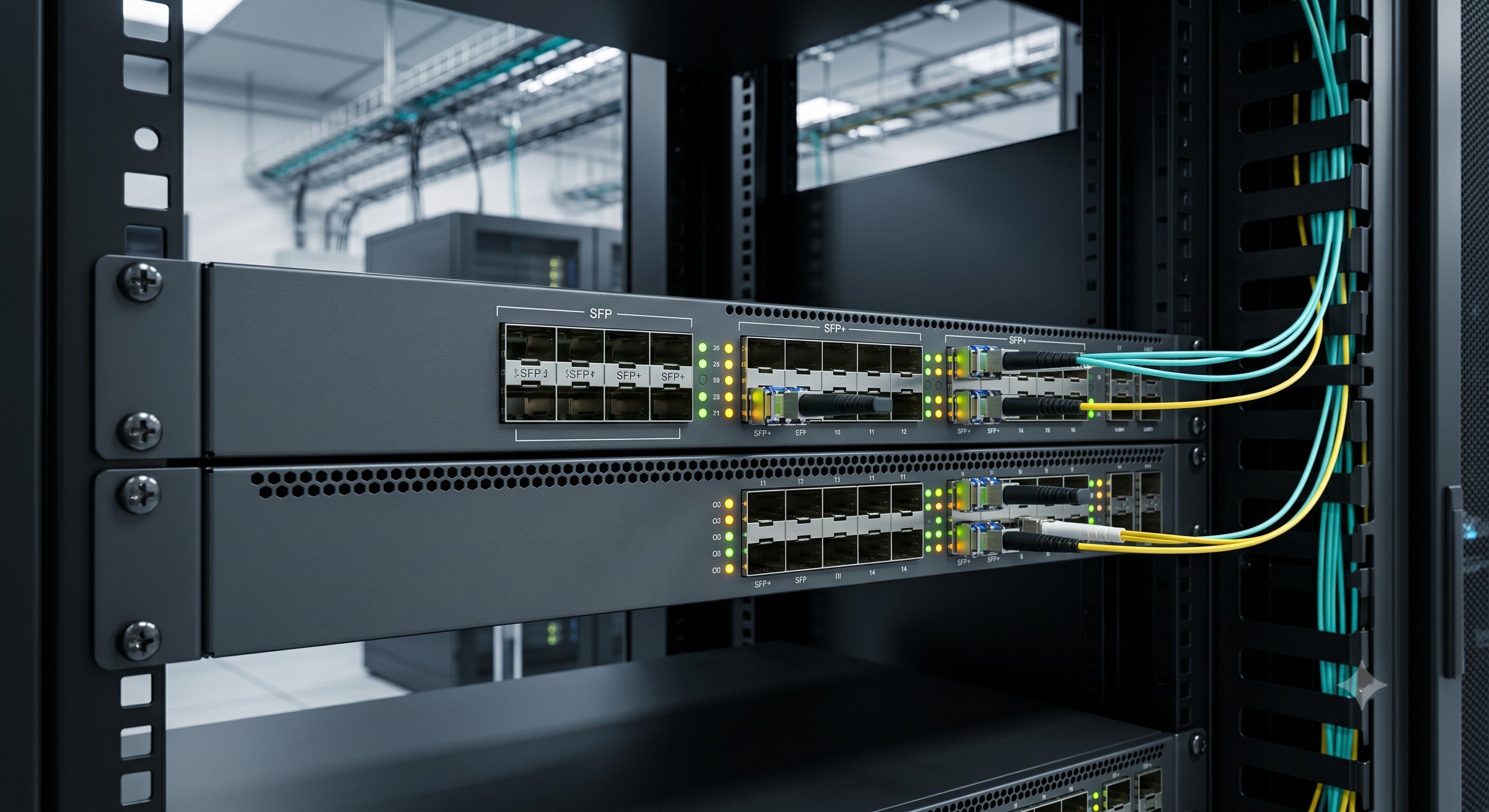
 SFP vs SFP+ Ports - Official Technical Overview & Hardware Datasheet
08 Jun, 2026. Posted by:XPONSHOP
Most Views Posts
Cross-Brand LACP Configuration Compatibility Checklist: Cisco Nexus and Huawei Switches - Official Technical Overview & Hardware Datasheet
2026-08-07 09:05:29
H901MPLA Control Board: 240G Switching Capacity - Official Technical Overview & Hardware Datasheet
2026-07-01 14:01:57
Managing ONT Router: Initial Setup, Console Connection & Firmware Upgrades FAQ
2026-10-13 10:07:49
Popular Posts
The Ultimate Guide to How to Upgrade Switch IOS/Firmware Without Downtime: Architecture, Backplane Bandwidth, and Deployment
2026-07-23 11:55:07
Troubleshooting SFP28 25G: Optical Interfaces, Stacking Errors & L3 Protocols
2026-08-21 10:24:23
ZTE C300 OLT System Clock Sync and NTP Server Integration Standards - Official Technical Overview & Hardware Datasheet
2026-09-03 10:24:58
Random Posts
Hardening Enterprise Infrastructure: MACsec Integration and ACL Capabilities of MAC Address Table Overflow Attack Prevention
2026-07-24 13:22:50
The Ultimate Guide to Modern Central Office: Architecture, Backplane Bandwidth, and Deployment
2026-08-27 10:43:47
Upgrading Huawei AC Device via the Web Platform
2025-10-22 09:07:35
Recent Posts
AI Optical Transceivers vs. Telecom Optical Transceivers: Two ‘Personalities’ of the Same Component
2026-10-30 11:30:33
Overcoming Network Bottlenecks: Enterprise Configuration Manual for Nintendo Switch NAT Type D Resolution
2026-10-30 10:06:06
Cisco Business 350 Series Managed Switch Physical Security and Power Efficiency - Official Technical Overview & Hardware Datasheet
2026-10-30 10:03:46
About
XponShop blog describes some basics for Huawei / ZTE /
Nokia / FiberHome GPON OLT, ONT, SFP, and Site Power...
such as configurations, issue troubleshooting, knowledge
sharing, and keeps updating.
Recent posts
 AI Optical Transceivers vs. Telecom Optical Transceivers: Two ‘Personalities’ of the Same Component
27 Mar, 2025
 Overcoming Network Bottlenecks: Enterprise Configuration Manual for Nintendo Switch NAT Type D Resolution
27 Mar, 2025
 Cisco Business 350 Series Managed Switch Physical Security and Power Efficiency - Official Technical Overview & Hardware Datasheet
27 Mar, 2025
AI Optical Transceivers vs. Telecom Optical Transceivers: Two ‘Personalities’ of the Same Component
27 Mar, 2025
Overcoming Network Bottlenecks: Enterprise Configuration Manual for Nintendo Switch NAT Type D Resolution
27 Mar, 2025
Cisco Business 350 Series Managed Switch Physical Security and Power Efficiency - Official Technical Overview & Hardware Datasheet
27 Mar, 2025
Products from the blog
PRODUCT OVERVIEW & TECHNOLOGY DIFFERENTIATION: SFP VS SFP+ PORTS
This document provides a definitive technical comparison between Small Form-factor Pluggable (SFP) and Small Form-factor Pluggable Plus (SFP+) port architectures. Network engineers and procurement specialists must understand these distinct physical interface standards to ensure correct transceiver mating, signal integrity compliance, and line-rate performance in modern Ethernet deployments.
CORE ARCHITECTURAL DIFFERENCES
The fundamental distinction between SFP and SFP+ ports resides in the electrical signaling interface and supported data rate ranges. SFP ports operate at line rates from 100 Mbps to 1.25 Gbps, while SFP+ ports are engineered for 8 Gbps to 10.3125 Gbps operation. Despite sharing identical mechanical footprint and cage dimensions, backward compatibility is limited: an SFP+ port will accept an SFP transceiver (operating at reduced speed), but an SFP port CANNOT accept an SFP+ transceiver due to higher frequency signaling requirements and different CDR (Clock and Data Recovery) circuitry.
KEY FEATURES
- Rate Differentiation: SFP supports 100BASE-FX, 1000BASE-T, 1000BASE-SX/LX. SFP+ supports 10GBASE-SR, 10GBASE-LR, 10GBASE-ER, and 10GBASE-T (copper).
- Signal Integrity: SFP+ ports implement enhanced EMI shielding and jitter tolerance per IEEE 802.3ae-2002; SFP follows IEEE 802.3z-1998.
- Power Consumption: SFP typically draws <1W per port; SFP+ draws <1.5W (passive DAC cables may draw <0.5W).
- Reach Capabilities: SFP supports up to 80km (1000BASE-ZX); SFP+ supports up to 80km (10GBASE-ER/ZR).
- Cabling: SFP primarily uses duplex LC multimode (up to 550m) or single-mode (up to 80km); SFP+ additionally supports passive direct-attach copper (DAC) up to 7m.
COMPLIANCE & STANDARDS
- SFP: Compliant with SFF-8074i (INF-8074i) and SFF-8472 digital diagnostics.
- SFP+: Compliant with SFF-8431 (SFP+ Electrical), SFF-8432 (Enhanced Management Interface), and IEEE 802.3ae (10 Gigabit Ethernet).
- Both: RoHS-6/6 compliant, IEC 60825-1 laser safety Class 1.
TECHNICAL SPECIFICATIONS
ORDERING GUIDANCE (SKU COMPATIBILITY MATRIX)
When procuring line cards, switches, or transceivers, verify port labeling: "SFP" ports are rate-limited to 1.25 Gbps maximum; "SFP+" ports are rate-limited to 10.3125 Gbps. Mixed deployment on a common backplane requires the host ASIC to negotiate per-port speed. For greenfield 10GbE aggregation, specify SFP+ only. For 1GbE edge access, SFP remains cost-optimal.
📥 Download Technical Specification
Click the button below to view or download the full official PDF datasheet.
⬇️ Download Official PDF