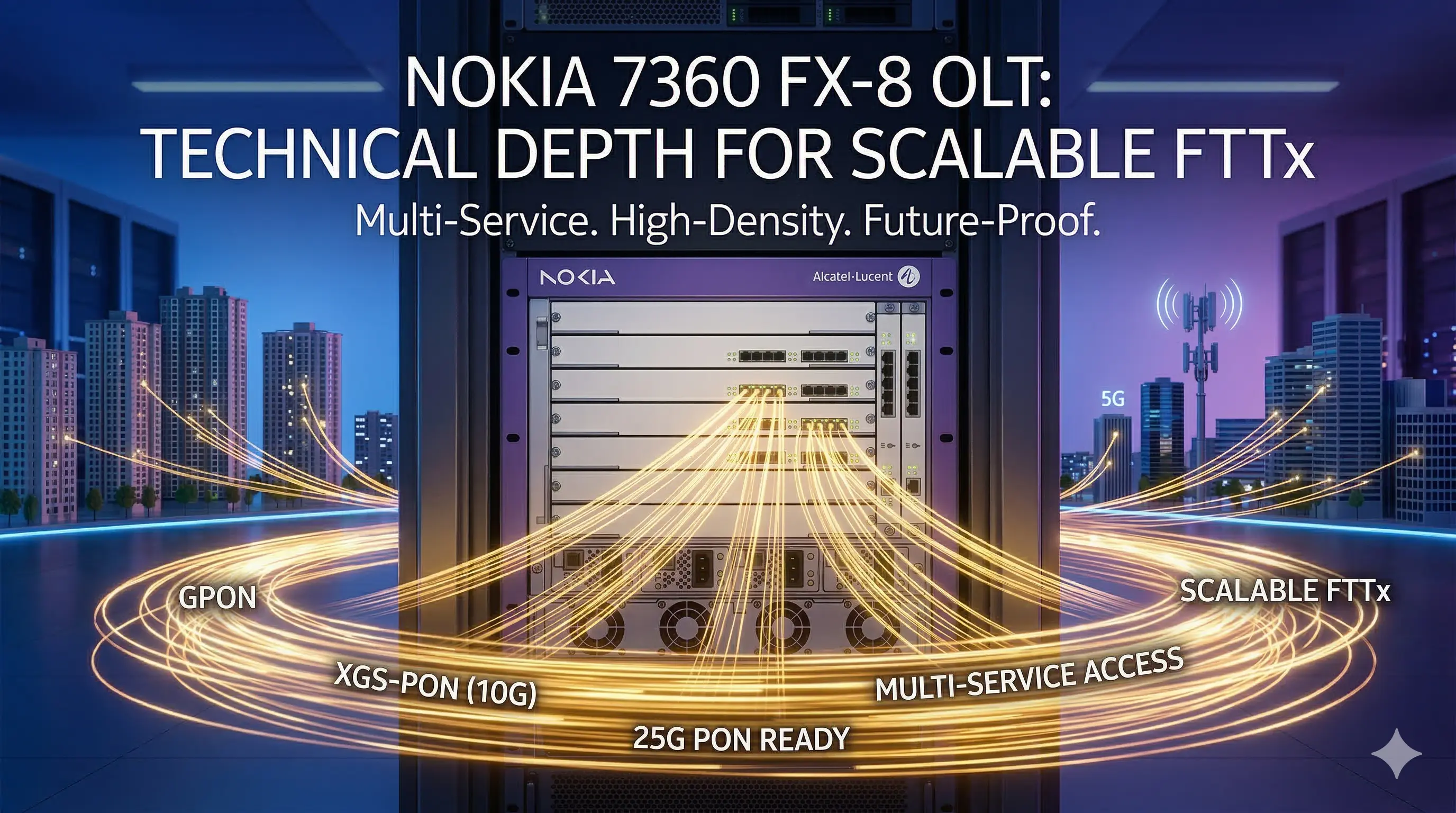
 Nokia 7360 FX-8 OLT: Technical Depth for Scalable FTTx
13 Mar, 2026. Posted by:XPONSHOP
Most Views Posts
Hardening Enterprise Infrastructure: MACsec Integration and ACL Capabilities of MAC Address Table Overflow Attack Prevention
2026-07-24 13:22:50
Automated SEO Blog
2026-10-28 09:35:56
How to Login to NE8000 M Series Router?
2025-10-22 09:04:55
Popular Posts
Network Loopback Storm Deep Dive: Internal ASIC Forwarding, Packet Pipelines, and Latency Limits
2026-06-05 16:40:55
Quantified Network Throughput Gains: A Data-Driven Performance Evaluation of Enterprise Core Switch Lifespan
2026-06-10 13:55:25
802.3bt Ultra PoE 60W 90W Port - Official Technical Overview & Hardware Datasheet
2026-06-02 16:20:36
FAQ: What is Huawei FTTR for Home?
2025-10-22 08:58:30
Random Posts
Maximizing Core Network ROI: A Total Cost of Ownership Analysis of 10GbE enterprise router price
2026-05-21 15:26:40
Maximizing Core Network ROI: A Total Cost of Ownership Analysis of OEM Devices
2026-08-07 09:08:14
Switch MAC Address Table Exhaustion Countermeasures and Port Security Profiles - Official Technical Overview & Hardware Datasheet
2026-09-29 09:31:53
Managing ONT Device Time: NTP Server Configuration & CLI Setup FAQ
2026-10-21 09:23:39
Recent Posts
AI Optical Transceivers vs. Telecom Optical Transceivers: Two ‘Personalities’ of the Same Component
2026-10-30 11:30:33
Overcoming Network Bottlenecks: Enterprise Configuration Manual for Nintendo Switch NAT Type D Resolution
2026-10-30 10:06:06
Cisco Business 350 Series Managed Switch Physical Security and Power Efficiency - Official Technical Overview & Hardware Datasheet
2026-10-30 10:03:46
About
XponShop blog describes some basics for Huawei / ZTE /
Nokia / FiberHome GPON OLT, ONT, SFP, and Site Power...
such as configurations, issue troubleshooting, knowledge
sharing, and keeps updating.
Recent posts
 AI Optical Transceivers vs. Telecom Optical Transceivers: Two ‘Personalities’ of the Same Component
27 Mar, 2025
 Overcoming Network Bottlenecks: Enterprise Configuration Manual for Nintendo Switch NAT Type D Resolution
27 Mar, 2025
 Cisco Business 350 Series Managed Switch Physical Security and Power Efficiency - Official Technical Overview & Hardware Datasheet
27 Mar, 2025
AI Optical Transceivers vs. Telecom Optical Transceivers: Two ‘Personalities’ of the Same Component
27 Mar, 2025
Overcoming Network Bottlenecks: Enterprise Configuration Manual for Nintendo Switch NAT Type D Resolution
27 Mar, 2025
Cisco Business 350 Series Managed Switch Physical Security and Power Efficiency - Official Technical Overview & Hardware Datasheet
27 Mar, 2025
Products from the blog
Unveiling the Nokia 7360 ISAM FX-8 Chassis Architecture
The "FX-8" designation refers to the eight universal slots available in this 19-inch rack-mountable chassis, designed specifically for line cards. Beyond these application slots, the chassis incorporates essential common equipment slots for power, management, and cooling, creating a highly redundant and robust system.
Chassis Dimensions and Physical Layout
The 7360 ISAM FX-8 is engineered for efficient use of rack space, complying with standard 19-inch ETSI rack requirements. Its compact form factor (approximately 8RU height) makes it suitable for deployment in various central office (CO) and outdoor cabinet environments, where space is often at a premium.
Core Components and Redundancy
The chassis architecture is built around hardware and software redundancy to maximize service availability. Key components within the 19-inch frame include:
Universal Line Card Slots (8 Slots): These slots accommodate a wide range of access cards, allowing operators to mix and match technologies (GPON, XGS-PON, TWDM-PON, Point-to-Point Fiber, and even xDSL/G.fast if supported by the specific chassis revision) within the same shelf. This flexibility is crucial for phased migrations and varied service offerings.
Network Termination (NT) Cards: The NT cards provide the central switching fabric, management interface, and uplink connectivity for the entire OLT. The FX-8 supports redundant NT card operation (active/standby), ensuring that a single controller failure does not disrupt network services. These cards handle critical functions like traffic management, QoS, and synchronization.
Power Supply Modules: The chassis typically supports dual redundant DC power inputs. Power modules distribute stable voltage to all cards and components, protecting against external power failures.
Fan Tray: An integrated, field-replaceable fan tray provides forced-air cooling, ensuring optimal operating temperatures for all cards, even under heavy load. The system monitors temperature and adjusts fan speed accordingly, contributing to energy efficiency.
Distributed Switching Fabric and Backplane Capacity
The 7360 FX-8 features a high-capacity distributed switching architecture. While the NT card provides central control, much of the data plane switching occurs directly on the line cards or between line cards over a high-speed backplane. This design prevents bottlenecks and allows the system to scale its total switching capacity linearly as more line cards are added. The backplane itself is engineered to support the multi-terabit throughput required by simultaneous XGS-PON and future 25G/50G PON deployments. (Source: Omdia, 2025)
Deployment and Configuration Workflow for the Nokia 7360 FX-8 OLT
Deploying a high-capacity OLT like the 7360 FX-8 involves a structured process, from physical installation to logical service provisioning. Following best practices ensures network stability and optimal performance.
Physical Installation and Hardware Provisioning
The first phase involves securely mounting the chassis and installing the necessary hardware components. This includes:
Rack Mounting: Securely installing the 19-inch chassis into the assigned ETSI rack space.
Power and Grounding: Connecting the redundant DC power feeds and establishing proper chassis grounding.
Card Installation: Inserting the redundant NT cards, power modules, fan tray, and the initial set of line cards (e.g., GPON or XGS-PON cards) into their designated slots.
Fiber Connectivity: Connecting uplink fibers to the NT card(s) and distribution fibers (to splitters) to the PON ports on the line cards.
Logical Configuration and Service Provisioning
Once the hardware is in place, the logical configuration begins, typically managed via Nokia's Access Management System (AMS) or a Command Line Interface (CLI).
Initial Management Connection: Establishing connection to the active NT card for configuration.
System Settings: Configuring basic parameters like system name, time, IP management interfaces, and SNMP settings.
VLAN Configuration: Defining Virtual LANs (VLANs) to segregate different service types (e.g., Internet, VoIP, IPTV) and management traffic.
Service Profile Provisioning: Creating templates (profiles) that define bandwidth allocations, Quality of Service (QoS) parameters, and security settings for different service tiers. These profiles are then applied to individual subscribers or ports.
ONU/ONT Registration: Enabling the PON ports to automatically discover and register new Optical Network Units (ONUs) or Terminals (ONTs) connected to the ODN.
Service Activation: Mapping registered ONUs to specific service profiles and VLANs to activate subscriber services.
This structured workflow ensures that the high-capacity hardware of the 7360 FX-8 is correctly integrated into the operator's network and prepared to deliver reliable, high-performance services. (Source: Broadband Forum, TR-101/TR-156)
Strategic Advantages of the Nokia 7360 ISAM FX-8 19-inch Chassis
The 7360 FX-8 offers significant advantages for network operators aiming to modernize their access networks and capitalize on growing broadband demands.
Unmatched Scalability and Future-Proofing
The universal slot architecture of the FX-8 is its most significant strategic asset. It allows operators to start with existing GPON technology and seamlessly introduce higher-speed technologies like XGS-PON (10G symetrical) or 25G PON on a port-by-port or card-by-card basis within the same chassis. This gradual upgrade path minimizes initial capital expenditure (CAPEX) while ensuring the network can evolve to meet future bandwidth requirements without extensive forklift upgrades. This concept of a "universal PON" shelf is key to long-term investment protection.
Network Convergence and Simplified Management
By supporting multiple access technologies and service types (residential, business, mobile backhaul) on a single platform, the 7360 FX-8 facilitates network convergence. This reduces the number of distinct platforms operators need to manage, simplifying network operations and reducing operational expenditure (OPEX). Centralized management via Nokia AMS provides comprehensive visibility, streamlining provisioning, maintenance, and troubleshooting across the entire access domain. (Source: Analysys Mason, 2025)
Robustness and High Availability
The FX-8 is designed for carrier-grade reliability. Redundant NT cards, power supplies, and a hot-swappable fan tray ensure maximum uptime and service continuity. This high level of availability is critical for delivering premium services to business customers and supporting critical infrastructure applications.
Nokia 7360 ISAM FX-8 OLT vs. FX-4 vs. Competitor Comparison
To better understand the position of the 7360 ISAM FX-8 in the market, it's helpful to compare it to a smaller model within the same family (FX-4) and a generic competitor's high-capacity OLT. This highlights the trade-offs between capacity, scalability, and deployment scenarios.
Analysis of the Comparison
The 7360 ISAM FX-8 strikes a balance between high capacity and compact form factor. It provides double the line card slots of the FX-4, making it more suitable for environments with higher subscriber density while still fitting within a standard 19-inch rack. While larger competitor OLTs might offer even higher port densities per chassis, they often require more rack space and power. The FX-8's universal slots across the 7360 family ensure that the same line cards can be used in different chassis sizes, optimizing spare parts inventory and operational flexibility. (Source: Heavy Reading, 2024)
FAQs
Here are answers to frequently asked questions about the Nokia Alcatel-Lucent 7360 ISAM FX-8 OLT.
1. What is the total GPON subscriber capacity of a single 7360 FX-8 chassis?
A single FX-8 chassis with 8 slots, utilizing standard 16-port GPON line cards, can support up to 128 GPON ports. With a typical 1:64 split ratio, this translates to over 8,000 subscribers per chassis.
2. Does the 7360 FX-8 support XGS-PON?
Yes, the universal slots in the 7360 FX-8 chassis fully support XGS-PON line cards. This allows operators to deliver symmetrical 10 Gbps services alongside or instead of GPON.
3. Can I mix GPON and XGS-PON line cards in the same 7360 FX-8 chassis?
Absolutely. One of the key strengths of the 7360 FX-8's universal slot design is the ability to mix and match different PON technologies, enabling a graceful migration to higher speeds.
4. What kind of redundancy does the 7360 FX-8 offer?
The FX-8 provides extensive redundancy, including dual active/standby Network Termination (NT) cards, redundant DC power inputs, and a hot-swappable fan tray.
5. What are the typical uplink options for the 7360 FX-8?
Uplink connectivity is provided via the NT cards, which typically offer multiple 10GE or 100GE interfaces to connect the OLT to the core network.
6. How is the Nokia 7360 ISAM FX-8 OLT managed?
The 7360 FX-8 is primarily managed using Nokia's Access Management System (AMS), a comprehensive network management platform. It also supports Command Line Interface (CLI) and SNMP for integration with other OSS.
7. What are the power requirements for the 7360 FX-8 chassis?
The 7360 FX-8 typically requires dual -48V DC power feeds. The total power consumption depends heavily on the number and type of line cards installed.
8. Is the 7360 FX-8 suitable for outdoor cabinet deployments?
Yes, its compact 19-inch form factor makes it a good candidate for installation in environmentally controlled outdoor cabinets, enabling fiber deeper into the network.
Conclusion
The Nokia Alcatel-Lucent 7360 ISAM FX-8 OLT 19-inch chassis stands as a highly versatile and scalable access platform, ideally suited for service providers navigating the transition to next-generation FTTx networks. Its robust architecture, featuring redundant components and a high-capacity distributed switching fabric, ensures carrier-grade reliability for critical services. The defining characteristic of the 7360 FX-8 is its eight universal slots, offering unprecedented flexibility to deploy and mix GPON, XGS-PON, and future technologies within a single, space-efficient shelf. By investing in the 7360 FX-8, network operators gain a future-proof foundation capable of delivering gigabit and multi-gigabit services to residential and business subscribers, supporting network convergence, and optimizing long-term CAPEX and OPEX. This technical depth and strategic flexibility make the 7360 FX-8 a key enabler of sustainable broadband growth.