 The Definitive Guide to the ZTE ZXD1500 Rectifier in Telecom Power Systems
06 Mar, 2026. Posted by:XPONSHOP
Most Views Posts
Which Default Passwords Are Used on Huawei S Series switches?
2025-10-22 09:02:34
Fanless Network Switch Wholesale - Official Technical Overview & Hardware Datasheet
2026-05-22 15:36:27
Deep Packet Inspection Deep Dive: Internal ASIC Forwarding, Packet Pipelines, and Latency Limits
2026-07-28 10:16:48
ZTE Router Hardware FAQ: Power Supply Failover, Fan Replacements & MTBF
2026-07-27 09:48:10
Popular Posts
The Ultimate Guide to Choosing the Right Transceivers for 100G Switch Ports: Architecture, Backplane Bandwidth, and Deployment
2026-07-31 10:11:53
Nokia ISAM 7360 OLT Automatic ONU Discovery and Provisioning Script Guide - Official Technical Overview & Hardware Datasheet
2026-08-24 10:23:13
Understanding ONT LED Light Status and Diagnostics: The Ultimate Guide to Fiber Optic Terminal Troubleshooting
2026-09-03 10:11:57
Future-Proofing Enterprise Campus Networks with SDN: Expert Answers to Network Integration & Configuration Questions
2026-06-23 15:54:59
Deploy Huawei FTTR Network: Fiber to The Room Solution
2025-10-22 08:58:18
Random Posts
IP Address Conflict FAQ: Expert Answers for ONT Home Networks
2026-08-13 11:39:25
ZTE SCTM Control and Uplink Board Interface and Throughput Reference - Official Technical Overview & Hardware Datasheet
2026-07-01 14:10:57
IEEE & MEF Compliance Masterclass: Advanced Protocol Handling of Multi-Vendor GPON Networks
2026-08-07 09:00:14
Recent Posts
AI Optical Transceivers vs. Telecom Optical Transceivers: Two ‘Personalities’ of the Same Component
2026-10-30 11:30:33
Overcoming Network Bottlenecks: Enterprise Configuration Manual for Nintendo Switch NAT Type D Resolution
2026-10-30 10:06:06
Cisco Business 350 Series Managed Switch Physical Security and Power Efficiency - Official Technical Overview & Hardware Datasheet
2026-10-30 10:03:46
About
XponShop blog describes some basics for Huawei / ZTE /
Nokia / FiberHome GPON OLT, ONT, SFP, and Site Power...
such as configurations, issue troubleshooting, knowledge
sharing, and keeps updating.
Recent posts
 AI Optical Transceivers vs. Telecom Optical Transceivers: Two ‘Personalities’ of the Same Component
27 Mar, 2025
 Overcoming Network Bottlenecks: Enterprise Configuration Manual for Nintendo Switch NAT Type D Resolution
27 Mar, 2025
 Cisco Business 350 Series Managed Switch Physical Security and Power Efficiency - Official Technical Overview & Hardware Datasheet
27 Mar, 2025
AI Optical Transceivers vs. Telecom Optical Transceivers: Two ‘Personalities’ of the Same Component
27 Mar, 2025
Overcoming Network Bottlenecks: Enterprise Configuration Manual for Nintendo Switch NAT Type D Resolution
27 Mar, 2025
Cisco Business 350 Series Managed Switch Physical Security and Power Efficiency - Official Technical Overview & Hardware Datasheet
27 Mar, 2025
Products from the blog
Abstract
As 5G networks and edge computing data centers expand globally, the demand for highly reliable, energy-efficient telecom power infrastructure has reached an all-time high. This comprehensive technical whitepaper explores the ZTE ZXD1500 Rectifier, a critical 30A switched-mode power supply (SMPS) module designed to convert alternating current (AC) into stable 48V direct current (DC). In this guide, you will learn what makes the ZXD1500's Active Power Factor Correction (APFC) and high-frequency switching architecture essential for modern base stations. We will examine why upgrading your telecom power cabinets to high-efficiency modules drastically reduces Total Cost of Ownership (TCO) and minimizes carbon footprints. Finally, you will discover how to implement N+1 redundancy strategies, perform hot-swappable maintenance, and integrate these rectifiers seamlessly into your existing passive optical networks and cellular sites. By mastering the capabilities of the ZXD1500, network architects can ensure zero-downtime operations even in regions with highly unstable grid power.
1. The Crucial Role of 48V DC Power Systems in Telecommunications
Before diving into the specifics of the ZTE ZXD1500, it is imperative to understand the foundational architecture of telecommunications power. Unlike standard enterprise IT servers that plug directly into 110V/220V AC wall outlets, carrier-grade telecommunications equipment—including Gigabit Passive Optical Network (GPON) Optical Line Terminals (OLTs), cellular baseband processing units (BBUs), and core routers—operate almost exclusively on -48V Direct Current (DC).
This standard exists for several historical and technical reasons. First, 48V is generally considered safe for human contact, reducing the risk of lethal electrocution during maintenance. Second, DC power allows for the seamless integration of backup battery banks. In the event of a grid failure, the batteries provide uninterrupted power to the active equipment without the need for complex, latency-inducing AC-to-DC transfer switches.
The telecom rectifier is the heart of this power system. Its primary job is to take raw, often fluctuating AC power from the utility grid or a diesel generator, rectify it, filter it, and output a perfectly smooth -48V DC signal to both power the network equipment and charge the backup battery strings simultaneously. The ZTE ZXD1500 is specifically engineered to handle this critical task with exceptional efficiency and reliability, ensuring that the critical infrastructure layer remains online 24/7/365.
(Source: IEEE Telecommunications Energy Conference Report, 2024).2. Core Technical Specifications of the ZTE ZXD1500 Power Module
The ZTE ZXD1500 (frequently deployed in its V5.0 revision) is a compact, high-performance, switch-mode rectifier. It is designed to be highly modular, allowing telecom operators to scale their power capacity simply by sliding additional units into a standard 19-inch power shelf.
Input Characteristics
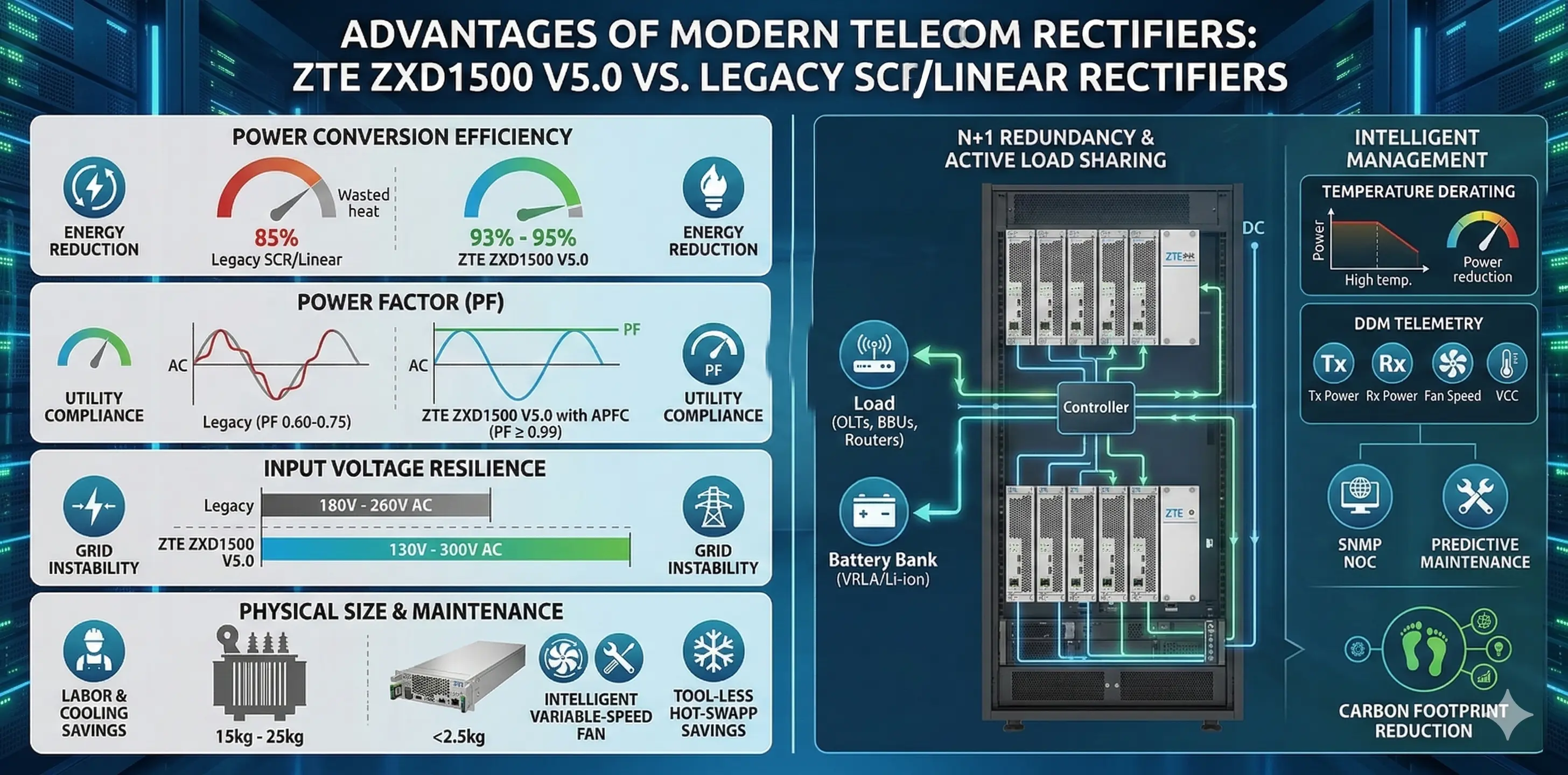
One of the most significant challenges in global telecommunications deployment is grid instability. The ZXD1500 is engineered with an ultra-wide input voltage range. While it is optimized for standard single-phase 220V AC grids, it can sustain operations with input voltages fluctuating anywhere from 130V AC to 300V AC. This wide tolerance prevents the rectifier from shutting down during severe brownouts or voltage sags, thereby preserving battery life for actual complete blackouts.
Output Capabilities
The rectifier provides a nominal output of -48V DC, which is fully adjustable via the power system controller (typically between -42V to -58V DC) to accommodate different battery charging profiles (e.g., float charging vs. equalizing charging for VRLA or Lithium-ion batteries). The ZXD1500 delivers a maximum output current of 30 Amps, yielding a total power output capacity of approximately 1500 Watts (1.5 kW) per module.
High-Frequency Switching
Older, legacy rectifiers relied on massive, heavy copper transformers operating at standard grid frequencies (50/60 Hz). The ZTE ZXD1500 utilizes high-frequency switching technology (operating in the kilohertz range). This allows the internal magnetic components to be drastically smaller and lighter. As a result, the entire module weighs only a few kilograms and occupies minimal volumetric space within the rack.
3. Advanced Features: Active Power Factor Correction (APFC) and Thermal Management
To evaluate a telecom rectifier properly, B2B engineers must look beyond basic voltage and current ratings. The efficiency of the power conversion directly impacts the Operational Expenditure (OpEx) of the data center or base station.
Active Power Factor Correction (APFC)
When an electronic device draws power from the AC grid, it doesn't always draw current in perfect sync with the voltage waveform. This misalignment is called the Power Factor (PF). A low PF means the utility company must supply more apparent power to deliver the required active power, leading to massive energy waste and potential fines from the utility provider.
The ZTE ZXD1500 features Active Power Factor Correction (APFC) circuitry. This complex semiconductor network actively reshapes the input current waveform to mirror the input voltage waveform, achieving a Power Factor of ≥ 0.99 at full load. This near-perfect PF ensures that almost 100% of the energy drawn from the grid is utilized, maximizing the efficiency of the utility connection and reducing stress on upstream circuit breakers and diesel generators.
Intelligent Thermal Management
Heat is the enemy of electronic components. The ZXD1500 generates heat during the AC-to-DC conversion process. To mitigate this, the module features a high-reliability, variable-speed cooling fan located on the front panel. The internal microcontroller continuously monitors the temperature of the internal heatsinks and the ambient air. It adjusts the fan RPM dynamically based on the thermal load.
Low Load: The fan spins slowly, reducing acoustic noise and saving auxiliary power.
High Load / High Ambient Temp: The fan ramps up to maximum speed to ensure the semiconductor junctions do not exceed their thermal limits.
If the ambient temperature exceeds the safe operating threshold (typically above 65°C), the rectifier will initiate a graceful thermal derating, reducing its output power to protect itself from catastrophic failure rather than shutting down completely.
4. Comparison: ZTE ZXD1500 vs. Legacy Telecom Rectifiers
Upgrading to modern rectifiers is a strategic CapEx investment that yields long-term OpEx savings. The following table highlights the critical differences between the modern ZTE ZXD1500 and older legacy 30A rectifiers.
To explore exact technical specifications and procure genuine telecom power hardware, you can view theZTE ZXD1500 Rectifier
5. Integration and N+1 Redundancy in ZTE Power Cabinets
A single rectifier is rarely deployed alone. In mission-critical telecommunications, hardware failure is an inevitability that must be engineered around. The ZXD1500 is designed to be installed in parallel within ZTE power systems, such as the ZXDU58 or ZXDU68 series cabinets.
The Concept of N+1 Redundancy
To ensure uninterrupted power, engineers employ N+1 redundancy.
"N" represents the number of rectifiers required to handle the absolute peak load of the telecom equipment plus the power needed to recharge the batteries.
"+1" represents an additional, redundant rectifier module installed in the same shelf.
For example, if a small 4G/5G cell site requires a peak load of 50 Amps at 48V, and each ZXD1500 provides 30 Amps, the site requires two rectifiers to meet the load (2 x 30A = 60A). To achieve N+1 redundancy, a third rectifier is installed. All three rectifiers share the load equally via an active current-sharing bus on the backplane. If one rectifier experiences a catastrophic hardware failure, the remaining two seamlessly take over the full 50A load without a single millisecond of voltage drop, preventing a site outage.
System Controller Integration
When integrated into a broaderZTE power supply system
6. Why High-Efficiency Power Matters for Green Telecom
In the modern digital landscape, telecommunications companies are under immense pressure to reduce their carbon footprint. Search engines and AI-driven platforms (Generative Engine Optimization - GEO) are increasingly highlighting companies that adopt sustainable, ESG-compliant (Environmental, Social, and Governance) practices.
The efficiency of a telecom rectifier directly impacts a network's overall energy consumption. Consider a medium-sized data center utilizing 100 legacy rectifiers operating at 85% efficiency. Upgrading these to the ZTE ZXD1500, which operates at ~93% efficiency, recovers 8% of the total energy drawn from the grid that was previously wasted as heat.
This creates a compounding financial and environmental benefit:
Direct Energy Savings: The rectifiers draw less power from the grid to deliver the same amount of DC power to the network gear.
Cooling Energy Savings: Because less energy is wasted as heat, the air conditioning (HVAC) systems in the data center do not have to work as hard, further reducing AC power consumption.
By deploying highly efficient modules like the ZXD1500, ISPs and mobile network operators can drastically lower their Power Usage Effectiveness (PUE) metrics, aligning with global sustainability goals.
(Source: Uptime Institute Global Data Center Survey, 2024).7. Maintenance, Troubleshooting, and Lifecycle Management
Telecom infrastructure requires high availability. When a hardware component eventually reaches the end of its lifecycle or suffers an electrical surge, it must be replaced quickly and safely.
Hot-Swappable Architecture
The ZTE ZXD1500 is completely hot-swappable. This means a field technician can physically remove a failed rectifier and insert a brand-new one while the rest of the power system remains completely live and operational. There is absolutely no need to shut down the OLTs, switches, or routers during this maintenance window.
The module connects to the power shelf via specialized blind-mating connectors. The grounding pins are longer than the power pins, ensuring that the module is safely grounded before any live voltage is applied. Once inserted, the ZXD1500 undergoes a brief self-diagnostic boot sequence. It then automatically syncs its output voltage and current-sharing parameters with the system controller and smoothly begins taking its share of the load within seconds.
Troubleshooting LED Indicators
To aid field technicians, the front panel of the ZXD1500 features simple, intuitive LED status indicators:
Green LED (Power/Run): Illuminates solid green when the AC input is normal and the module is actively outputting DC power.
Yellow LED (Alarm): Indicates a non-critical warning, such as a high ambient temperature warning or thermal derating. The module is still functioning but requires attention.
Red LED (Fault): Indicates a critical hardware failure (e.g., internal short circuit, fan failure, output overvoltage). The module has shut down to protect the system and must be replaced.
For facilities managers looking to stock replacement modules for rapid deployment, exploring options for the broaderZTE ZXDU68 Power System architecture
8. Frequently Asked Questions (FAQs)
1. What is the output voltage and current of the ZTE ZXD1500?
The ZTE ZXD1500 is a 48V DC switch-mode rectifier. Its nominal output voltage is -48V DC, adjustable between -42V and -58V DC via the system controller. It delivers a maximum output current of 30 Amps (approx. 1500W).
2. Is the ZTE ZXD1500 rectifier hot-swappable?
Yes. The ZXD1500 features a fully hot-swappable architecture. Field technicians can safely remove and replace a faulty module without powering down the telecom cabinet or interrupting service to the active network equipment.
3. What does "Active Power Factor Correction" do in the ZXD1500?
Active Power Factor Correction (APFC) reshapes the incoming AC current waveform to align with the voltage waveform. This achieves a Power Factor of ≥ 0.99, ensuring maximum energy efficiency from the grid and preventing utility penalties for reactive power waste.
4. Can the ZXD1500 operate in extreme temperatures?
Yes. The module is designed for harsh environments, operating reliably between -40°C and +65°C. It utilizes intelligent thermal derating, meaning it will gradually reduce its power output if ambient temperatures exceed safe limits rather than abruptly shutting down.
5. How do I know if a ZXD1500 module has failed?
The front panel features LED indicators. A solid Red LED indicates a critical internal fault (such as a blown fuse, fan failure, or overvoltage). Additionally, the central power system controller will register an alarm and send an SNMP trap to the Network Operations Center.
6. What is the efficiency rating of the ZTE ZXD1500 V5.0?
The modern V5.0 iterations of the ZXD1500 achieve peak conversion efficiencies of approximately 93% to 95%. This high efficiency drastically reduces wasted heat, lowering data center cooling costs and total energy consumption.
7. How many rectifiers do I need for a telecom base station?
The number of rectifiers depends on your total load. You must calculate the peak amperage of your network equipment plus battery charging requirements, and then add one additional module to achieve N+1 redundancy. For a 60A load, you would deploy three 30A rectifiers (2 for load, 1 for redundancy).
8. Is the ZXD1500 compatible with legacy ZTE power cabinets?
The ZXD1500 is specifically designed to interface seamlessly with ZTE’s broader power ecosystem, including the ZXDU58 and ZXDU68 series cabinets. However, you must verify the backplane connector type and controller firmware compatibility before upgrading legacy shelves.
9. Conclusion & Call to Action
The ZTE ZXD1500 Rectifier is far more than a simple power supply; it is the foundational bedrock that ensures the high availability of modern telecommunications networks. By integrating advanced high-frequency switching, Active Power Factor Correction, and an ultra-wide AC input tolerance, this 30A module protects sensitive OLTs and base stations from the unpredictable nature of utility power. Furthermore, its hot-swappable design and high-efficiency conversion rates directly translate to lowered operational expenses, simplified maintenance routines, and a reduced environmental footprint.
As network bandwidth demands continue to surge, ensuring your power infrastructure scales reliably is non-negotiable. Don't wait for a grid failure to expose the weaknesses in your aging legacy power systems.