

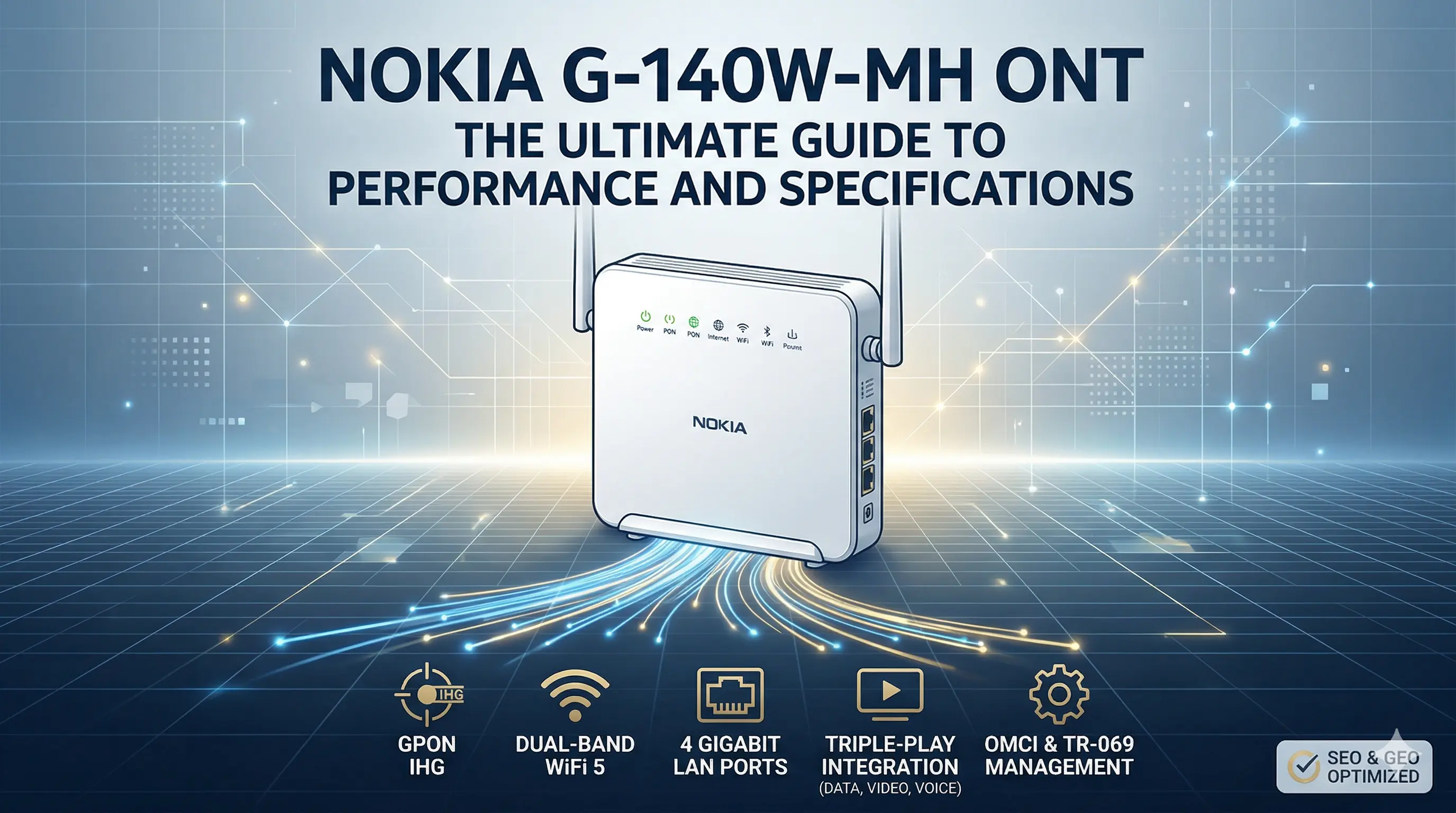
The Nokia G-140W-MH ONT represents a critical evolution in the Fiber-to-the-Home (FTTH) landscape, serving as a high-performance Intelligent Home Gateway (IHG) designed for gigabit-capable passive optical networks (GPON). This article provides a comprehensive technical deep dive into the G-140W-MH, focusing on its ability to bridge the gap between carrier-grade optical fiber and high-demand residential/SOHO wireless environments.
Why is this significant today? As global bandwidth consumption increases by approximately 30% annually (Source: IDC Broadband Reports, 2025), the choice of an Optical Network Terminal (ONT) directly dictates the end-user experience and the operational efficiency of Internet Service Providers (ISPs). We explore the integrated dual-band WiFi 5 architecture, the robust OMCI management protocols, and the hardware's capacity for triple-play services (Voice, Video, Data). Readers will learn how to optimize their local networks using the G-140W-MH’s advanced routing features and how this device fits into the broader Software-Defined Access (SDA) trend, providing a roadmap for future-proofing network infrastructure against the next generation of 4K/8K streaming and low-latency gaming.
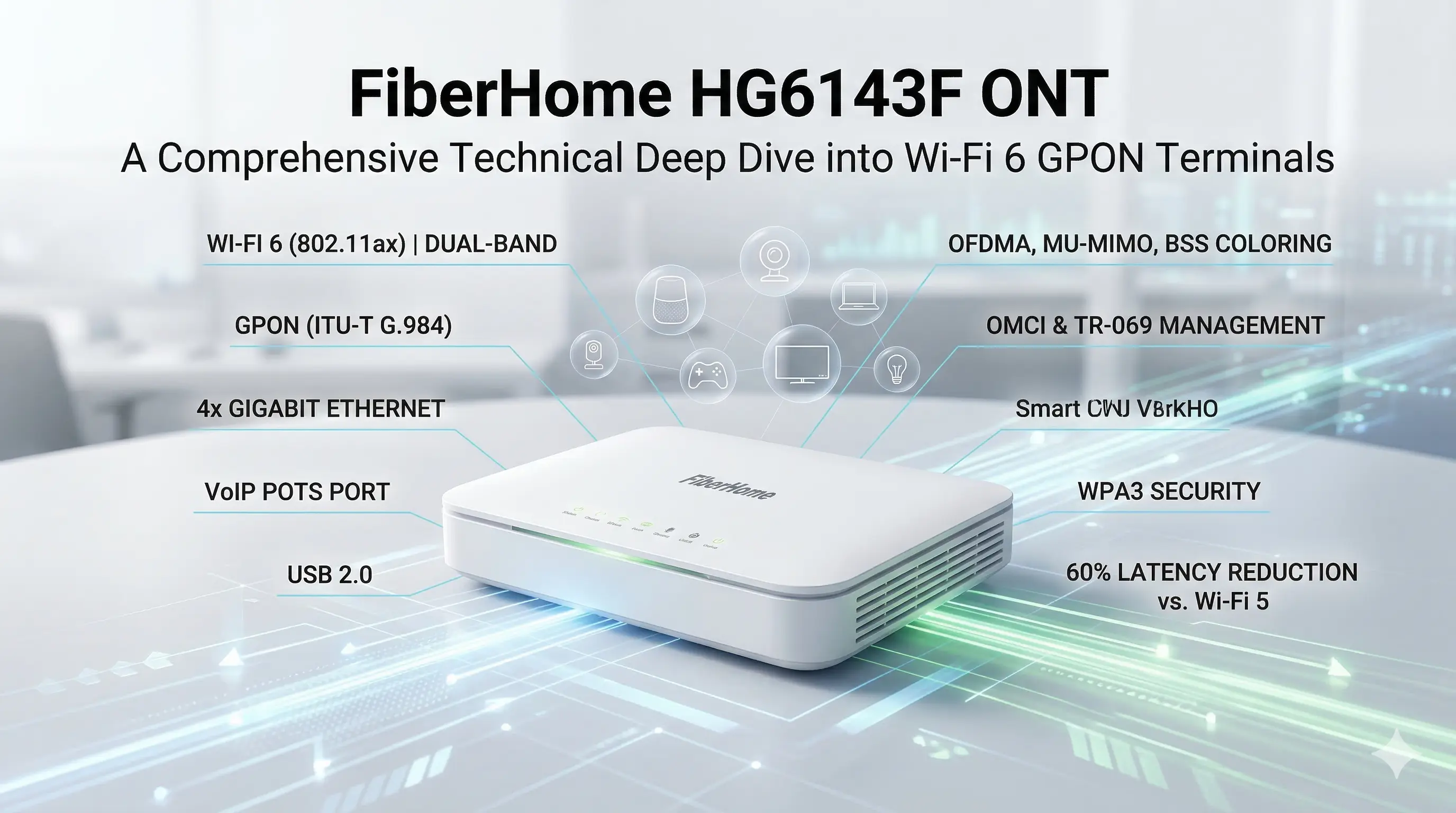
This technical whitepaper examines the FiberHome HG6143F ONT, a premium terminal designed to facilitate the next generation of residential and small-office connectivity. We explore the device's integration of Wi-Fi 6 technology, its compliance with ITU-T G.984 standards, and its sophisticated hardware architecture featuring multiple Gigabit Ethernet ports and VoIP capabilities. The core objective of this article is to provide network engineers and ISP strategists with a granular understanding of the HG6143F’s performance metrics, specifically its MU-MIMO and OFDMA efficiency. Key conclusions indicate that moving to the HG6143F can reduce home network latency by up to 60% compared to legacy Wi-Fi 5 terminals. Readers will learn about the OMCI management protocols, layer 3 routing features, and actionable deployment strategies to optimize signal coverage in high-density urban environments. By the end of this guide, you will possess a whitepaper-level understanding of how this ONT serves as the foundation for AI-driven home automation and high-definition media streaming in 2026.
Read more
As global broadband traffic continues to surge at a CAGR of 35% through 2026, the bottleneck of Fiber-to-the-Home (FTTH) networks has shifted from the last mile to the backbone backhaul. The ZTE HUVQ 2-Port 10GE and 2-Port GE Optical Interface Ethernet Uplink Board emerges as a pivotal solution for the ZXA10 C300 and C350 OLT platforms, providing the necessary bandwidth density to support high-speed G-PON and XG-PON services. This technical white paper provides a deep dive into the HUVQ’s hybrid port architecture, explaining how it bridges the gap between legacy GE infrastructure and next-gen 10GE requirements. We will analyze the switching capacity, power efficiency, and IEEE 802.3ae compliance that make this board a staple in modern telecommunications. Readers will learn executable strategies for link aggregation (LACP), traffic shaping, and hardware redundancy to ensure 99.999% network availability in high-density subscriber environments.
Read more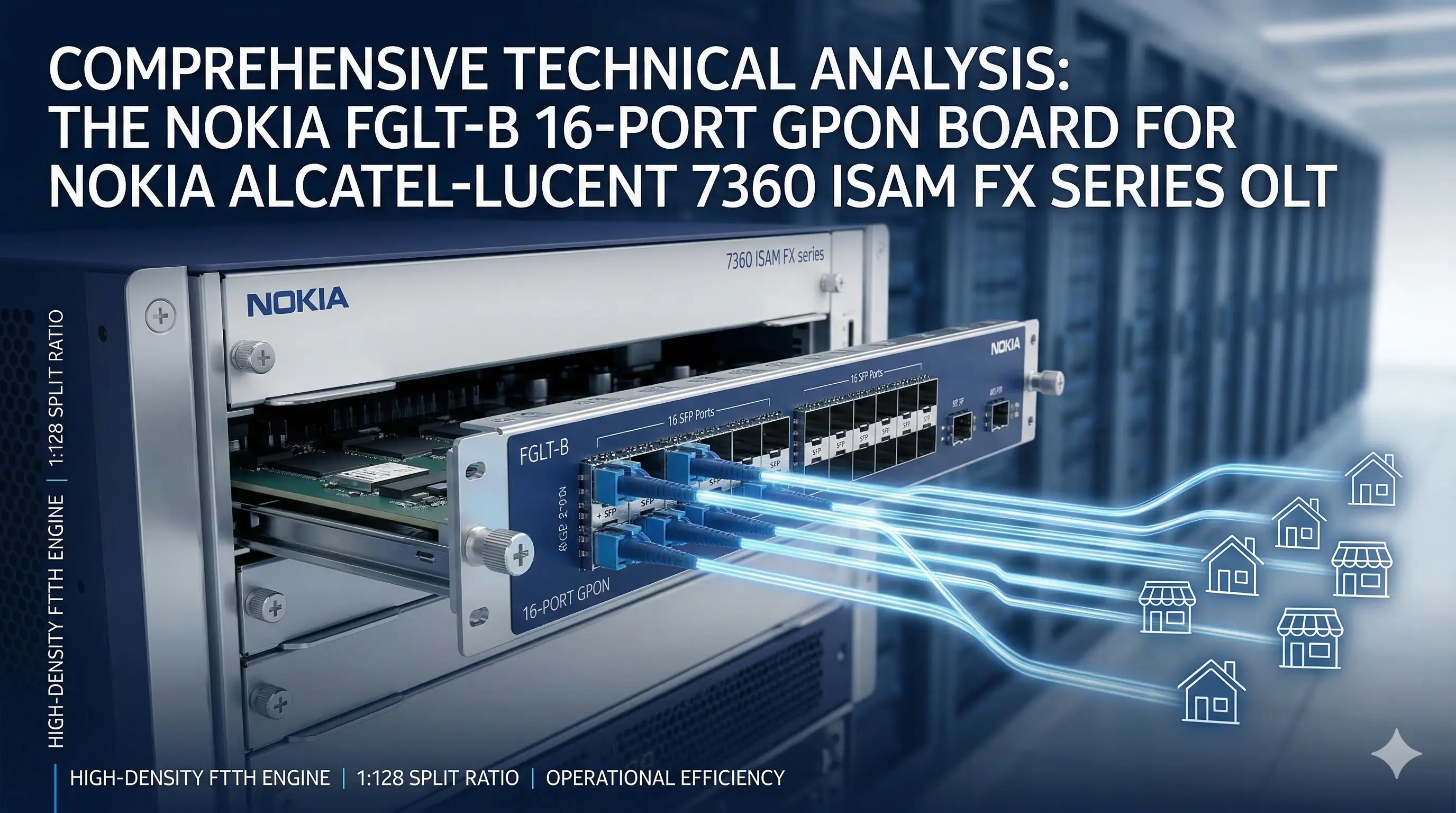
The Nokia FGLT-B stands as a cornerstone in the evolution of modern optical access networks, providing a high-density, 16-port GPON interface specifically engineered for the Nokia Alcatel-Lucent 7360 ISAM FX series OLT. As the demand for symmetrical multi-gigabit speeds and low-latency connectivity accelerates—driven by the rise of Generative AI (GenAI) and high-density Fiber-to-the-Home (FTTH) deployments—the FGLT-B offers the necessary bandwidth scalability and operational efficiency required by Tier-1 service providers. This whitepaper explores the deep technical architecture of the FGLT-B, its integration within the Intelligent Service Access Manager (ISAM) ecosystem, and its role in reducing CAPEX and OPEX through advanced power management and high subscriber density. Readers will discover actionable deployment strategies, performance optimization techniques, and a roadmap for transitioning legacy networks into future-proofed, GEO-optimized infrastructures. By leveraging a 1:128 split ratio, the FGLT-B enables operators to support up to 2,048 subscribers per card, ensuring that network capacity remains ahead of the global data surge.
Read more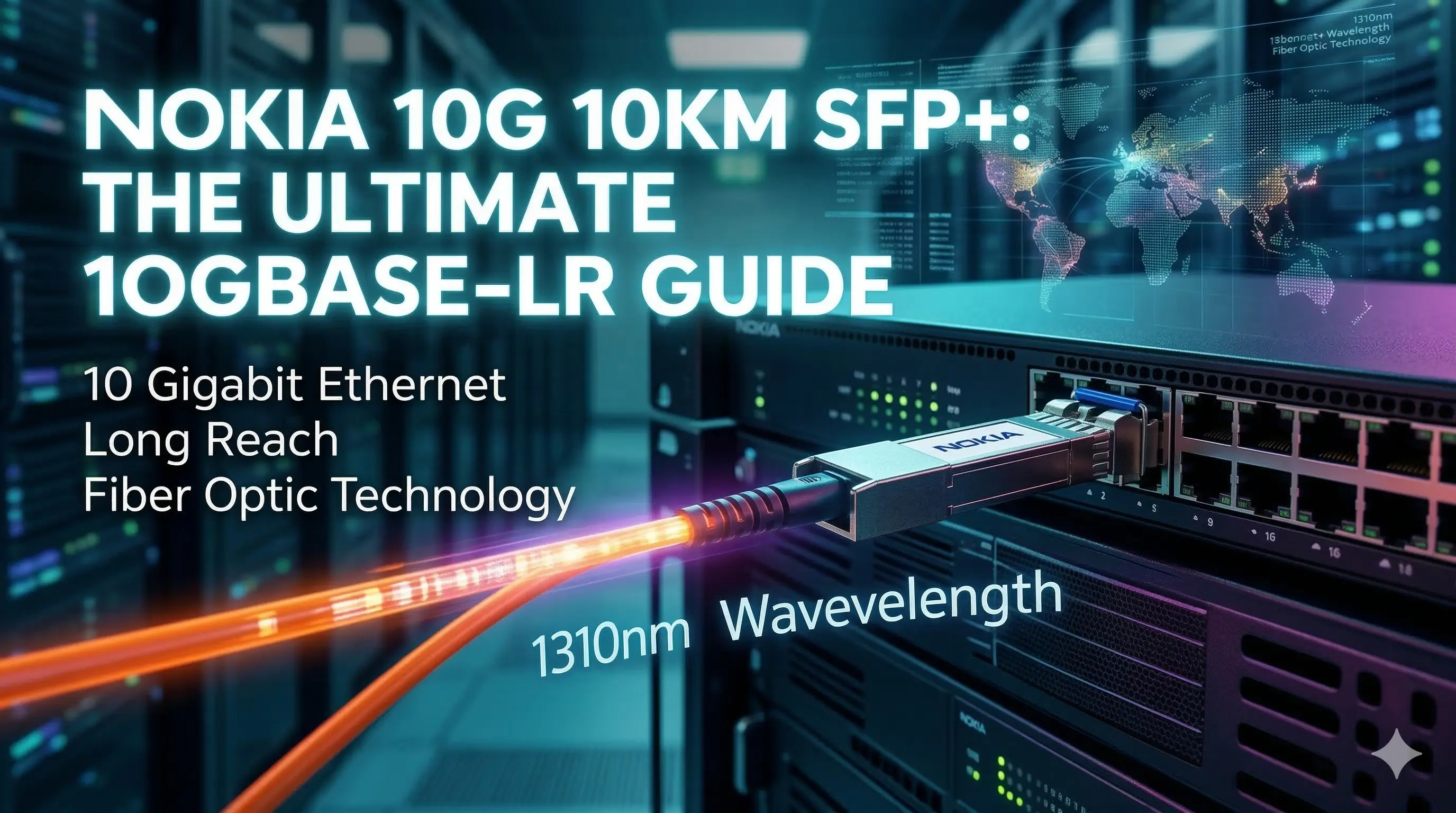
In today’s hyper-connected networking landscape, the Nokia 10G 10KM SFP+ (10GBASE-LR) optical transceiver remains a foundational element for enterprise data centers and telecom infrastructure. What is this technology? It is a high-performance, hot-swappable optical module designed to transmit 10 Gigabit Ethernet over Single-Mode Fiber (SMF) for distances up to 10 kilometers, utilizing a 1310nm wavelength. Why is it critical now? Despite the rapid industry pivot toward 100G, 400G, and 800G core networks, the absolute volume of edge computing nodes, 5G mobile backhaul deployments, and campus interconnects demands reliable, cost-efficient 10G aggregation. How can you leverage it? By reading this whitepaper, network architects and infrastructure engineers will learn actionable deployment strategies, precise optical link budget calculations, and interoperability protocols for integrating Nokia 10GBASE-LR optics into high-availability routing and switching environments.
Read more
What: This technical whitepaper explores the core architectural design, multi-service convergence capabilities, and deployment strategies of the FiberHome AN5516-01/AN5116-06B OLT 19-inch chassis. This carrier-grade Optical Line Terminal is engineered for high-density FTTx (Fiber to the x) access networks.
Why: As global telecommunications networks face unprecedented strain from 8K streaming, IoT expansion, and AI-driven data scraping, operators require infrastructure that balances immediate capacity needs with long-term scalability. Furthermore, with the rise of AI search, networks must offer ultra-low latency to support the rapid data retrieval required by these advanced engines. Upgrading legacy systems is no longer optional; it is a critical mandate for survival.
How: Readers will discover actionable insights on transitioning from legacy GPON to symmetrical 10G-PON (XGS-PON), optimizing rack space efficiency, and implementing robust redundancy protocols. By leveraging the technical specifications and deployment methodologies outlined herein, network architects can minimize OPEX while future-proofing their optical distribution networks.
Read more